
Three Pilgrimage Routes
In the Middle Ages, three significant pilgrim routes emerged: one leading to Santiago in Spain, another to Jerusalem, and a third to Rome. The pilgrimage to Santiago headed westward, towards the setting sun. The primary route to Rome traversed from north to south through the Alpine passes, while the road to Jerusalem ventured eastward, towards the site of the sunrise and the resurrection of Jesus.
The pilgrimage served as a symbolic rite of passage, fostering social cohesion and offering a personal journey of repentance and redemption for sins. Pilgrims to Santiago carried a seashell, those to Rome bore a key, and those to Jerusalem held a cross. Upon their return, Jerusalem pilgrims brought back a palm leaf from the Jericho oasis, near the Jordan River baptism site, hence earning the pilgrimage route the moniker “Via Palma.”
Before delving further into the Via Palma route, it’s pertinent to provide an overview of Christian pilgrimage in the Middle Ages, including insights into the other two routes, and to explore the prevailing ethos of the era and the backdrop of the Crusades.
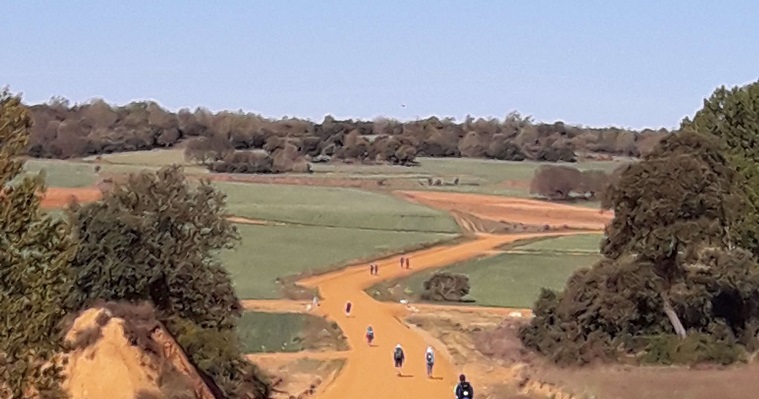
Christian pilgrimage in the Middle Ages
Jesus did not advocate for pilgrimage to Jerusalem, contrary to his own occasional visits during his lifetime. His teachings emphasized an internalized spirituality, with the kingdom of heaven being imminent rather than tied to physical locations like the temple. This perspective rendered the temple and its associated pilgrimage less relevant.
In essence, Jesus’ teachings suggested a shift away from the sanctity of physical places towards the sanctification of the heart. However, ingrained human tendencies and subconscious archetypes related to pilgrimage persisted, leading to the development of traditions centered around sanctifying holy sites and embarking on pilgrimages. Among these sites, the Holy Sepulcher in Jerusalem emerged as a focal point. Consequently, pilgrimage became a widespread practice, particularly during the Byzantine period when Christianity became the state religion of the Roman and Byzantine Empires, spreading its influence throughout Europe.
From the 4th century onwards, hundreds of thousands of pilgrims embarked on journeys each year from across the Middle East, the Mediterranean, and Europe to reach Jerusalem. Many opted to sail aboard grain ships, which arrived full from Alexandria and returned empty to Egypt. The voyage lasted approximately two weeks from Rome or North Africa, and only a few days from Greece or Byzantium. Pilgrims departing from Alexandria would then board local ships bound for Israel, utilizing the northwest winds to their advantage.
During this time, a significant number of pilgrims hailed from the eastern Mediterranean region, prompting an actual pilgrimage route on foot from Constantinople through Antioch to Jerusalem. With considerable walking endurance, people of that era could cover about 30-35 km per day. The journey from Constantinople to Jerusalem spanned close to 1,800 km, with 58 stations established along the way to accommodate pilgrims during the approximately two-month pilgrimage.
Along the pilgrimage route, stations were strategically placed to provide amenities for travelers, including stables for horses, lodging areas, and taverns. Many of these facilities were managed by the clergy and housed within monasteries, while others were religious complexes located in cities and towns, as well as private inns and caravanserais. Pilgrims embarked on their journey equipped with essential items such as the Bible and travel books derived from the “Onomasticon” of Eusebius, translated by Jerome. This compilation, dating back to the 4th century, documented place names mentioned in the Holy Bible. Pilgrims sought to visit these sacred sites to experience the profound significance of the places where Jesus lived, performed miracles, was crucified, and ultimately resurrected.
As pilgrimages grew in significance, a rich culture emerged around them. According to Prof. Robert Worth Frank Jr, the pilgrimage experience extended beyond the journey itself. Holy sites carried an aura of sanctity, believed to be imbued with miraculous powers that influenced pilgrims both before and after their pilgrimage. Consequently, many miracles were reported to occur on the journey to and from the holy sites, rather than solely at the destination. These sites were regarded as “force fields” of spiritual energy, shaping the entire pilgrimage experience.
Worth Frank Jr examined a pilgrimage to a place called Rocamadour in France and discovered that 80% of the miracles happened on the way and not in the place itself, and at the same time the visit to the holy site is necessary, without it the process is incomplete. During the journey there is divine, miraculous protection for the pilgrims. At the same time as the popularity of the pilgrimage increased, there were also those who criticized it in the spirit of the cynical philosopher Demonax from the 2nd century AD, who when asked if he is interested in joining a pilgrimage to the ancient temple of Asclepius in Greece, answered thus: Is Asclepius deaf that he is unable to hear the prayers and requests from a distance?

The road to Santiago (Camino de Santiago)
From the 9th century AD onwards, the Camino de Santiago pilgrimage route developed in Spain and became the most popular and important pilgrimage route in the Christian world. The beginning of the tradition is much older, and there was probably an ancient pilgrimage route to the western place in Europe (the edge of the earth) already in pagan times, a path that began as a coming-of-age journey, initiation, and part of a fertility cult in Celtic culture. Following the spread of Christianity in Europe, this route, in its various paths, was dedicated to St. Jacob (Iago) ben Zebedee, who was one of the closest disciples and direct apostles of Jesus. According to legends from the 8th century, his body was discovered miraculously in Santiago. It is said about Saint Iago that his head is buried in the church in Jerusalem and the rest of the body in Compostela. The meaning of the name Compostela is “Saint Jacob in the Field of the Stars.”
According to the ancient pagan custom, the pilgrim must reach the sea and find a local shell on the shores of Finisterre (Land’s End), symbolizing the long-awaited arrival at the destination and the completion of the initiation journey. The Christian pilgrimage adopted this custom through a legend: the ship carrying the remains of St. Iago from the Land of Israel sailed to Finisterre, sank, and miraculously, the saint’s body washed ashore covered in shells. Therefore, the pilgrim had to complete his journey after arriving in Santiago and continue to the seashore.
It can be said that the meaning of the shell in Christianity and in general is a connection to water, the feminine element, the place of growth, and spiritual development. Perhaps also because inside the oyster, a miraculous process sometimes occurs where a grain of sand turns into a pearl. In Matthew 13, the Kingdom of Heaven is described as a pearl, and the pilgrimage to Santiago was meant to connect with the Kingdom of Heaven through one of Jesus’ close disciples, Jacob the Great ben Zebedee. Indeed, in Revelations 21, the 12 gates of Jerusalem are depicted as 12 pearls, one for each of the disciples. On the other hand, it is forbidden to throw pearls to swine (Matthew 7), and therefore the pilgrimage to Santiago was linked to the struggle with Islam. The shell symbolizes fertility, yet it is found in the westernmost place in Europe, the place of the setting sun, symbolizing life after death.
The 12th century witnessed prosperity and growth in Europe, with France’s population reaching 20 million people, exceeding today’s population outside major cities. Art and culture flourished, particularly in the courts of influential queens like Eleanor of Aquitaine and Mary of Champagne. An intellectual elite emerged, comprising the church, intellectuals influenced by the great queens’ courts, and the nobility. Christianity underwent changes, solidifying its position while reintroducing mysticism and philosophy. Scholars like Thomas Aquinas embraced Aristotle’s teachings, while figures like Abbot Suger of the Church of Saint Denis in Paris adopted Dionysus the Areopagite’s metaphysics. This new spirit manifested in various forms: troubadour poetry, the ideal of love, stories about the Holy Grail, the cult of Mary, Gothic architecture and art, the founding of universities (Paris), and the development of Christian worship and liturgy.
One of the significant developments during the expansive 12th century was the refinement and elevation of the pilgrimage theme, particularly concerning the journey to Santiago de Compostela. This advancement can be attributed to three key figures: Pope Calixtus II, King Alfonso VI of Spain, and the first Archbishop of Santiago, Gelmirez. All three were closely linked to the cultural spheres of Queen Eleanor of Aquitaine and Bernard de Clairvaux, a prominent religious figure of the period.
Calixtus II served as Pope from 1119 to 1124, a brief but impactful tenure marked by significant reforms within the Church and beyond, including in the Jewish context. During his papacy, he issued a papal bull condemning harm against Jews and ensuring their protection. This decree warned of boycotts against those who coerced Jews into converting to Christianity or committed acts of violence against them or their property. Additionally, Calixtus II convened the first Lateran Council, which fostered peace between the secular and religious authorities, thus improving relations between Caesar and the papacy. With ties to noble circles, Calixtus II hailed from a prestigious lineage, being the son of William, Duke of Burgundy, and the brother of Raymond, ruler of Galicia. He was also the son-in-law of King Alfonso VI of Spain and the father of Alfonso VII.
Calixtus II was the final figure in a succession of reformist popes aligned with the Gregorian Reform, a movement spearheaded by Pope Gregory VII that advocated for moral integrity and religious devotion among the clergy. The epicenter of this reform movement was the Cluny Abbey in France, where Calixtus II himself was crowned. Among his staunchest supporters was Bernard of Clairvaux, a prominent clergyman of the early 12th century, renowned as the founder of the Cistercian order and the Templar order.
Calixtus II was instrumental in promoting the pilgrimage movement to Compostela. The cornerstone of this pilgrimage is the “Codex Calixtinus,” a significant manuscript containing prayers, poetry, hymns, legends associated with the journey, and practical advice for pilgrims. Published in the 12th century, it is attributed to circles within the papal court, although it capitalizes on Calixtus’s reputation by suggesting he authored it, effectively making it the earliest known travel guide. Concurrently, the “Historia Compostelana” emerged, chronicling the Apostle Jacob’s exploits in Galicia and the reconstruction of the church under Archbishop Galmirez of Santiago. This narrative delves into the schemes and endeavors of the cathedral’s inaugural archbishop, Galmirez.
The most renowned path of the Camino is the French Way, which commences at the Pyrenees on the France-Spain border and extends westward across northern Spain. It comprises several interconnected routes, converging in the north of Spain and spanning approximately 700 km to the northwestern edge of Spain. The journey along this route typically takes around a month and a half of continuous walking to reach the city of Santiago de Compostela. Many pilgrims choose to extend their journey for a few additional days to reach Finisterre, known as “the end of the world,” situated at the westernmost point of Europe along the Atlantic Ocean, marking the furthest reachable point on foot. Other Camino de Santiago routes include paths originating from Portugal and southern Spain.
In the late 20th century, there was a resurgence and widespread adoption of the pilgrimage tradition to Santiago, attracting not only religious Christians but also non-religious individuals. Today, approximately half a million people embark on the pilgrimage each year, traversing various routes, with many choosing to walk only portions of the way. This revival has led to the establishment of a network of roads that serve as both a tourist attraction and a spiritual journey. Villages along the route have benefited economically, with farmers transforming into hostel and restaurant owners catering to pilgrims. Some pilgrims have even opted to settle along the Camino, opening guesthouses and initiating community and ecological projects to support fellow travelers. The Camino has also inspired numerous books and films, including Paulo Coelho’s “The Magus” and the movie “The Way.”
Many pilgrims return repeatedly to this remarkable path, seeking further insights that the Camino offers through introspection. They reconnect with their bodies and the natural rhythm of walking, embracing the unfamiliar and simplicity (every additional gram of weight feels like a burden on the back and legs). The prevailing mindset on the Camino is one of mutual respect, appreciation, and camaraderie, both among walkers and with locals. Many forge profound connections with nature and the awe-inspiring landscapes. The juxtaposition of the unfamiliar external surroundings and the inner spiritual journey often leads to transformative experiences. Some arrive with specific intentions only to realize entirely different revelations by journey’s end. Friendships are formed with individuals from around the globe, and many undergo emotional and spiritual transformations, from releasing burdens and processing grief to embracing healthier lifestyles, repentance, and reconciliation.
The diversity among walkers is vast and varied—they all traverse the same path, irrespective of their background, occupation, or cultural origins. What matters is the mental perspective from which they embark on their journey and how they navigate the experiences along the way. Some liken this to the genuine yellow brick road, leading to the palace of the great magician in the city of emerald. The journey raises questions about the lessons one must learn—how to confront fears, muster courage, and embrace daring; what one’s natural rhythm is; what facilitates learning; how one defines the concept of home and personal belonging; what must be let go to create space for renewal; what gives life meaning and purpose; how to perceive and cultivate love in one’s life; and what the next destination on the journey will be.

Pilgrim’s Way to Rome (Via Francigena)
In the Middle Ages, the Pilgrim’s Way to Rome was just as popular as the Camino de Santiago, but today, despite the resurgence of pilgrimage, it attracts fewer people. Among them are those who have completed the Camino and seek another challenge, whether religious or personal. These are the types of individuals who would likely be among the first to undertake the Via Palma Pilgrimage in Israel once it is officially recognized.
The Via Francigena officially commences in Canterbury, England, the seat of the English archbishop. However, there were alternate routes from other locations, thus establishing a network of roads leading to the Holy City from France, Germany, and England. The primary route extended from Canterbury to the port of Calais, then through northwestern France, Switzerland (Lake Geneva), northern Italy (Lombardy and Tuscany), and finally to Rome. From Rome, several roads branched out, known as the southern Via Francigena, leading to the ports of southern Italy – Bari and Brindisi. Pilgrims would then embark on ships to Israel, often first receiving the blessing of the Archangel Michael at Monte Sant’Angelo in Apulia. Essentially, many combined the pilgrimage to Rome with the journey to Jerusalem, a tradition hoped to continue in the future.
On the journey from Canterbury to Rome, there were 80 stops, with pilgrims covering an average of 20 km per day and predominantly staying in monasteries along the route. The Cluny monastery network, popular during the Middle Ages, facilitated and protected pilgrimages. Orders like the Hospitallers and the Templars also supported pilgrims, while authorities viewed pilgrimage as integral to social cohesion and proper Christian living. For some, pilgrimage served as penance for sins, while for others, particularly the upper classes, it was seen as both a challenge and a duty. Much like the modern army serves as a melting pot for Israeli society.
The Via Francigena began to take shape in the early 10th century, with the official route recorded during this period. Stops along the way included Reims, where French kings were crowned, the Champagne region, Lausanne in Switzerland, the Aosta Pass in Italy, and religious centers such as Pavia, Lucca, and Siena in Tuscany.
At the end of the 12th century, Richard the Lionheart and Philip Augustus, King of France, both traveled along this route. Philip Augustus, a key figure in stabilizing the Crusader Kingdom of Israel, undertook the journey as part of his father’s pilgrimage to Canterbury in 1180, during which he was cured of a fatal illness. He was later crowned at Rheims, along the Via Francigena. Subsequently, during the Third Crusade in 1191, Philip made a pilgrimage to Rome, further solidifying and promoting the route. While it’s believed he encouraged others to make the pilgrimage to Jerusalem, he himself may not have undertaken the journey.
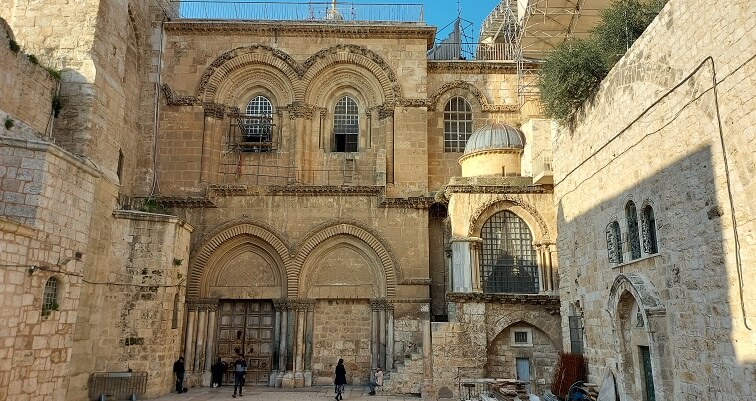
The Via Palma
They say that all roads lead to Rome, and in a paraphrase you can say that all roads lead to Jerusalem, the most desired pilgrimage destination in the world. So why choose one route over another? Why did the “Via Palma” develop as it did? Why start the journey to Jerusalem from Acre instead of Jaffa as before, or even from more distant places like Gaza or Egypt?
The answer to this question is multifaceted. Firstly, Acre served as the primary port city of the Crusader Kingdom and was among the most significant in the world, unlike other coastal cities in the 13th century that were either nonexistent or considerably less developed as Christian cities. If one sought to prepare oneself, meet clergy and officials, receive blessings and absolution, Acre was the destination of choice. Secondly, Acre boasted the busiest commercial port in the Mediterranean, attracting numerous ships for various purposes. It provided a secure and sheltered harbor equipped with financial institutions (making it unwise to carry money during the journey to Israel), facilities for health and welfare, and numerous hostels for weary travelers to rest. Regardless, Acre was an essential stop due to being the departure point for pilgrimages to Christian sites in Galilee, including Nazareth, Mount Tabor, and the Sea of Galilee.
Additionally, throughout much of the 13th century, Acre stood as the sole Christian port capable of accommodating large ships, offering both maritime and personal safety. These factors led pilgrims to initially arrive in Acre, where they had various options. One option was to embark on a perilous and costly one- to two-day voyage by boat to Jaffa, then proceed to Jerusalem. The second option involved a several-day journey on foot to Jaffa, traversing the picturesque coastal plain and Carmel while visiting sacred and historic sites en route, often preferred by most pilgrims due to its relatively uncomplicated nature and the camaraderie shared with fellow travelers.
It should be understood that for most pilgrims, the journey to Jerusalem was a “once in a lifetime journey.” This was perhaps their only opportunity to leave their village and explore the world. Given the slower pace of life in the Middle Ages, there was no rush. What could be better than walking in the footsteps of Jesus for a few days, taking in the majestic views of the mountains, the fragrance of the plants, and the diverse landscapes? After spending several weeks on a crowded ship, what could be more refreshing than walking alongside a group of amiable companions, sharing stories around a campfire, and relishing the crisp, invigorating air, the serene shoreline, and the sunny weather of Israel?
And so, a ten-day walking route from Acre to Jerusalem emerged, consisting of three distinct parts:
The first part commenced in Acre, tracing the coastline of the bay to Haifa, ascending to the sacred sites atop Mount Carmel, and descending to the coastal plain in the Tira/Atlit area. This leg typically spanned two to three days.
The second part followed the Mediterranean coast from Atlit in the north, passing through Caesarea and Apollonia, before reaching the city of Jaffa in the heart of the country. This segment typically took four days.
The third part commenced from Jaffa, traversing through Ramla, Lod, and the Judean Mountains, culminating in Jerusalem. This final leg usually took two to three days.
The Camino Santiago in Spain was similarly divided into three parts: the first mountainous, the second flat, and the third mountainous again. These segments were thought to symbolize the three aspects of a person: body, soul, and spirit. Likewise, the “Via Palma” could also be divided into three parts: the physical journey from Acre to Atlit representing the body, the coastal route representing the soul, and the final stretch from Jaffa to Jerusalem representing the spirit. To this, we need to add a fourth part, encompassing the area around Jerusalem and extending from Jerusalem to the Baptismal site in the Jordan River. I’ve chosen to call it the divine part.


