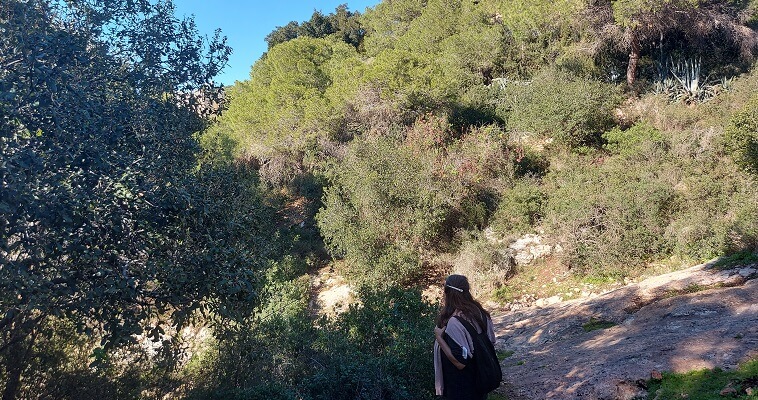
This article covers the second day of the pilgrimage along the Via Palma Pilgrimage Route from Acre to Jerusalem, akin to the Santiago pilgrimage. It includes references to Crusader sites in Haifa, with the second day’s journey centered around Haifa and concluding in Tirat Carmel
to complete this review read the complementary article – Carmelite sites on mount Carmel
Haifa at the time of the Crusaders
In the time of the Crusaders, Haifa occupied the area of today’s old city and the lower city near the harbor. Likely, it was a fortified city even before the Crusaders’ arrival, having been an important city rebuilt by the Fatimids (rulers of Egypt) at the end of the 11th century and predominantly inhabited by Jews. Following its conquest by the Crusaders (under Baldwin I and a Venetian fleet), a fortress known as Castrllum Caypha (Caiaphas) was erected to safeguard the harbor, only to be dismantled by Saladin in 1187. Subsequent to the reconquest of the Holy Land in 1191, the Crusaders reconstructed Haifa, with King Louis IX introducing significant religious and public edifices in the mid-13th century.
Before the 11th century, during the Byzantine Empire and the early Muslim empires, Haifa was situated differently compared to the Crusader city. It extended to the area of Tel al-Hawa, in the southeast of modern-day Haifa, where the electric company is currently located. However, the Fatimids established a new walled city northwest of there, encompassing today’s lower Haifa areas. It’s likely that the Crusaders adopted the layout of this city and constructed their own on top of the Fatimid city. Unfortunately, little remains from both the Crusader and Fatimid periods in Haifa, as most remnants are buried beneath later structures. Consequently, our knowledge of Crusader Haifa is quite limited. Nevertheless, historical records indicate that the old Haifa area was granted to the Church of the Sepulchre in 1165, while the primary church in the Crusader Haifa area likely belonged to the Marys Tomb Monastery in the Yehoshaphat Valley in Jerusalem and was dedicated to Mary.
Following the establishment of the Second Kingdom of Jerusalem, Haifa assumed a secondary port status compared to Acre. According to Willebrand of Oldenburg, a German clergyman and nobleman who traveled to Israel to prepare for the Fifth Crusade and was closely associated with the Teutonic Knights, the name “Haifa” is derived from the name of the priest Caiaphas, which also lent its name to the fortress. Mount Carmel, meanwhile, was famously associated with Elijah being fed by ravens, although the conventional identification of this event’s location is in Chorath Wadi near the Jordan River. Additionally, Mount Carmel was where the Shunammite woman found Elisha, and it features in various other biblical stories.
The second day: Haifa and the Carmel
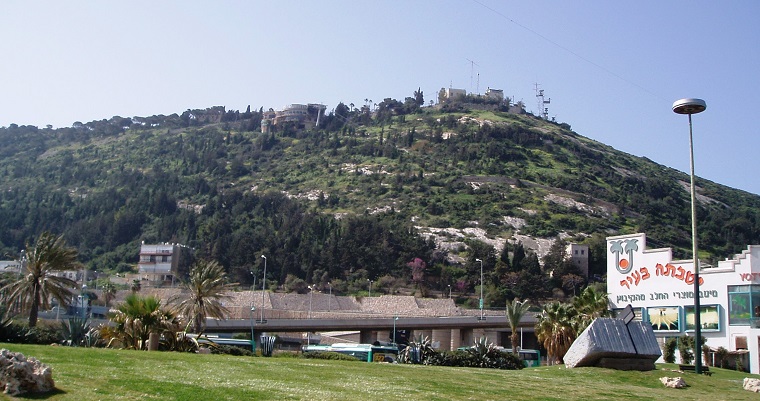
The second day of the pilgrimage centers around Haifa and Mount Carmel, offering various route options. The route I suggest begins with what I refer to as the “road of the churches” within the lower city, traverses through to the Bat Galim area, proceeds to Eliyahu Cave, and ascends to Rosh Carmel and Stella Maris. From there, it continues along the mountain’s summit to the Bahá’í gardens and Kababir neighborhood, descends to Wadi Shih, the historic site of the Carmelite order, ascends back to the mountain ridge, descends to the Crusader Mia’s Fortress, and concludes by ascending once more to the mountain ridge before descending to the Tirat Carmel neighborhood at the mountain’s base.
This route allows the pilgrim to visit the greatest number of churches, Christian sites, and Crusader landmarks in Haifa. Despite its numerous ascents and descents, it leads to an optimal endpoint for continuing the journey the following day. It’s not necessary to complete the entire route in a single day; the itinerary I’ve outlined can be comfortably spread across two leisurely days, or portions of it can be incorporated into the latter part of the first day’s walk. In total, this provides a three-day walking experience from Acre to Tirat Carmel.
In modern-day Haifa, there’s a notable concentration of churches representing various denominations, primarily constructed in the lower city area during the late 19th and early 20th centuries. Prior to the War of Independence, Haifa was a diverse city, with Jews comprising slightly over half of the population and Arabs making up the remainder. Among the Arab population, slightly more than half were Muslims, while slightly less than half were Christians. This meant that approximately one-fifth of Haifa’s residents were Christians, totaling around 30,000 individuals out of a population of roughly 150,000.
Beginning in the late 19th century and particularly after World War I, Haifa underwent significant development and progress, largely driven by its international harbor, railway connections, and industrial and commercial growth. The presence of foreign entities, notably the British during the Mandate period, led to the construction of numerous Christian churches and institutions. Despite the decline in the Christian population in Haifa since the War of Independence, with fewer than half the previous number of Christians residing in the city, many churches remain active today.
Our journey on this day begins in the Wadi Salib area, from where we proceed towards Paris Square. Along the way, we encounter the first two churches: the Catholic Church of Our Lady – House of Grace, and the Maronite Church of Saint Louis IX, who was the King of France in the 13th century. The close proximity of these churches suggests that this area was a significant Christian center in Arab Haifa before 1948. The Church of Our Lady served as the seat of the Greek Catholic bishop, while the Maronite church served as the seat of the Maronite bishop. Beneath the Catholic Church of Our Lady lies a burial cave of prominent leaders from the Arab Christian community in Haifa and the Galilee. This expansive complex, constructed at the end of the 19th century, is primarily utilized today for charitable activities, including the rehabilitation of prisoners and providing shelter for women in need. Managed by an association established by the Christian Shahada family, this site exemplifies Haifa’s commitment to Christian charitable institutions that benefit the broader population.
Adjacent to the Catholic Church of Our Lady is the Maronite St. Louis Church, an imposing structure distinguished by its large dome. Nestled among surrounding buildings near the beginning of Independence Road, this church was constructed at the end of the 19th century, about twenty years after the completion of the Greek Catholic Church of Our Lady. Saint Louis, after whom the church is named, refers to Louis IX, the French king who spent four years in Israel beginning in 1250. During his time in the region, he contributed significantly to various construction projects, leaving his mark on sites in Acre, Caesarea, Haifa, and Jaffa. However, beyond his architectural endeavors, the specifics of his activities during those four years remain a subject of speculation.
From Paris Square, the route proceeds along Sderot Hagana until reaching the intersection with Ein Dor Street. Here, another cluster of significant and sizable churches awaits, primarily dating from the Mandate period. The first church encountered along Ein Dor Street is the Elijah the Prophet Cathedral, constructed in 1939. Presently, it serves as the seat of the Greek Catholic Bishop, representing the largest Christian denomination in Haifa. Roughly 200 meters further along St. John’s Street stands the Anglican St. John’s Church, erected in 1935 in the Gothic architectural style. Currently, it functions as part of a school complex and hosts concerts. Approximately 250 meters away, in another direction along Haparsim Street, lies the expansive and magnificent new church belonging to the Greek Orthodox community. Adjacent to it, tucked away in one of the nearby alleys, is the old Orthodox church. The proliferation of Christian denominations in Haifa, akin to Jerusalem and other locales in Israel, inevitably results in the construction of numerous churches, as each denomination and community necessitates its own place of worship.
Further along Sderot Hagana, we encounter the Church of St. Joseph of the Carmelites, meticulously designed and constructed by the renowned architect Antonio Barluzzi in 1961. This church forms part of a larger complex, situated near the offices of the Catholic Church in the Haifa and North region, as well as a school. A prominent feature adorning the exterior of the church is a sizable, vibrant window set within a beautifully crafted stone wall. Upon entering the church, visitors are immersed in a world rich with symbolism. One immediately notices a shift in perspective and focus, transitioning from the external light streaming through the grand windows punctuating the sidewalls, symbolizing the heavens, to an inward concentration on the internal light illuminating the apse (prayer alcove) of the church. This internal light filters in through small, concealed side windows, creating a contrast with the visible windows elsewhere in the church—a recurring motif in Barluzzi’s designs. This deliberate transition, if embraced by the visitor, fosters a profound and dynamic experience, forging a spiritual connection to the Christian mystery woven throughout the church’s architecture.
The expansive apse features a complete vaulted roof, housing an altar at its commencement and culminating with the iconic figure of the Crucifix. Barluzzi, known for his penchant for conveying transitions from the physical to the spiritual realm, adeptly employs architectural motifs to underscore these shifts. In particular, he frequently utilizes the motif of transitioning from visible light to hidden light, as well as from the focal point of worship at the altar to the sacrificial essence embodied by Jesus.
A prominent motif that characterizes the structure’s silhouette is the transition from rounded lines and architectural curvature, symbolizing the sun and spiritual illumination, to straight lines emblematic of the cross and the earthly realm. Thus, while the apse exhibits a circular form, the body of the church assumes a rectangular and linear configuration. This transition between linearity and circularity is also echoed in the symbol of the Carmelite order, to which the building belongs. Moreover, this symbolism resonates with Jewish Kabbalah, which delineates two realms of governance: the Government of the Circle, representing the eternally divine and sacred spiritual realm, and the Government of the Straight line, which demarcates the duality of the physical world into realms of good and evil.
Continuing from Barluzzi’s church in the lower city of Haifa, we proceed along Ben Gurion Boulevard, which serves as a thoroughfare connecting the harbor area with the Bahá’í gardens, effectively extending the path of the gardens. Surrounding the gardens is the Templar neighborhood, recently revitalized into a bustling tourist hub boasting an array of restaurants, cafes, and galleries.
The Templars, a German religious sect, espoused beliefs in accessing the “gifts of the spirit” and ventured to Israel in the mid-19th century with the aim of expediting the return of Jesus. They emerged as among the earliest European settlers in Ottoman Palestine, establishing seven colonies across the country, with the Haifa colony standing out as the most prominent and aesthetically captivating. Despite their expulsion from the country during the Second World War, the legacy of the exquisite homes and neighborhoods they constructed endures.
Descending along Ben Gurion Boulevard toward the harbor, we pass the Haifa City Museum on our right and veer left onto Independence Road, then onto Railroad Street leading to the ancient Jewish cemetery of Haifa. Despite a prevailing belief among the public that Haifa is a modern city, as you’ve come to understand, its history extends far beyond contemporary times. Haifa held significance during the Crusader era, yet much of its ancient core has been obscured, with remnants lying beneath the urban landscape. The cemetery and its environs stand as rare vestiges of antiquity, housing the graves of Jewish rabbis from the 13th century who arrived in Israel during the Crusades.
Within the cemetery, you may explore the 4th-century grave complex of Rabbi Avdimi Dmin, a prominent Amora of Eretz Israel. Across the railroad tracks on El-Atika Street lies an entrance to a remarkable underground burial cave system. One of its chambers even features a pool. These burial caves housed the remains of notable figures like the Nachmanides and Rabbi Yechiel of Paris, among others. It’s worth noting that according to Jewish law, Haifa falls within the borders of the Land of Israel, whereas Acre does not. Consequently, during the Crusades, Jews residing in Acre preferred burial in Haifa or the nearby Galilean villages. This preference persisted during the era of the Second Jerusalem Kingdom and the emergence of the “Via Palma.” A significant Jewish community thrived within the Crusader city of Acre, hosting an important Yeshiva. However, some burial caves date back to the Byzantine period.
As mentioned, Haifa is often perceived as a modern city, but the presence of burial caves attests to its ancient and significant roots dating back to the first centuries AD, if not earlier. Where the expansive artificial harbor now stands, once existed a natural, small, and sheltered harbor, likely mirrored in the Tel al-Hawa area near the Kishon estuary. Haifa retained its importance into the early Arab period and underwent reconstruction by the Fatimids in the 11th century. During this time, it likely surpassed Acre in significance, evident in its ability to withstand the Crusader siege for over a month, aided by its Jewish population. The fortified walls of Haifa during this era underscore its importance. Despite the Crusader period, Haifa persisted and flourished, serving as a secondary port to Acre and a vital export hub for agricultural goods. It hosted a diverse community including monks, knights, merchants, and possibly an international population, particularly in the 13th century, which may have included Jewish residents. However, unlike other cities in the region, the construction of the modern Haifa port and city obliterated all remnants of the old city, leaving behind only these burial caves and few other relatively inconsequential remnants.
Not far from the burial caves, near the perimeter of the military harbor, stands a Greek Catholic church dedicated to the Archangel Gabriel. On the western side of the military port lies the Rambam (Maimonides) Hospital, with a striking building that once served as a convent for Carmelite nuns. Today, it houses the hospital’s administrative offices. Erected at the close of the 19th century, the convent was designed in a Middle age style, featuring a Stoa courtyard, surrounded by a picturesque garden. Following the construction of the harbor and hospital in 1933, the contemplative nuns, known for their practice of meditation, relocated to a quieter setting—the monastery of Our Lady of Carmel near Stella Maris, a destination we will soon reach on our route.
Continuing from the Carmelite monastery building, we traverse the streets of Bat Galim neighborhood, leading to the enchanting yet lesser-known promenade of Bat Galim along the coastline. Stretching from the neighborhood to the ancient Tel Shikmona at the tip of the Carmel peninsula, this promenade culminates at the new Maritime Research Institute. Before reaching its terminus, a bridge over Hahagana Avenue guides us to one of Haifa’s most sacred and significant sites: the Eliyahu Cave, also known as the Cave of Elijah.

Eliyahu Cave
The Carmel is a mountain range that extends into the sea, culminating in a promontory known as “Rosh” in Hebrew, visible from afar in the open sea and overlooking Haifa Bay. This headland, known as Rosh Carmel, has been revered since ancient times as a sacred site—a convergence of water and mountain, sky and earth. Referred to as “the deer’s nose” by the Egyptians, dedicated to Baal by the Canaanites, and revered by the Romans as sacred to Jupiter, Rosh Carmel holds significance across various cultures.
In Christian tradition, it is believed that the Holy Family—Joseph, Mary, and Jesus—sought refuge in the cave of Elijah at the base of Rosh Carmel upon their return from Egypt. According to Jewish lore, the prophet Elijah sought shelter here while fleeing from Ahab, and it is said that he may have received revelations about the end times during his time here. Elijah is said to have established a school for prophets in the area and caused a spring to flow within the cave. Both Muslims and Druze acknowledge the sanctity of the cave and the stories surrounding Elijah, and they also incorporate tales of El Kidar—a figure believed to guide souls—who is said to have rested here on his journey from Jerusalem to the Galilee.
Indeed, the cave is revered across all religions and spiritual traditions in the Land of Israel for its purported healing properties and its role in the journey of purification and enlightenment. Presently, under Jewish control, the cave serves as a site for Jewish prayers, with Jewish religious institutions located nearby. However, during the Crusades, it held significance as a Christian holy site, with a church and monastery erected in its vicinity. Similarly, during Muslim rule, it was frequented by Muslim dervishes, with a Zawiya established nearby. Accounts by Wilbrand of Oldenburg during the Crusades reveal that Masses were conducted daily in the Cave of Elijah, situated near a Christian village known as Galilee.
The Christian pilgrims traversing the “Via Palma” were deeply familiar with the narrative of Elijah: his seclusion in Chorath Wadi, his confrontation with the prophets of Baal, his revelation on Mount Sinai, and the passing of spiritual authority to Elisha. They held the belief that the Carmelite monks residing in Carmel during the same era, who also inhabited the Cave of Elijah, continued the spiritual legacy of Elijah and Elisha, remaining connected to the prophetic lineage established in Carmel. According to their beliefs, the Carmelite monks they encountered drew their spiritual power from the cloak they wore—a cloak believed to be the very one passed from Elijah to Elisha before Elijah’s ascension to heaven.
The 13th century was a time steeped in legends and tales, marked by the rise of mysticism and the veneration of saints. It was during this era that a particular genre of Christian romance, epitomized by the tales of the Holy Grail, flourished. A significant aspect of the literary landscape of the time comprised legends of saints, which found expression in troubadour poetry, chivalric romances, and religious literature alike. The narratives surrounding Elijah, in particular, thrived during the 13th century and formed an integral part of the pilgrim’s journey upon reaching Carmel. Yet, Elijah was not the sole saint revered in Carmel; a pantheon of other Christian saints also held significance in this sacred place.
Churches on the Carmel
From the Cave of Elijah, we will ascend to the Stella Maris Church, stopping to visit the Chapels along the way. Then, we’ll proceed to the Teresa of Avila Chapel and the Monastery of the Discalced Carmelite Nuns. These sites, associated with the Carmelite order, are detailed in another article dedicated to Carmelite Sites in Haifa – Read about the Carmelite Sites on the Carmel
From the Carmelite monastery, we’ll proceed along Tschernikhovski Street towards Hanassi Street, which traverses the center of Carmel. Approximately 400 meters up the street, at the intersection with Ha-Hursha Street, lies one of Haifa’s hidden gems—a Russian monastery and church dedicated to Elijah the Prophet (which seems fitting, doesn’t it?). Upon entering, visitors are greeted by a serene and picturesque courtyard with a distinctly European ambiance. Inside the unassuming church, one can admire icons and frescoes in the Russian Orthodox style, with one painting depicting Elijah’s ascent in the heavenly chariot of fire.
It appears that this church dedicated to Elijah represents a human who has achieved Theosis—an enlightened state akin to being like God. Elijah’s transformation from a mere mortal to embodying the divine image fully is symbolized by his ascension to heaven. This act signifies his profound sanctification, allowing him to witness God on Mount Sinai and stand alongside Jesus during the miraculous transfiguration on Mount Tabor.
Within Orthodox Christianity, there exists a mystical branch known for its meditative practices called Hesychasm, which teaches a Unique king of Meditation. This tradition has its own literature known as the Philokalia, or “the writings of the Neptic fathers.” In these texts, Elijah is elevated to the status of an enlightened individual who has mastered the secrets of meditation, gaining insight into the spiritual realms, particularly the uncreated light—the divine illumination of Mount Tabor. The Philokalia and the concept of Theosis are highly regarded in the Russian Church, as evidenced by the imagery depicted in this church.
From the Russian Church, we will retrace our steps to Hanassi Street and proceed to Yefe Nof Street, offering stunning vistas of Haifa Bay and the Bahá’í Gardens from its elevated position. This street boasts breathtaking panoramas of the entire bay and features a delightful promenade. We will stroll along this scenic route, eventually returning to Hanassi Boulevard in the heart of Carmel. Continuing along the boulevard, we will reach the Kababir neighborhood.
While today this area is home to a Muslim community of the Ahmadiyya movement, historically, it was the site of a Crusader village known as Anne. Surprisingly, it is believed that this village was where the nails used in the crucifixion of Jesus were forged. The reasons for this association remain speculative—perhaps the abundance of trees in the area facilitated the operation of furnaces for metalworking. There may also be conjecture linking it to Caiaphas, adding to the mystique of the location.
Regardless, prior to entering the Kababir neighborhood, there lies a dirt path that descends from the square area of Lotus Street to Nahal Siach—the Wadi of Siach, where the initial settlement of the Carmelite monks was established and where the Carmelite Order was founded. Alternatively, one can navigate through the streets of the Kababir neighborhood to reach the large mosque in the center, near which steep steps lead down to the valley. Opting for the former, we will embark on the path from Lotus Street, traversing the serene forest and the deepening gorge of Nahal Shih, until we reach the site chosen by the first Carmelite monks for their settlement.
Learn more about Nahal Siach and the remnants of the first Carmelite monastery in a separate article – Read about Carmelite Sites in Haifa
Rosh Mia Fortress and Carmel Castle
From Nahal Shih, we will ascend back to the higher regions of Carmel along the same path we descended earlier. Continuing from Lotus Street, we’ll traverse through the streets for a few hundred meters, cross Moria Avenue, and begin descending to the other side of Carmel towards the Romema neighborhood.
Nestled in the heart of the neighborhood lies a diminutive and lesser-known Crusader fortress ensconced within a delightful grove, offering panoramic vistas of the bay. While today the neighborhood is seamlessly integrated into the urban tapestry of Haifa, during the Middle Ages, it existed as a distinct world, far removed from the bustling cities of Haifa and Acre, yet just an hour’s journey away. From this vantage point, one could observe the ebb and flow of life in the valley below and across the bay. Nestled within the verdant expanse of the Carmel forest, Crusader pilgrims might have felt transported to the sylvan realms of France or England, particularly during the spring. Perhaps it was this sentiment that led them to associate the nearby village with St. Denis, the patron saint of France, claiming it to be his birthplace and home. However, according to tradition, St. Denis was the first bishop of Paris, raising questions about the connection to Carmel.
According to legend, Saint Dionysius, or Saint Denis, was a figure whose identity became intertwined with various narratives. Initially baptized into Christianity by the apostle Paul in Athens, he purportedly journeyed to Rome before ultimately arriving in France. Over time, his story became entwined with that of another missionary named Denis, who arrived in Gaul during the 3rd century. This Denis preached Christianity among the Gauls and was later martyred for his faith. Despite his martyrdom, legend holds that he miraculously continued to walk, carrying his severed head to the site of his eventual burial, where the Basilica of Saint-Denis was erected in his honor. Consequently, Saint Denis became revered as the patron saint of France, and his basilica became the burial place for French kings.
In the 9th century, writings attributed to a Byzantine theologian from the 5th or 6th centuries, who wrote under the pseudonym Dionysius the Areopagite, were introduced to Paris. These writings, known as the works of “pseudo-Dionysius the Areopagite,” were later associated with both the original Saint Denis and the adopted narrative, further intertwining the various strands of legend surrounding this revered figure. In the 12th century, the writings attributed to Dionysius the Areopagite, also known as the late Saint Denis, experienced a revival under the patronage of Abbot Suger, one of the most influential figures in the French clergy. Suger served as the abbot of Saint Denis cathedral and oversaw the construction of the new Basilica of Saint Denis in Paris, which became a masterpiece of Gothic architecture. Upon rediscovering these writings, Suger found within them a profound mystical understanding of spiritual realms as emanations of divinity. This discovery prompted a renewal of Christian mysticism within Catholic Christianity.
Abbot Suger became renowned as a teacher, instructing monarchs such as Eleanor of Aquitaine in the teachings of Saint Denis. His affinity for the mysticism of Saint Dionysius was shared by other prominent thinkers of the era, including Bernard of Clairvaux, further solidifying the influence of these mystical teachings within medieval Christianity. Indeed, during the 12th century, the veneration of St. Denis in France, particularly among the educated elite, experienced a significant surge. This period coincided with the era of the Crusades, and it was not uncommon to attribute a birthplace in the Holy Land to a saint associated with early Christian history. Given the historical context of apostles traveling from Israel to evangelize among the Greeks, it seemed natural to ascribe such origins to figures like St. Denis.
Indeed, Paul’s early missionary efforts focused on the Greek Jews, leading to the belief that he baptized St. Denis, a Jew from Israel who migrated to Athens. Legends subsequently emerged claiming that St. Denis was born in a small village on Mount Carmel before immigrating to Athens. Another possibility is that a local saint named Denis or Dionysus was revered in the Carmel village, and his story became intertwined with that of the French St. Denis. Regardless, associating the village near Rosh Mia Fortress on Mount Carmel with the birthplace of St. Denis proved advantageous for the pilgrimage industry, especially given the significant number of French knights and pilgrims.
During the 12th and 13th centuries, Mount Carmel experienced significant French influence, with many of the early Carmelite monks being French, alongside numerous crusaders and pilgrims. The pilgrimage to Rosh Mia in Carmel became a major event, particularly on the feast day of Dionysus, celebrated on the 9th of October. It’s worth noting that St. Denis isn’t just the patron saint of France; he’s also recognized as one of the 14 “helpers” saints, known for his expertise in treating headaches.
According to the accounts in the “Journeys of the Holy Pilgrims,” pilgrims could observe remnants of the house where Saint Denis was purportedly born in the village near Rosh Mia Fortress. Nearby, in the adjacent valley, they could also find the spring that he discovered and sanctified, with the commentary noting that “this is a very healthy place for a person.” The “Ways of the Pilgrims” further describe a cave beneath the house, believed to be the actual birthplace of Saint Denis. Professor Pringle, an authority on the Crusaders and their holy sites, proposes that Denis may have originally been a local Byzantine monk who attained sainthood. However, the French later associated him with Saint Denis and Saint Dionysus, asserting that he was a monk on Mount Carmel before journeying to Greece.
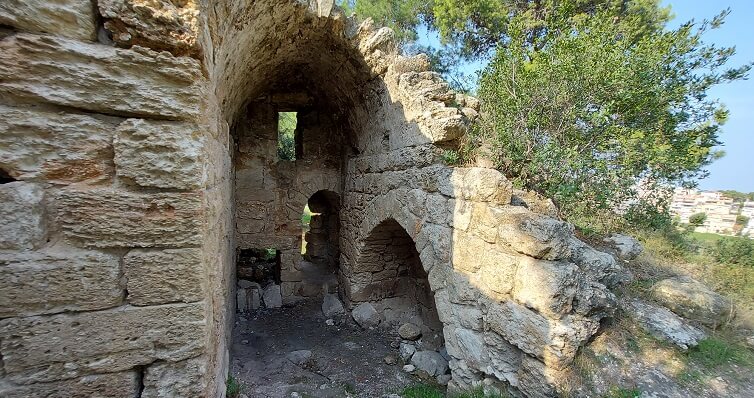
Today, atop the scenic and forested hill of Rosh Mia, several arches, cisterns, and walls remain from the fortress. However, the spring near the village once known as French Ville, associated with St. Denis, has vanished, along with his purported house and the tradition of his birth there. Teitmer notes that in February, knights would arrive at Mount Carmel with their horses and donkeys, establishing camp on the grassy meadow adjacent to the fortress. Bedouins would join them, engaging in horse competitions. From this vantage point, one could observe all activity in the ports of Haifa and Acre, allowing for both vigilance and leisure amidst nature. Guarding the principal entrance to the Carmel Mountain range from the north, Rosh Mia Fortress held significant strategic importance.
In essence, the Knights Templar, Hospitallers, and other knights of the kingdom frequented this site, particularly during spring, when traditional knight tournaments were held. One can envision the knights on horseback, armed with lances, charging toward each other across the open field at the meadow below the fortress.

Tirat Carmel
From Rosh Mia, our journey leads us upward to the higher reaches of the Carmel, following Pica Road toward the Horev Center. Upon reaching the intersection with Horev Street, we continue our ascent, then begin our descent through the streets of the Ramat Begin neighborhood, heading toward the paths leading down to Nahal Ovadia (Ovadia Valley) on our way to Tirat Carmel Castle. Inside the wadi, we encounter scenic yet rugged paths, with many boulders along the way. Alternatively, a smoother route is available along the slopes descending from Ramat Begin to Tirat Carmel.
During the Crusader era, Tirat Carmel, known as the Carmel Castle of St. John, bore the name of John the Baptist. Given the Christian identification of St. John with the prophet Elijah, his presence in Carmel was fitting, particularly in this vicinity. Indeed, an Orthodox monastery and a church dedicated to St. John once stood here, with the latter eventually repurposed as a mosque in the Arab village, and later as the “Yad Lebanim” synagogue.
It’s intriguing to learn that recent rescue excavations in Tirat Carmel unearthed a significant structure, likely part of a Gothic church, featuring an opening leading to a courtyard. Adjacent to it stands a small tomb building, housing an underground tomb and a niche dedicated to an unidentified saint. According to accounts in the “Journeys of the Holy Pilgrims,” St. John was attributed with numerous miracles in this locale, where a Greek Orthodox monastery now stands. Speculation has arisen regarding ownership of the village of Tirat Carmel, with some suggesting ties to the Teutonic Order and others to the Templars. It’s not uncommon for a Greek Orthodox monastery to be situated near a Frankish agricultural center.
The path leading down the Ovadia Wadi eventually reaches Tirat Carmel, where the first notable site near the settlement on the north slope of the Wadi is the Ovadia Cave. This impressive two-story cave complex contains remnants of buildings and halls. According to legend, Ovadia, who was in charge of King Ahab’s household during Elijah’s time, sheltered a hundred Jewish prophets in this cave, dividing them into two groups of fifty to protect them from Jezebel’s wrath. The cave’s size suggests it could indeed accommodate such a large group.
Adjacent to the cave, amidst the middle slope, lie the remains of a sizable structure believed by Pringle to be a Crusader church. On the southern spur of the Ovadia Cave, across the Wadi’s south exit at the end of Yeffe Nof Street, stand the remnants of another Crusader building, likely a small fortress.
From Tirat Carmel to Atlit Fortress
From Tirat Carmel, we’ll head west, crossing the bustling Road No. 4, and follow the dirt road along Nahal Galim for a few hundred meters until we reach the crossing under the coastal road. Turning north for about 700 meters, we’ll arrive at a hill dotted with quarries and the remnants of walls known as “Khirbet Koness.” According to the “Ways of the Pilgrims,” there existed a village named “Capernaum” during the time of the “Via Palma” in this area. It was where the silver coins used in the betrayal of Jesus, given to Judas Iscariot, were made. Pringle suggests that Khirbet Koness may be the location of ancient Capernaum. This connection underscores how the sacred geography of Galilee extends into the Carmel region.
Curiously, this western side of Carmel is linked with some of the most somber events in Jesus’ life. In the village of Anne, located a few kilometers north, the nails used in Jesus’ crucifixion were purportedly forged. Similarly, in the village of “Capernaum,” the coins of betrayal were minted. Even the harbor housed a fortress named after Caiaphas, further deepening the connection to these tragic events.
From “Capernaum,” pilgrims would continue for a few kilometers along the coast to reach the Citadel of Atlit, where they would spend the evening of the second or third day of their pilgrimage, depending on their pace. Near Atlit stood a prayer house known as Peroun, believed by many to be a place where Jesus rested during one of his journeys. It’s plausible that the entire Holy Family also rested there on their return journey from Egypt to Galilee. The likely location of Peroun is near the small and picturesque Detroa fortress, now situated within the Kherbet Karta Nature Reserve.