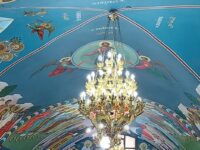
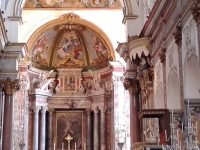
The Joyful Mystery of birth in Bethlehem
The fruit of this mystery is the poverty of the spirit.
According to Christian teaching, Jesus is part of God, existing before the creation of the world and continuing after it. Jesus, God, and the Holy Spirit form a Trinity, likened to the analogy of the sun’s rays: God is the sun, the way the sun illuminates and warms us is the Son, and the sunray is the Holy Spirit. Together, they comprise one entity made of three parts – a Trinity. Jesus, as part of divinity, is eternal and indefinable. Yet, the Christian miracle lies in the manifestation of divinity in matter, a specific appearance in time and place through the birth of Jesus two thousand years ago in Bethlehem.
Jesus’ birth was painless, according to Catholic Dogma. Mary was a virgin before and after Jesus’ birth, making it a miraculous yet human event. This joyous occasion is celebrated as the Joyful Mystery of Birth.
The birth of Jesus is recounted in both the Gospel of Luke and the Gospel of Matthew. In Luke’s narrative: “And so it was, that, while they were there, the days were accomplished that she should be delivered. And she brought forth her firstborn son, and wrapped him in swaddling clothes, and laid him in a manger; because there was no room for them in the inn. And there were in the same country shepherds abiding in the field, keeping watch over their flock by night. And, lo, the angel of the Lord came upon them, and the glory of the Lord shone round about them: and they were sore afraid. And the angel said unto them, Fear not: for, behold, I bring you good tidings of great joy, which shall be to all people. For unto you is born this day in the city of David a Savior, which is Christ the Lord. And this shall be a sign unto you; Ye shall find the babe wrapped in swaddling clothes, lying in a manger. And suddenly there was with the angel a multitude of the heavenly host praising God, and saying, Glory to God in the highest, and on earth peace, good will toward men. And it came to pass, as the angels were gone away from them into heaven, the shepherds said one to another, let us now go even unto Bethlehem, and see this thing which is come to pass, which the Lord hath made known unto us. And they came with haste, and found Mary, and Joseph, and the babe lying in a manger. And when they had seen it, they made known abroad the saying which was told them concerning this child. And all they that heard it wondered at those things which were told them by the shepherds. But Mary kept all these things, and pondered them in her heart. (Luke 2:6-19).
Luke tells about the visit of the shepherds (from Bayt Sahur) to Bethlehem and the divine revelation they had, while Matthew tells about the visit of the Magus from the land of the east: “Now when Jesus was born in Bethlehem of Judaea in the days of Herod the king, behold, there came wise men from the east to Jerusalem, Saying, where is he that is born King of the Jews? for we have seen his star in the east, and are come to worship him.” (Matthew 2:1-2). And further: ” When they had heard the king, they departed; and, lo, the star, which they saw in the east, went before them, till it came and stood over where the young child was. When they saw the star, they rejoiced with exceeding great joy. And when they were come into the house, they saw the young child with Mary his mother, and fell down, and worshipped him: and when they had opened their treasures, they presented unto him gifts; gold, and frankincense and myrrh.” (Matthew 2:9-11).
The mystery of birth involves the recognition of Jesus by all the people in the world, represented on one hand by the shepherds, the common people at the bottom of the social ladder, and on the other hand by the Magi, probably rich kings from the east, at the head of society. Everyone can recognize Jesus, but to do so, one needs poverty of spirit, to be emptied of the ego. This is the fruit of the birth Mystery (and also the seed), somewhat similar to modesty, which is the fruit of the Annunciation Mystery.
Jesus was born in a stable because there was no room in the inn. And it teaches us that we are only passers-by in the world and therefore should be humble and poor in spirit. According to John Paul II, the birth of the divine child, the Messiah of the world, is heralded by the singing of angels, but these are revealed to the common people, and it is a fact that the angel of Jehovah appeared before the shepherds. The birth of Jesus is a great joy, like the annunciation, but it requires recognition like the visitation. The kings from the east come to the manger and bow before the baby, presenting him with treasures of this world. They show humility in recognizing that earthly treasures hold less significance than spiritual ones. Thus, they turn away from Herod and towards the true king.
Jesus was born in a stable because there was no room in the inn. This teaches us that we are only passers-by in the world and therefore should be humble and poor in spirit. According to John Paul II, the birth of the divine child, the Messiah of the world, is heralded by the singing of angels, revealed to the common people, as the angel of Jehovah appeared before the shepherds. Jesus’s birth, like the annunciation, brings great joy but requires recognition like the visitation. The kings from the east bow before the baby, offering treasures of this world, yet understanding that spiritual treasures matter more, they turn away from Herod to the true king.
Mary nurses the helpless Jesus, symbolizing the humble beginnings of divine manifestations in the physical world, echoing Jesus’s words in the Sermon on the Mount: “Blessed are the poor in spirit, for theirs is the kingdom of heaven.” The birth of Jesus is intertwined with numerous supernatural occurrences, as recounted in the Gospel of James, such as angelic visitations, celestial phenomena, and divine voices. Mary treasures these experiences in her heart.
The birth of Jesus, embodying God within a woman’s body, remains a profound mystery intertwined with a key Catholic dogma, the notion of “the mother of God.” While God could have appeared suddenly as a grown man or been implanted externally into Mary’s body, He chose the path of human birth. In essence, this birth Mystery reflects God’s enigmatic desire for an earthly mother, despite being indescribable and transcendent. Jesus’s dual nature, divine and human, mirrors the world’s dual nature, a core tenet of Christian Catholic belief. Through the mystery of birth, these two natures converge.
The miracle of the incarnation, described in John (1:1): “In the beginning was the Word, and the Word was with God, and the Word was God,” reaches its pinnacle in the birth of Jesus. The conception following the Annunciation marks the initial stage of God’s physical manifestation in the world, but it is the birth that is the crucial and decisive moment. Everyone, whether shepherd or king, who is open to it, feels the presence of Jesus and has the opportunity to witness and celebrate this miraculous mystery.

The Church of the Nativity in Bethlehem and the Church of the Shepherds in Beit Sechor
The third station along the rosary route is the Church of the Nativity in Bethlehem, closely linked with the Church of the Shepherds in Beit Sahur, situated just 2 kilometers away. The Church of the Nativity, one of the world’s oldest churches, was initially constructed by Helena, the mother of Emperor Constantine, in the 4th century AD. However, it was rebuilt during the reign of Justinian in the 6th century. Currently, the church is jointly held by three Christian denominations: the Catholics, represented by the Franciscans, the Greek Orthodox, and the Armenians.
The central part of the church is a spacious basilica, stretching 50 meters in length and divided into five halls, supported by 48 large columns. Positioned on its eastern side is an apse, beneath which lies the cave where Jesus was born, marked by a 14-pointed silver star symbolizing the generations from Abraham to David and from the Babylonian exile to Jesus. Leading from the cave is a grotto, housing the manger where the infant Jesus was laid. Inside the grotto stands an altar dedicated to the Three Magi who followed the eastern star to present gifts and bless the newborn child.
Adjacent to the basilica on the north side stands the Franciscan compound of St. Catherine, featuring a large church dating back to the Crusader period. This church hosts Christmas ceremonies broadcasted worldwide. Located approximately 200 meters east of the church is the Milk Grotto (Cave), where the Holy Family sought refuge during the search by Herod’s soldiers for the newborn baby Jesus. Legend has it that a drop of Mary’s milk fell on the cave floor, miraculously turning its walls white. A church was subsequently erected above the cave, along with a convent for nuns.
Near Bethlehem, and actually part of it today, lies the neighborhood of Beit Sahur, where a remarkable church stands in honor of the good shepherds blessed with the revelation of the angel, who then came to bless the baby Jesus (as recounted in Luke chapter 2). Situated about 2 km east of the Church of the Nativity, it is known as the Church of the Shepherds’ Field, built by Barlוzzi. Though constructed of stone, its shape resembles a tent, akin to those of Bedouin shepherds, with a dome-shaped glass roof allowing both physical light from the open field and spiritual light inside, in line with Christian mystical beliefs. Symbolizing the wonder of divine light appearing in this world, the structure features ten sides and five apses depicting the angel’s appearance before the shepherds and their worship of Jesus.
The Joyous Mystery of presentation in the temple
The fourth Joyful Mystery occurred 40 days after the birth of Jesus. According to Jewish tradition, a woman who gives birth is considered impure for 40 days, after which she must purify herself in the temple and bring a sacrifice (usually two pigeons). Hence, Mary brings baby Jesus to the temple. However, upon arrival, some intriguing events unfold, as described in the New Testament: “And when the days of her purification according to the law of Moses were accomplished, they brought him to Jerusalem, to present him to the Lord; (As it is written in the law of the Lord, every male that openeth the womb shall be called holy to the Lord;) And to offer a sacrifice according to that which is said in the law of the Lord, A pair of turtledoves, or two young pigeons. And, behold, there was a man in Jerusalem, whose name was Simeon; and the same man was just and devout, waiting for the consolation of Israel: and the Holy Ghost was upon him. And it was revealed unto him by the Holy Ghost, that he should not see death, before he had seen the Lord’s Christ. And he came by the Spirit into the temple: and when the parents brought in the child Jesus, to do for him after the custom of the law, Then took he him up in his arms, and blessed God, and said, Lord, now lettest thou thy servant depart in peace, according to thy word: For mine eyes have seen thy salvation, Which thou hast prepared before the face of all people; A light to lighten the Gentiles, and the glory of thy people Israel. And Joseph and his mother marveled at those things which were spoken of him. And Simeon blessed them, and said unto Mary his mother, Behold, this child is set for the fall and rising again of many in Israel; and for a sign which shall be spoken against; (Yea, a sword shall pierce through thy own soul also,) that the thoughts of many hearts may be revealed. And there was one Anna, a prophetess, the daughter of Phanuel, of the tribe of Asher: she was of a great age, and had lived with an husband seven years from her virginity; And she was a widow of about fourscore and four years, which departed not from the temple, but served God with fastings and prayers night and day. And she coming in that instant gave thanks likewise unto the Lord, and spake of him to all them that looked for redemption in Jerusalem.” (Luke 2:22-38).
In the temple, there was a prophet named Simeon who had been waiting all his life to see the Messiah. God granted him many years so that he could fulfill his wish, and finally, it came true. He got to see Jesus, touch Him, and was filled with joy. This joy stemmed from the fulfillment of his long-held expectation of redemption in his lifetime. It’s the kind of joy that defies description, marking the realization of all hopes and faith, allowing one to depart this world wholeheartedly and content.
According to John Paul II, Simeon’s joy upon seeing the child he had awaited all his life was intertwined with a prophecy he had foreseen regarding a sword piercing Mary’s heart. Simeon tells Mary that Jesus will cause the rise and fall of many and will face opposition. He prophesies that a day will come when a sword will pierce her heart. Mary deeply takes these words to heart and remembers them while witnessing Jesus’s crucifixion.
According to John Paul II, Simeon’s joy upon seeing the child he had awaited all his life was intertwined with a prophecy he had foreseen regarding a sword piercing Mary’s heart. Simeon tells Mary that Jesus will cause the rise and fall of many and will face opposition. He prophesies that a day will come when a sword will pierce her heart. Mary deeply takes these words to heart and remembers them while witnessing Jesus’s crucifixion.
It is vital to recall that Mary was raised in the temple from the age of three, sanctified, purified, and imbued with wisdom and the Holy Spirit. In a sense, she herself became a temple, an ark of the covenant, receiving sustenance from angels. When she reached maturity, the temple priests entrusted her to Joseph’s care. Now, returning to the temple after several years, she carries the fruit of her consecration and prayers. This moment must have been deeply emotional for Mary and for the temple priests who had known her since childhood. The mystery of the presentation in the temple teaches us that the true temple is purity of body and spirit. When this purity is achieved, God can dwell within us, fulfilling the injunction: “Make me a sanctuary; that I may dwell among them.”
If we delve into the significance, Mary’s arrival with Jesus at the temple marks the initial encounter between the divinity of Jesus and the sanctity of the temple, a profoundly important and joyful moment. Viewed from this angle, it is as though the temple is being presented to Jesus, rather than the reverse. At this meeting, something mysterious and powerful unfolds—a connection between the historical destiny of the Israelites, the spirit of prophecy, and the emergence of divinity. It appears that from this moment, the spiritual leadership scepter transitions to Jesus, supplanting the Jewish temple. Henceforth, Jesus, the temple incarnate, replaces the physical sanctuary. Becoming a temple of God entails purity in body and spirit, a fruit of the Mystery of the Presentation in the Temple.
After the presentation in the temple, the angel instructs Joseph to take the child and flee to Egypt because Herod seeks to kill him. The family escapes to Egypt and resides there for approximately two years. Jesus’s presence in Egypt energetically purifies it of demons, magic, and pagan gods, preparing hearts for the advent of Christianity. Similarly, the encounter between the infant Jesus and the Magi from Persia purifies their tradition of magic. Furthermore, Jesus’s presence in the temple leads to the revelation of his glory. Indeed, Egypt emerges as a significant contributor to Christian thought and tradition.
In Egypt, the image of Mary carrying the divine baby Jesus parallels the traditional depiction of Isis carrying Horus. This replacement signifies Mary’s role as the new Mother figure, with Jesus representing a divine presence akin to Osiris, the god who dies and is reborn. Jesus’s presence in Egypt as both a divine being in human form and a Jewish figure reflects the complexity of the soul’s journey from spiritual realms to earthly existence. Just as Jesus and Mary journey from one country to another, so too does the soul traverse different worlds.

Santa Ana Church and Complex
Naturally, the rosary route ideally leads from the birthplace in Bethlehem to the temple in Jerusalem. However, with the temple’s destruction 2,000 years ago and a Muslim mosque now occupying the site, a visit to the original temple location is no longer feasible within the Christian pilgrimage route. Therefore, I suggest we visit the Christian sites near the Temple Mount that are connected to the temple in some way. The Santa Ana church and complex north of the Temple Mount is a recommended site to visit next.
The Crusader Church of Santa Anna is one of the most beautiful and well-preserved churches in Israel. It is one of three churches built by Melisende, the Armenian Queen of Jerusalem. The other two are Miriam’s Tomb in the nearby Jehoshaphat Valley and St. James Church in the Armenian Quarter. This church was constructed by Melisende around the same time as Mary’s tomb. Her sister served in the women’s monastery that was located there, as did her mother. Both were buried in the courtyard of Santa Anna church complex.
The Complex serves as a focal point for processions on Mary’s Ascension Day (August 15) from the place of her birth to her burial place in the nearby Jehoshaphat Valley. The church is built over the supposed place of Mary’s home and birthplace, which is in a crypt under the main altar (similar to the Church of the Nativity). Mary grew up in this house until the age of three and was then delivered to the temple to be raised there by the high priests. However, it is probable that even when she was in the nearby temple, she came to visit, if only because of the Torah commandment to respect one’s father and mother.
The Church has special acoustic effects that encourage singing and prayers in public. Some argue that the acoustics testify to the energetic properties of the space that affect those who enter it. The origin of this architectural tradition is said to be in the sacred Armenian architecture from which the Crusaders were inspired (Melisende was the daughter of an Armenian princess).
After the fall of the Crusader kingdom, the church was repurposed as a space for Muslim dervishes. However, it was later returned to the French government, representing the Christians, by the Ottoman Sultan during the Crimean War. Today, the site is managed by the Order of the White Fathers, supported by the French government. They are so named because of their work in Africa and their attire of white robes. The Church of Santa Ana is situated adjacent to Lions’ Gate, north of the most convenient entrance to the Temple Mount Plaza. In the expansive courtyard, one can find serene spots to connect with the mystery of the presentation in the temple and its essence, which is purity in body and soul. At the entrance to the complex stands an impressive square, featuring a small garden with a statue of the founder of the Order of the White Fathers, Archbishop Charles-Martial Allemand-Lavigerie of Algiers in 1868.
Across from the ancient Crusader church lies a vast and striking area housing two ancient and deep water pool reservoirs, unveiled during archaeological excavations. These are the historic Bethesda Pools, utilized as water reservoirs in the time of Herod. It was here that individuals would bring the sick and disabled who couldn’t enter the sacred grounds of the Temple Mount due to their impurity. Likely functioning as a place of healing, remnants of a temple dedicated to Asclepius, the God of medicine, were discovered near the pools, suggesting the presence of a kind of hospital.
According to the New Testament, an angel would occasionally descend into the pool, and the first person to enter afterward would be cured of their ailments. Jesus arrives at the site and encounters a man who had been attempting for years to enter the pool but failed due to his disability, always finding himself last in reaching the water. Jesus commands him: “Rise, take up thy bed, and walk” (John 5:9), and immediately he is healed and able to walk. This event led to the establishment of this location as a Christian holy site. Byzantine and Crusader churches were constructed above and around the pools, which were likely consecrated. Today, the remains of these churches hovering over the deep, empty pool are impressive and open for exploration.
In the Santa Anna complex, we can envision Mary arriving at her parents’ house with the “grandchild” and preparing him for the visit to the temple. It’s undeniably an impressive and enchanting place in Jerusalem, offering opportunities for inner reflection, meditation, and prayer.
Continuing along al Alam Street to the west, we encounter the beginning of the Via Dolorosa, the Sisters of Zion compound, which will be detailed in the next chapter. Further along is the Austrian Hospice, boasting the best view of the Temple Mount square from its rooftop. From this vantage point, one can imagine the temple against the backdrop of Jerusalem’s skyline as it appeared in the time of Jesus.
The mystery of Finding Jesus in the temple – the fruit is obedience
The fruit of the Mystery is Obedience.
The fifth Mystery of joy is also associated with the temple but occurs 12 years after the presentation in the temple, when Jesus, now a young boy, accompanies his parents to Jerusalem for the Passover pilgrimage.
According to the New Testament, Mary and Joseph, on their journey home after visiting Jerusalem, realize that Jesus is missing from their group. They return to Jerusalem to search for him and find him in the temple, engaging in discussions with the rabbis. As it is written: “And the child grew, and waxed strong in spirit, filled with wisdom: and the grace of God was upon him. Now his parents went to Jerusalem every year at the feast of the Passover. And when he was twelve years old, they went up to Jerusalem after the custom of the feast. And when they had fulfilled the days, as they returned, the child Jesus tarried behind in Jerusalem; and Joseph and his mother knew not of it. But they, supposing him to have been in the company, went a day’s journey; and they sought him among their kinsfolk and acquaintance. And when they found him not, they turned back again to Jerusalem, seeking him. And it came to pass, that after three days they found him in the temple, sitting in the midst of the doctors, both hearing them, and asking them questions. And all that heard him were astonished at his understanding and answers. And when they saw him, they were amazed: and his mother said unto him, Son, why hast thou thus dealt with us? behold, thy father and I have sought thee sorrowing. And he said unto them, how is it that ye sought me? wist ye not that I must be about my Father’s business? And they understood not the saying which he spake unto them. And he went down with them, and came to Nazareth, and was subject unto them: but his mother kept all these sayings in her heart. And Jesus increased in wisdom and stature, and in favor with God and man.” (Luke 2:40-52).
It is possible to interpret what is written allegorically and in several ways. Firstly, this event marks Jesus’s maturation, occurring at the age of bar mitzvah, when he becomes a man. He appears in his fullest form, as described in the first verse: “strong in spirit, filled with wisdom: and the grace of God was upon him.” In this sense, he embodies a human temple, his natural place being within the temple. Thus, Jesus is found in his rightful home, representing the complete manifestation of God. Consequently, he remains in the temple rather than returning with his parents to Nazareth. Another interpretation suggests that seeking Jesus and finding him in the temple is a task assigned to all Christians who seek to know him. One must diligently seek Jesus until he is found, with the temple representing the symbolic dwelling place of God—the Holy of Holies—in which Jesus is discovered.
According to John Paul II, the joy of finding Jesus in the temple is intertwined with wonder and fear, as the parents fail to understand Jesus, and the gospel itself can cause division within families. Mary expresses her distress to her son, saying, “why hast thou thus dealt with us? behold, thy father and I have sought thee sorrowing.” In response, Jesus asserts, “I must be about my Father’s business.” This interaction carries the message that each individual must follow their divine purpose and calling in this world, even if it conflicts with the expectations of others. As long as one’s actions do not harm others, they should heed their inner calling and obey it.
The fruit of the Mystery is obedience to one’s inner calling, a willingness to accept one’s destiny and fate. However, along the journey, we must also learn to obey our parents, our superiors, and fulfill the duties of life. Even Jesus was not exempt from this obligation; thus, despite his inclination, he did not remain in the temple, his true home, but returned with his parents to Nazareth: “And he went down with them, and came to Nazareth, and was subject unto them.” Obedience is twofold—it pertains both to society’s laws, social and moral commandments, and to the inner voice. As Jesus emphasizes elsewhere: “So give back to Caesar what is Caesar’s, and to God what is God’s” (Matthew 22:21).
Finding Jesus in the temple symbolizes discovering our inner calling, and there is immense joy in that realization. It’s akin to returning home after a long journey through the desert or catching sight of land after a prolonged time at sea. After being separated from his family for three days, Jesus’s parents find him transformed—not the same boy they left behind, but a new Jesus who has discovered his true self, as if reborn. Only Mary comprehends this transformation, as indicated by the scripture “but his mother kept all these sayings in her heart.” Jesus transitions from a child to a teacher, a leader, an exemplary human, unveiling his true divine nature. From that moment onward, though he outwardly “submits” to his parents, he embarks on his own independent path.
According to Maximus the Confessor, the final sentence in this episode, “And Jesus increased in wisdom and stature, and in favor with God and man,” appears peculiar because if Jesus is divine, he should have possessed complete wisdom from the outset, rather than needing to grow and develop like a human. Maximus suggests that Jesus’s human nature required growth and maturation for his inherent wisdom to manifest fully. The joy of finding Jesus in the temple signifies the emergence of this wisdom in public. Maximus interprets Jesus’s response to Mary’s statement, “thy father and I have sought thee,” as a correction, where Jesus reveals for the first time that his true father is God: “I must be about my Father’s business.”
Maximus suggests that the period between Jesus’s presentation in the temple at the age of 12 and his baptism at the age of 30 was crucial. During this time, Jesus lived out everything he later taught. He prayed, fasted, performed good deeds, and fully immersed himself in Jewish religious life like no one before him. Only after achieving perfection as a human did he proceed to be baptized in the Jordan River. During this period, Mary, his mother, acted as his disciple, as indicated by the phrase “kept all these things in her heart.”
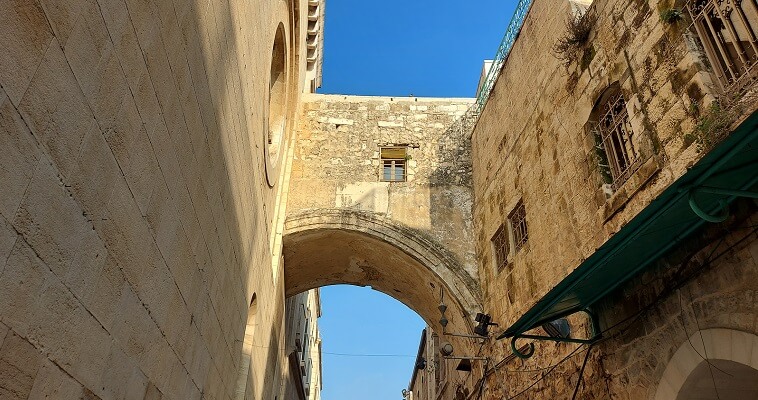
The Zion sisters Covent and the remains of the temple
The rosary tour, tracing the Mysteries of Joy, commenced in Nazareth, the site of the Annunciation, then proceeded to Ein Karem, the location of the Visitation. It then journeyed to Bethlehem, the birthplace of Jesus, and onward to Jerusalem, where the Santa Anna complex serves as a symbolic substitute for the Temple visit. Continuing our pilgrimage, we now arrive at the Sisters of Zion Covent on the Via Dolorosa, a site offering resonance with the final Mystery of joy: the finding in the Temple. Here, amidst the Covent and its underlying archaeological excavations, we discover a space for connection and commemoration of this profound event.
This selection of the Sisters of Zion Covent as a representation of the Mystery of finding in the temple is a personal choice, as there are other locations that could serve the same purpose. For instance, one could opt to visit the Western Wall, a relic and symbol of the Temple in Jerusalem, thereby connecting with Jesus’s Jewish heritage. Alternatively, ascending to the Temple Mount Plaza during permitted times serves this purpose as well.
Regardless of the chosen site, the pilgrimage following the Mysteries of Joy leads us from distant locations such as Nazareth, in a spiral movement, towards nearby areas like Ein Karem and Bethlehem, and ultimately to the heart of Jerusalem. Here lies the Sacred of Sacred, the temple, where heaven meets earth and the physical intertwines with the spiritual. It serves as a nexus between different planes of reality, where the divine permeates and enriches the mundane.
Jesus indeed shares a mystical connection with the temple, and his mission is often interpreted as replacing its significance. In the temple, sacrifices were central, yet Jesus emerges as the ultimate sacrifice, offered during the pivotal Passover, symbolizing the lamb that atones for Israel’s sins. If the temple’s primary purpose is atonement, then Jesus’s advent represents the ultimate expiation for humanity’s transgressions, leading to the purification of the world and even the underworld, as symbolized by Jesus’s descent after death.
Jesus embodies the concept of a Human temple, an idea that predates his time and was developed by the Essenes. He serves as the bridge between God and humanity, being both divine and human, transcending the need for earthly or heavenly temples since his ascension to Heaven. Instead, what is required is recognition of Jesus as the true temple, a role fulfilled by Mary. Despite the wisdom of the temple sages, it is Mary, a humble woman from Nazareth, who comprehends the significance of Jesus’s mission. Therefore, it is fitting that a place symbolizing the Mystery of finding in the Temple be associated with women, specifically the Sisters of Zion, a religious order that traces its origins to Mary’s apparition.
The Monastery of the Sisters of Zion on Via Dolorosa comprises a complex of halls, rooms, underground spaces, a small museum, reservoirs, and a magnificent church featuring an ancient Roman arch. The sisters are dedicated to fostering positive relations between Jews and Christians, prioritizing charity and social outreach, and operating schools and orphanages worldwide. I selected this convent to represent the mystery of finding in the Temple due to its proximity to the Temple Mount and its association with the Ecce Homo arch, symbolizing Jesus as the temple. Furthermore, its various rooms and spaces provide environments conducive to silence and introspection.
The convent marks the beginning of the Via Dolorosa, linking the rosary pilgrimage with the stations of the Via Dolorosa, aligning with the vision of Pope John Paul II’s reforms. At its heart lies a grand church incorporating elements of the ancient Roman arch known as Ecce Homo. Tradition holds that Pontius Pilate presented Jesus to the crowd from the window above the arch, proclaiming prophetically, “Here is the man,” or “Ecce Homo,” symbolizing Jesus as a Human temple. However, the arch itself does not date back to Jesus’s time; it is part of a triumphal arch constructed by Emperor Hadrian nearly a century later. This monumental structure features three arches—one large and two small on the sides—with the main arch starting at the convent monastery and spanning over the Via Dolorosa street, while one of the smaller arches is housed within the church.
From the convent entrance, corridors lead to subterranean spaces featuring ancient paving from the Roman forum that surrounded the arch during Hadrian’s time. While it was once believed that this pavement dated back to Jesus’s era and formed part of the courtyard where he was judged, it is more likely that the large stone tiles were originally from the Temple Mount Plaza and repurposed by Hadrian’s builders. Thus, it’s plausible that Jesus may have walked upon them during his time.
In the convent, a small museum displays artifacts uncovered during excavations at the site and elsewhere. These include stone utensils used by Jewish priests (as stone does not retain impurity), ancient ossuaries, and more. Beneath the ancient pavement lie water reservoirs initially excavated by the Hasmoneans and later expanded by Herod, forming part of the water supply system for the temple and the Antonia fortress guarding it from the north. At the entrance to the complex, a seating area features images depicting how the Temple and the Temple Mount Plaza appeared during Jesus’s time.
It’s worth mentioning that Alphonse Ratisbonne, the individual who founded the convent and established the Sisters of Zion order, was a practitioner of the rosary. His devotion to the rosary stemmed from a Marian apparition he experienced in Paris. Visitors to the Sisters of Zion Covent in Ein Karem can view his original rosary beads displayed in a museum room dedicated to his honor.
Inside the halls of the Covent, one can envision Jesus teaching the rabbis and priests in the temple, while his mother and father search for him, unaware that he is in his true home. After contemplating and meditating on the mysteries of joy, we will depart from Jerusalem and journey to the Galilee, where we will begin to explore and experience the Luminous Mysteries, three of which took place in this region. However, before proceeding to the Galilee, we will visit the site of the baptism in the Jordan River.