This is a rudimentary translation of articles from my book “Touching the Sacred” While it is far from ideal, it serves a purpose given the significance of the topic and the distinctiveness of the information contained. I have chosen to publish it in its current state, with the hope that a more refined translation will be available in the future.
Part Five: The Temple in Jerusalem
The Temple in Jerusalem stood as the focal point of Jewish life for a millennium, and its symbolic significance remains potent to this day. Orienting our prayers towards the temple site thrice daily underscores its enduring importance. Despite its absence, prayer serves as a surrogate for the sacrificial rituals once performed within its walls. The anticipation of the Messiah’s arrival and the temple’s eventual reconstruction imbue our faith with hope and expectation. Our holidays, steeped in temple traditions, serve as reminders of its central role in our spiritual heritage. Yet, within Israeli culture, the temple’s presence is muted, relegated to the margins of historical discourse. Save for a minority advocating its reconstruction, many view it as a distant relic, lacking relevance in contemporary life. This book seeks to rectify this oversight by providing essential insights into the temple’s profound significance.
The Temple held unparalleled sanctity for the Jewish people, a striking contrast to Judaism’s rejection of sacred sites prevalent in other cultures, such as the temples of Egypt and the idols of antiquity. While numerous questions linger regarding its significance, exploring Judaism and the history of the Jewish people necessitates grappling with the Temple’s legacy. In this section, we endeavor to examine the Temple from both a Jewish perspective and a broader secular lens, mirroring our approach thus far in our exploration of the Tabernacle.
In my perspective, there exists a universal human pursuit for meaning spanning generations, with each culture and civilization contributing to this quest. This collective endeavor propels humanity toward the next stage of cultural, religious, and spiritual evolution, both as a collective and as individuals. The Temple in Jerusalem is an integral piece of this puzzle, emerging over two millennia after similar temples began to grace the landscapes of Mesopotamia, Egypt, and Israel. For instance, in Megiddo, a significantly larger and equally magnificent temple was erected some 5,000 years ago at the dawn of history. Tyre, near Israel, boasted a grand temple dedicated to Melkert, bearing resemblance to the Jerusalem Temple. Babylon, the birthplace of Abraham, housed a complex of temples honoring Marduk. In Egypt, the sprawling Temple complex at Karnak remains the world’s largest. The Temple in Jerusalem must be contextualized within this broader framework, as we have done in the initial chapters of this book.
The Temple in Jerusalem stands as a singular manifestation of the Sacred, intertwined with the emergence of monotheism and the distinct character of Jewish religion and faith. In this section, we aim to delve into the significance and essence of the Temple’s establishment in Jerusalem, its unparalleled nature, and the various components from a Jewish perspective. To embark on this exploration of the Temple’s history, it is essential to embrace a Kabbalistic Jewish concept: the Torah does not adhere to a linear chronology. This notion implies that following the construction of the Temple during King Solomon’s era, ancient recollections associated with its location began to surface, establishing connections to creation narratives, the history of the world, and the Jewish people. Consequently, the Temple became linked to the Foundation Rock, the site of Adam and Eve, the location of Abraham’s Sacrifice of Isaac, and so forth.
The Jewish Temple in Jerusalem endured for over a millennium, punctuated only by a brief interlude of sixty years during the Babylonian exile. Throughout this extensive period, a divine energy known as “The Shekinah” or “Divine Glory” pervaded the structure, manifesting as a tangible presence that facilitated daily miracles. It could be contended that Judaism during this era diverged from its contemporary abstract monotheistic form—centered on prayer, ethical conduct, and study—to encompass mystical and magical elements. In the epoch of the Temple’s existence, Judaism was intertwined with practices such as Sacrifice, adherence to purity laws, temple worship, Pilgrimage, and a direct communion with the palpable divine presence housed within a structure crafted from wood, metals, and stone. This divine interaction unfolded through the agency of Priests and Levites serving in the sanctuary, alongside prophets and sages who guided the faithful.
The Temple in Jerusalem shared similarities with the sacred structures of other ancient civilizations, such as those in Egypt and Sumer, where claims of divine presence communicating with humanity were also made. These temples boasted Priests ministering in the sanctuary, alongside prophets, sages, sacrificial rituals, and Pilgrimage traditions. Acknowledging this reality underscores the Temple’s role as a continuation of age-old sacred traditions dating back over two millennia, originating not only in Egypt and Mesopotamia but also among the Phoenicians and in the land of Canaan.
Some may take issue with my portrayal, arguing that the Temple represented an abstract and transcendent God, distinct from the religions of the ancient world. However, the act of Sacrifice and offerings to God within the temple mirrors practices found in Egyptian Temples, where Priests similarly performed rituals. Likewise, the burning of incense before God in the temple resembles the practices observed in Egyptian Temples, where incense was offered before statues of the Gods. The two cherubs positioned above the Ark of the Covenant, crafted from wood and overlaid with gold, bear a striking resemblance to the statues of gods in Egyptian Temples. Nonetheless, I concur with those who recognize a significant distinction between the Temples of Egypt and the Jewish Temple, which introduced a novel concept of religion and Holiness.
Indeed, the distinction is evident in the Temple’s structure. Apart from the cherubs, the Temple lacked statues of gods typically found in Egyptian Temples. Unlike the multifaceted rooms dedicated to various deities in Egyptian Temples, the Jewish Temple comprised a singular Holy of Holies. Avigdor Aptowitzer posits that the Temple was a Temple of silence, devoid of singing or prayer, unlike its counterparts. God’s presence manifested in the form of a cloud, referred to in the Bible as “Zebul” or “mist,” aligning with His abstract nature. Additionally, the Temple served as the “eye of the storm,” a tranquil oasis amid the bustling activity of the temple mount and the city of Jerusalem.
The Sacredness of Jerusalem
According to Midrashic legends, the first man was created by God from the earth of Mount Moriah, where the Temple would eventually stand. This location held the foundational rock from which the world’s creation originated, and beneath which the subterranean waters of the world spring forth. Adam and Eve sought refuge here after their expulsion from Eden. It was on Mount Moriah that Adam made the inaugural sacrifice to God, later being laid to rest beneath the Foundation Rock. Cain and Abel also offered sacrifices to God at this sacred site and upon the same altar, as did Noah thereafter.
Our patriarch Abraham ascended Mount Moriah, identified with the Temple Mount, to carry out a harrowing act: sacrificing his beloved son Isaac. Erecting an altar atop the mountain, he prepared to fulfill God’s command, but just as he was about to proceed, a ram appeared in the thicket, and an angel’s voice intervened, instructing him, “Do not lay a hand on the boy” (Genesis 22:12). In that profound moment, Abraham glimpsed a vision of a future Temple to be built in the same location.
According to the Zohar, Jacob, another patriarch, rested his head upon the Foundation Rock, the very stone he used as a pillow. Mount Moriah served as the backdrop for Jacob’s visionary encounter, where he witnessed angels ascending and descending a celestial ladder, famously known as Jacob’s Ladder. Jerusalem, often referred to as the “House of the Lord,” holds significant spiritual importance—it is Bethel, where Jacob entered into a covenant with God and erected a monument to commemorate the occasion (Genesis 28).
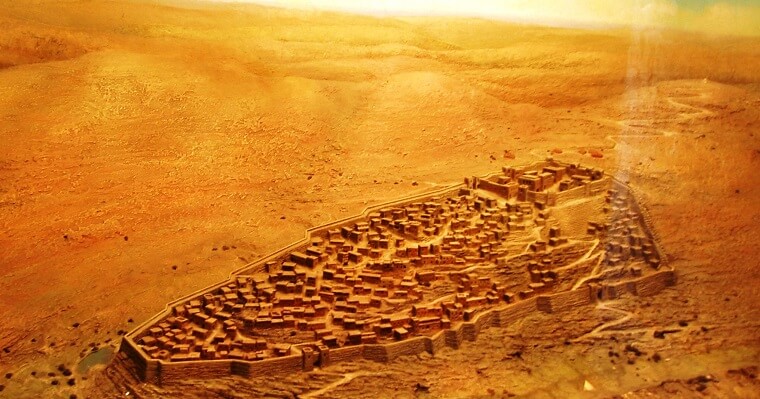
The sanctity of Jerusalem, evident in its selection by David and Solomon for the construction of a permanent Temple, is indeed profound. However, it’s intriguing that centuries earlier, during the Israelites’ presence in the land, Jerusalem remained unconquered and largely unoccupied by them, instead being held by the Jebusite people. This historical fact raises compelling questions: Why did the Israelites, despite residing in the land, not attempt to seize Jerusalem or establish a sanctuary there? Why was the Tabernacle, which endured for 369 years, situated in Shiloh rather than Jerusalem? And upon its destruction, why was it relocated to Gibeon and Nob, both near Jerusalem?
Remarkably, Jerusalem is conspicuously absent from explicit mention in the Torah. While the tale of Melchizedek, King of Salem, a priest of the Most High God who blesses Abraham, exists, it remains uncertain whether “Shalem” equates to Jerusalem, and the authenticity of the narrative is debated. If Jerusalem held paramount importance from the outset, why is its absence in the Torah distinct compared to the prominence accorded to Mount Sinai?
The answer for the above question is that the significance of Jerusalem is deeply intertwined with the concept of human free will and choice. In the directive for the Israelites to construct a dwelling place for God, it is stated: “in the presence of the Lord your God at the place he will choose as a dwelling for his Name” (Deuteronomy 14:23). Here, the choice of location is delegated to the people. Israel, as the chosen people, earned this distinction through their decision to obey the Lord. Following this logic, Jerusalem’s sanctity emerges from a historical act of choice.
If the establishment of the Temple in Jerusalem is indeed an act of choice, it opens up new avenues of inquiry regarding the reasons behind this decision. This perspective liberates us from traditional midrashic explanations concerning the Temple’s establishment, its form, worship practices, and overall significance. Consequently, we are afforded the opportunity to hypothesize independently and explore the underlying reasons for selecting Jerusalem as the site for the Temple and the architectural decisions that shaped its construction. This approach may lead us into unconventional territories and fields of study not typically explored, particularly within orthodox Jewish circles.
My approach to understanding the sanctity of Jerusalem adopts a universal and secular perspective, drawing from comparative religious studies and theories that explore the relationship between humans and sacred places. Additionally, I incorporate esoteric sciences such as astrology, earth energies, and sacred geography into my analysis. Similarly, when examining the structure of the Temple, I reference sacred architecture alongside alternative sciences such as energies, magic, and alchemy. This interdisciplinary approach allows for a broader exploration of Jerusalem’s significance and the design principles behind the Temple, transcending traditional religious frameworks to consider a diverse range of influences and perspectives.
It’s crucial to recognize that the construction of the Temple in Jerusalem by King David and King Solomon was not only a political and religious national endeavor but also a profoundly magical and spiritual act. This undertaking established a threefold bond between a dynasty (the House of David), a place (Jerusalem), and Judaism itself. This trinity of connections endures to this day, shaping our prayers toward Jerusalem and our anticipation of the Messiah from the lineage of David.
Prior to the Temple, the Jewish people prayed in various directions, and the prophetic and spiritual light could manifest through any individual. However, the spirituality of the Temple differs significantly from that of the Tabernacle, primarily because it is tethered to a fixed location on Earth. It appears that after 480 years of testing, the Shekinah, the divine presence, deemed the time ripe to permanently anchor the energy of God in Israel. The people had proven themselves worthy of this divine presence. Indeed, according to the Kabbalah, the Temple represents the culmination of the process of Creation and the purpose of the Shekinah’s revelation among the material worlds.
The presence of the Shekinah in Jerusalem aligns with the epithet of God as “the place.” However, this wasn’t always the case. Once, God was perceived as a mobile deity, responding to inquiries about identity with the enigmatic statement “I am that I am.” This perspective has led some scholars to argue against sanctifying places in Judaism, asserting that God Himself is the ultimate “place” (Makom) and transcends physical location. According to this viewpoint, Judaism maintains a separation between place and holiness, with no inherent connection between heaven, earth, and the underworld. God is encountered in a voice without a specific location, in the ethereal realm of the cloud. The Jewish approach emphasizes distancing from physical places and emphasizes the pursuit of the holy. In this interpretation, the “place” is the realm of the human universe.
Furthermore, proponents of this perspective argue that if a physical location were truly sacred, the destruction of the Temple should have spelled the end of Judaism. Yet, Judaism not only survived but thrived, producing seminal works like the Mishnah and the Talmud following the Temple’s destruction. This resilience suggests that Judaism’s essence transcends any singular physical site. Indeed, despite God’s revelation on Mount Sinai, the mountain itself was not designated as a pilgrimage site in Jewish tradition, further underscoring the idea that physical places are not inherently sacred within Judaism.
Others continue this line of thinking, asserting that the entire concept of the Tabernacle was rooted in its mobility, reflecting the omnipresence of God. While it is acknowledged that Israel holds sacred significance as the Promised Land and that the Torah repeatedly commands the construction of a house for God in the chosen place, some interpret this as metaphorical. Prior to the time of King David, there was no consensus on the feasibility of this task, nor was it evident what this designated place truly entailed—whether it was physical or symbolic, and how it could be identified. Moreover, questions persisted regarding the nature of this house for God and who would undertake its construction
I emphasize this point because it serves as a valuable starting point for comprehending the phenomenon of the Temple and the sanctity of Jerusalem. The adopted approach of “a place is not sacred” allows us to clear away pre-existing assumptions, associations, and unnecessary emotional baggage associated with Jerusalem. However, once we have purged ourselves of this artificial notion of holiness, we must then pivot and explore what true holiness entails and how it relates to the relationship between an individual and a place.
My PhD research focuses on exploring the connection between religious inner experiences and visits to charismatic sacred places. From my perspective, certain places have a profound impact on us and can evoke experiences of the sacred within us, while others do not. Jerusalem is one such place capable of triggering such experiences. However, this process is not automatic but requires active participation on the part of the individual. Human beings are inherently religious creatures, seeking to experience the sacred at the appropriate times and in sacred spaces. When this occurs, divinity can manifest through various forms, such as stones, trees, defined areas, and especially through unique geographical and topographical structures—a phenomenon referred to as hierophany.
A permanent home
According to Eliade in his seminal work “The Myth of the Eternal Return,” the fundamental human experience is characterized by a sense of being distant from home and a longing to reconnect with the eternal, sacred, and meaningful, as opposed to the transient, temporary, and mundane. Sacred places and times facilitate this process. In Judaism, the notion of “returning home” can be equated with the aspiration to rectify the world.
According to Jewish spirituality, humanity’s purpose is to rectify itself and, in doing so, aid the Creator and Creation in rectifying the world, thereby restoring it to its original state in the Garden of Eden. Initially, humanity’s natural home was in heaven, but due to the original sin, humanity descended into the material world. The giving of the Torah at Mount Sinai, followed by the construction of the Tabernacle and later the Temple in Jerusalem, marks the beginning of the journey back home. The construction of the Tabernacle and the Temple represents pivotal stages in the historical progression from the fall to redemption. The significance of the Temple lies in its establishment of heavenly presence on earth, which ultimately leads to the restoration of the world to its original paradisiacal state.
The profound significance of constructing the Temple lies in the creation of a center—a point of reference akin to a world axis—that connects the realms of heaven, earth, and the underworld. This concept resonates with other temples in the ancient world. However, the construction of the Jewish Temple in Jerusalem marks a pivotal moment in history. It bridges the past, including the fall, with the future, particularly the anticipated redemption. In erecting the Temple, the Jewish people established a place that serves as both a world axis and a locus for historical reversal. Consequently, the Temple is anachronistically associated with the site of Creation’s inception.
The transition from God dwelling in the Tabernacle to God dwelling in the Temple can be likened to humanity’s shift from a nomadic existence as hunters and gatherers—wandering the sacred journey around the earth, with every place serving as our home—to a sedentary lifestyle characterized by permanent homes and settlements. In settling down, we created a sacred space of a different kind than the natural world.
In constructing a house, humans participate in a creative act, molding their surroundings in a way that sets them apart from other species. This activity positions humans outside the natural world, underscoring their ability to engage with and contemplate higher planes found in the celestial spheres and the unseen divine realms. The act of building a house requires planning, thought, perception, and artistic creativity—traits uniquely human that mirror our essence. As Eliade notes, houses, along with temples, palaces, and fortresses, have one thing in common—they serve as the epicenter of human activity, positioning themselves at the universe’s heart. This central point symbolizes a transcendental space, separate from the mundane, and can contain numerous, possibly infinite, “centers” at once.
The central point of a house or temple possesses more than just geographical importance and being an activity hub; it also represents a temporal center, mirroring the act of creation and the original moment. In doing so, it reinstates the cosmic order, acting as a pivotal point that surpasses both spatial and temporal boundaries. Therefore, every house, and especially a temple, becomes an “Axis Mundi.”
The Tabernacle was a central element in Jewish religious life, acting as a bridge between different realms. Its role, however, was constrained by its portable nature. This limitation was apparent in the practice of setting up altars to God across the land during specific times. Although this flexibility had its merits and suited the period, the progression of Jewish faith called for stability and continuity. The advancement and realization of the Jewish people’s mission to enlighten all nations and bring redemption necessitated the establishment of a steadfast center. This center would enable focused efforts, inspiration, growth, and sanctity—forging a renewed link between God, the community, and the territory. This ambition was fulfilled with the erection of the Temple in Jerusalem.
The foundational spiritual dimension of founding the Temple is intertwined with its relationship to the land. The Temple stood as the world’s axis, acting as a portal to other realms and bridging the divine and the terrestrial. Thus, it was positioned on a distinguished rock atop a mountain, for both mountains and rocks were seen as venues for divine manifestation, reminiscent of the Sinai event. Mountains are valued as pilgrimage sites, with the Hebrew term “aliyah” (ascent) denoting both physical pilgrimage and the idea of ascending to a sacred mountain. Symbolically, a mountain touched by divinity is regarded as the “world mountain,” representing the universe’s nucleus. Various religious traditions recount a mythical mountain at creation’s dawn, which could be an allegorical or actual place. In mystical Islam, this mountain is Mount Kaf; in Buddhism, Mount Meru; in Judaism, Mount Moriah; and in Christianity, Golgotha Hill.
A significant rock is seen as a central axis of the world, akin to a mountain. Both mountain and rock are foundational symbols in the spiritual unconscious of humanity, representing the initial form emerging from disorder. This is exemplified by the Egyptian Benben stone in Heliopolis (the mound emerging from the primordial waters), the omphalos stone in Delphi, or Mount Ararat ascending from the waters of the biblical deluge. There’s a Jewish tradition suggesting the flood did not engulf Mount Moriah. It’s crucial to recognize that constructing the Temple wasn’t merely about creating a permanent residence for God but also marked the first hallowing of a mountain and a rock within Judaism. It was not merely a place, but a distinct type of place, its distinctiveness not solely due to the presence of a mountain and rock but also related to other geographical characteristics that will be further discussed.
The construction of a Temple went beyond establishing a world axis; it was about the sanctification of the land and forging a deeper bond (covenant) between the Jewish people and the land. This shift marked the end of wandering and temporary dwellings, ushering in a Kingdom, cities, and a temple—all solidifying the Jewish people as a religious entity in the rocks, mountains, and soil of the Land of Israel. From another angle, it could be argued that after 480 years of trials, the land was finally ready to fully embrace the people dwelling upon it. This acceptance sparked thoughts and feelings among the land’s inhabitants, guiding them towards the construction of a permanent temple. The people living in the land were in tune with its higher qualities, receiving its approval and blessings.
Before the arrival of the Israelites in the land of Israel, the Egyptians had a presence there for 400 years. However, they did not receive the land’s blessing or approval and thus failed to establish a permanent foothold or build a temple, eventually departing. Similarly, the Israelites’ stay in Egypt spanned 400 years, but they too had to leave, as they did not resonate with the land’s essence. In a sense, the early Zionist saying, “A land without a people for a people without a land,” held true even in biblical times. The land of Israel and the Jewish people discovered a mutual connection, leading to the construction of the Temple in Jerusalem. This act not only sealed their covenant but also represented a culmination of the creation process.
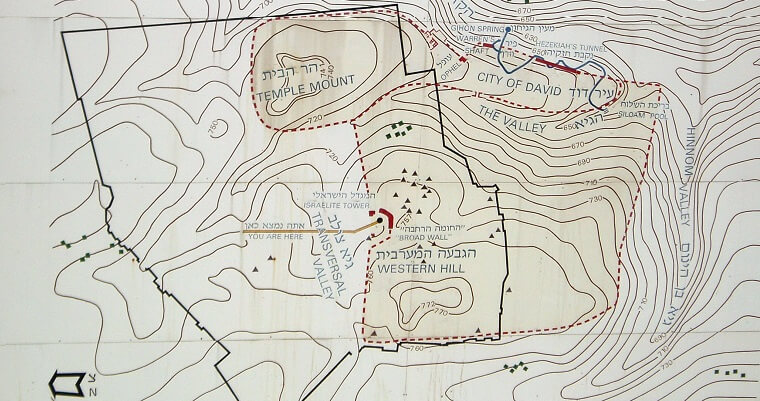
Completion of the act of Creation
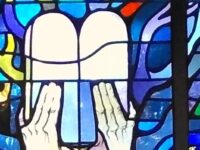
Delving deeper into the significance of constructing the Temple requires revisiting its connection to the revelation at Mount Sinai, a pivotal moment in both human and Jewish history. This event marked the establishment of the Jewish people’s mission and path, and it was then that the directives for constructing the Tabernacle were imparted, including the mandate to build a house for God in a location He would designate upon their arrival in the land. According to the Sages, it was also during this time that Moses received a scroll detailing the design and blueprint of the future Temple.
The revelation at Mount Sinai represented a divine presence manifesting in this world, appearing as a cloud by day and a pillar of fire by night, with the Tabernacle serving as its earthly anchor. This event was monumental because it opened a channel for communication between the divine realms and humanity. The biblical narrative describes the cloud hovering above the Tabernacle, with God’s glory dwelling within it. This presence was not yet complete; it would take another 480 years for the divine presence to fully inhabit the Temple, signifying a more profound manifestation of the deity in the material world. The construction of the Temple marked the culmination of a historical rectification process that began at Mount Sinai, and on a deeper level, it represented the completion and redefinition of the entire process of Creation. This is why the Temple was established at the site where Creation itself commenced – the Foundation Stone.
The link between constructing the Temple and finalizing the Creation process can be appreciated as follows: The natural world, as it was originally created, does not present an ideal setting for humanity, the pinnacle of Creation. Humans are challenged by the variability of the climate—cold, scorching heat, drought, wind, and rain—not to mention the peril posed by wild animals. These conditions are not inherently conducive to human well-being, prompting people to construct houses as sanctuaries from the untamed elements. In doing so, humans have enhanced nature and, by extension, engaged in the act of Creation themselves. They have carved out spaces and circumstances where tranquility prevails, enabling thought, development, and the fulfillment of their role as conduits of spiritual energies. A defining human attribute is our capacity to refine and augment Creation, crafting artificial environments where we can reside—a “sanctified” living space, embodying our contribution to the ongoing process of Creation.
Just as the natural world presents challenges to humanity, requiring the construction of houses for protection and improvement of living conditions, it can also be seen that the world, in its raw state, is not the ideal residence for a deity. This perspective suggests that a divine presence similarly requires a “house” to safely inhabit within the material realm. Thus, when the Temple was completed, the cloud that had previously hovered above the Tabernacle moved to reside within the Temple, bringing with it the glory of God. This transition allowed the divine presence to fully embody its role as a source of salvation for humanity. As described in 1 Kings 8:10, “When the Priests withdrew from the Holy Place, the cloud filled the temple of the Lord.” From that point forward, the divine presence was housed within the Temple, marking the perfection and completion of Creation.
As peculiar as it may seem, the Temple enabled the deity to carry out its purpose of disseminating spiritual light throughout the world. The collective effort of the entire nation to erect this wondrous edifice led to the deity taking residence in the Temple, thereby facilitating a link between the realms. It is important to mention that the construction act served as a profound prayer and plea by the entire Jewish community, creating the perfect conditions for the cloud to descend and inhabit the Temple.
In the construction of the Temple, the sequence was reversed compared to the Tabernacle’s construction. Initially, the structure was erected, the artifacts crafted, everything positioned, and the courtyard organized. Everyone worked with sincere intention and systematically. Only after these efforts did God respond—His reaction was inevitable. This method mirrors a magical invocation of energies. The actions of the Israelites under Solomon’s leadership acted as a call to higher forces. The manifestation of the Sacred in this instance was a call from below upwards, enabling a more enduring, elevated connection, unlike the Tabernacle, where the Divine manifestation occurred from top to bottom. After the revelation at Mount Sinai, the cloud settled within the Israeli camp even before the construction of the Tabernacle, a Divine blessing bestowed upon those who were merely receptive. Conversely, in Jerusalem, the Divine presence was summoned through the people’s efforts (and Divine grace, without which nothing would have been achieved) and their prayers.
During the desert wanderings, the cloud appeared before the Tabernacle was constructed, guiding its creation. Initially, the Israelis built the Ark of the Covenant, followed by the creation of the vessels, assembly of the boards, and weaving of the fabrics. The cloud, present on the mountain, directed the Israelites through Moses. In contrast, in the Temple, the Divine cloud filled the sanctuary only after everything was set in place, necessitating a leader filled with wisdom and understanding to direct the construction efforts. After seven years, once the construction was completed, the artifacts were positioned, and the community united under the King, the Priests, and a prayer leader, the Ark of the Covenant was placed inside. Only then did the cloud descend, based on the comprehensive work previously accomplished, thereby solidifying a much stronger link between the celestial and terrestrial realms.
Solomon’s Temple symbolizes the culmination of the Creation process, embodying the filling of the structure with spiritual light, as depicted in the verse, “Then Solomon said, ‘The Lord has said that he would dwell in a dark cloud; I have indeed built a magnificent temple for you, a place for you to dwell forever.'” (1 Kings 8:12). This cloud represents the “darkness over the abyss” from the first day of Creation, alongside “the Spirit of God hovering over the waters.” It signifies the obscurity that transforms into light with the initial manifestation of the divine, as indicated by the word “be” (yehi) in the Torah (“Let there be light”). The Temple thus becomes the locus where the transition from darkness to light perpetually occurs. This dynamic might elucidate why the windows of the Temple are described as “opaque transparent,” designed to admit not just the physical light but also to emit spiritual illumination.
The core nature of the Temple, embodying spiritual light and serving as a connection to the primal state of the universe before Creation began and to humanity’s original condition in the Garden of Eden prior to the original sin and fall, is encapsulated in a deceptively straightforward yet profound prohibition: the ban on introducing any impurity associated with death. Essentially, the Temple was envisioned as a realm of eternal souls, offering an opportunity to revert to a state of everlasting life, akin to that in the Garden of Eden.
After humanity’s exile from the Garden of Eden, humans became subject to death and illness, states viewed by religious perspectives as unnatural, thus rendering death as impure. The profound significance behind the construction of the Temple lies in its establishment as a place on Earth devoid of death’s impurity, a sanctuary that paves the way to eternal life. In this sense, building the Temple represents the completion of a cycle, triumph over death—humanity’s penalty for consuming the fruit of the tree of knowledge. Therefore, the construction of the Temple serves as both a permit and an inspiration for humanity to access the tree of life.

Innovations in the construction of the Temple
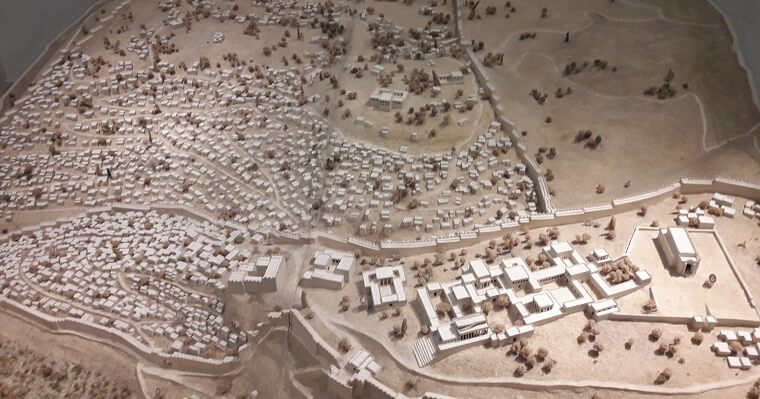
The Temple was the most significant architectural project in Jewish Israel since the tribes settled, marking the zenith of Solomon’s accomplishments. It mirrored the Tabernacle’s design, albeit on a grander scale, incorporating modifications and enhancements. The courtyard’s size was fivefold that of the Tabernacle’s, the Temple’s total volume was precisely ten times greater than that of the Tabernacle, and certain internal dimensions of the Temple were doubled or even tripled compared to those of the Tabernacle. These proportions carry symbolic and spiritual significance. Whereas the Holy of Holies in the Tabernacle measured ten cubits in height, width, and length, in the Temple, these dimensions were doubled to twenty cubits, forming a square. In the Tabernacle, the main hall was twenty cubits in length and ten in width and height; in the Temple, these dimensions were expanded to forty cubits in length and twenty in width, with the height increased threefold to thirty cubits. Besides the Holy of Holies and the main hall, the Temple also featured an additional space functioning as an open entrance hall.
The expansion of the Tabernacle’s dimensions in the Temple, through doubling and tripling, illustrates that the essential proportions and layout of the Tabernacle, symbolizing the Sacred, can be infinitely extended. This principle also influenced the sacred architecture of other ancient world temples, teaching us that these proportions embody abstract principles applicable beyond architecture into other life facets. A hidden mystery within the Temple’s augmented dimensions lies in the 1:10 volume ratio between the Tabernacle and the Temple’s spaces (3,600 cubic cubits to 36,000 cubic cubits). This ratio is linked to the tree of life and its ten sefirot, illustrating a profound spiritual concept embedded in the physical structure of the Temple.
To grasp the essence and innovations of the Temple, it’s insightful to examine the structural modifications (beyond merely size) compared to the Tabernacle. Beginning with the courtyard, the Ezra, the dwelling place of the Shekhina, was enclosed by a canvas fence during the Tabernacle era, but in the Temple, it is encircled by a wall featuring rooms, buildings, and porticos. Inside the Ezra, where a copper altar stood in the Tabernacle period, the Temple boasted a significantly larger stone altar accessible via a ramp. Replacing the Tabernacle’s single copper wash basin, King Solomon introduced ten larger, mobile wash basins mounted on wheeled machines, adorned with figures of three entities: a lion, a bull, and cherubs, echoing the visions seen by Ezekiel in the Merkava vision. These basins, intended for the purification of the sacrifices’ internal organs, correspond to the ten commandments, while the machines on which they stand reflect the ten articles (sefirot) utilized in the Creation of the world.
Beyond the wash basins, Solomon also crafted the “Sea,” a vast copper basin with a diameter of five meters, supported by 12 copper bulls arranged in groups of three, each group facing one of the four cardinal directions. This setup mirrors the organization of the 12 tribes of Israel during their desert sojourn.
From a mystical magical perspective, water is renowned for its electrical conductivity and capacity to retain memories. If the Holy of Holies served as a type of energy apparatus, with the Ark of the Covenant being its activator and power source, then the Temple and its components were meticulously designed to facilitate this process of spiritual energy generation. In this context, situating a large copper water container within the courtyard functioned akin to an energy storage unit (a sort of battery), paralleling the inclusion of holy lakes within Egyptian temple designs as part of their sacred architecture. The orientation of the bulls towards the cardinal directions could facilitate the harnessing of the Earth’s energies. The “sea” was fed water through an aqueduct from the Bethlehem area, serving as the primary water supply for the Temple. Estimates by researchers suggest that the “sea,” when filled with water, could weigh up to 250 tons.
The “sea,” the wash basins, and the Altar were all positioned in the Ezra, the Temple courtyard deemed the dwelling place of the Shekinah. Consequently, entry into the Ezra with the impurity of death (such as after being in a graveyard or touching a deceased person) was strictly prohibited. The Ezra’s size was quintuple that of the Tabernacle’s Ezra, serving as the venue for the congregation’s worship, including the Levites and Priests’ activities and sacrifices. Additions not present during the Tabernacle era, such as the Levites’ morning song and daily occurrences of miracles like the Altar’s smoke rising straight into the sky regardless of wind, were incorporated. Beyond the Ezra itself, an additional courtyard enclosed by four chambers, known as “Ezra Nashim” (Women’s Courtyard), was situated to the east, a feature absent in the Tabernacle period.
The Ezra was located within the Temple Mount enclosure, which itself was situated within the walls of Jerusalem. This tripartite division mirrored the organization of the Israelite camp in the desert: Jerusalem represented the camp of Israel, the Temple Mount symbolized the camp of the Levites, and the Ezra paralleled the location of the Tabernacle. These tiers of sanctity were also mirrored in the roles and positions of the Priests, Levites, and Israelites. The founding of Jerusalem and the establishment of the Temple therein essentially allowed for the reenactment of the Torah’s reception at Mount Sinai. After 480 years during which the Israelites were dispersed across their tribal lands, a unified city was finally established, embodying the Israeli camp and welcoming to all. Consequently, all Israelites making pilgrimage to Jerusalem, as prescribed in the Torah, were entitled to stay within the city walls without charge, with city residents encouraged to offer their support. Jerusalem thus emerged as a unique city, belonging to and providing for everyone, reimagining the Israelite camp in the desert as a permanent fixture.
The Temple’s design echoed the Tabernacle while introducing significant innovations. One of the most striking additions was the grand façade and entrance hall, a vast and towering space. Flanking the hall’s exterior, two large copper pillars were erected, named Boaz and Jachin, echoing similar structures in Egyptian temples. A distinctive feature of the Temple, not found in other ancient world temples, was the addition of a three-story gallery surrounding the Temple, housing 38 rooms. The presence of the entrance hall, columns, and gallery in the Temple, absent in the Tabernacle, holds profound spiritual significance. As the Temple represented the culmination of the Creation act, a place designed to facilitate the manifestation of divinity within the material world, it was necessary to incorporate intermediary elements, whether these be the columns, the entrance hall, or the gallery. Approaching the divine directly is not possible; the sacred must be veiled. Moreover, the intensified divine presence in the world necessitated a larger vessel (structure) to house it.
At the entrance hall, a large door led into the main hall of the Temple, which was both higher and significantly larger than the Tabernacle’s equivalent. Constructed from ashlar stones, the interior of the hall featured cedar wood planks on the walls, which were possibly coated with gold, and cypress wood planks beneath the floor. There’s a belief that the wooden wall planks were gold-coated like those in the Tabernacle but, unlike the Tabernacle, adorned with decorations such as palm trees, flowers, and possibly cherub representations. Additionally, some posit that the walls were embedded with gems. The hall extended up to a height of 15 meters and had “opaque transparent” windows positioned at its upper section, allowing light to enter, in contrast to the Tabernacle’s darkness. The exact nature of these “opaque transparent” windows remains unclear.
Within the Temple, there was ample space to accommodate all the new Sacred vessels, whose quantity significantly exceeded those in the Tabernacle. Solomon and Hiram Abiff crafted ten Menorahs from pure gold, in contrast to the single one in the Tabernacle, and also made ten tables for the Showbread instead of just one. The design of the Showbread tables and the bread itself underwent changes, becoming more intricate in shape and composition due to alterations in preparation methods; it no longer resembled pita bread but was more akin to a folded loaf. In addition to the ten Showbread tables and ten Menorahs, there was only one gold Altar in both the Tabernacle and the Temple. However, the Altar in the Temple was constructed slightly differently, a detail we will explore further.
The construction materials for the Temple differed from those used for the Tabernacle, with stone replacing wood and canvas as the primary structural element. The interior also saw a shift in wood types, with cedar and cypress replacing acacia for the walls and floors. Cedar, used for both the ceiling and walls, can reach heights of up to 40 meters, making its beams suitable for constructing significant structures like the Temple and other grand edifices in Jerusalem. The use of stone for the walls, complemented by cedar beams and interior cedar wood planking, likely carried religious symbolic significance and possibly served a magical-energetic purpose.
Viewing the Temple from an energetic perspective offers intriguing insights. The combination of exterior stone, interior wood, and gold coatings creates an ideal structure for containing energy. Wood acts as an excellent insulator, and metal serves as a conductive material, together forming an effective energy storage system, while the stone provides structural stability. It’s noteworthy that the Egyptians also valued cedar, importing it from Lebanon for their religious constructions, where it symbolized the deity Osiris. Cedar was found in Canaanite temples, such as the one in Lachish, and its grandeur (among other qualities) has rendered it a sacred tree since ancient times.
The main hall was the largest space within the Temple, serving as the primary site for the religious duties of the Priests. However, the most sacred area was the Holy of Holies – the Devir, situated at the Temple’s western end. During the First Temple period, it was delineated from the rest of the Temple not only by a curtain (Parokhet), as instructed in the Bible, but also by a wall featuring an entrance adorned with olive wood doors. These doors, covered in gold, were embellished with figures of cherubs, palms, and various motifs. The door frame included five lintels, a detail that might hold significance, possibly echoing the five gold-coated pillars at the entrance to the Holy of Holies in the Tabernacle. In the era of the Second Temple, the division between the main hall and the Holy of Holies consisted solely of the Parokhet (curtain), with no intervening wall.
Reflecting on the sacred architecture of the ancient world, we find two key proportional concepts represented through numbers and symbols: The first is the two-thirds to one-third ratio (2:1), symbolized by the Star of David, which epitomizes a harmonious and balanced world. This principle ratio manifests in the Temple, particularly in the dimensions of the main hall, illustrating the interplay between length and width. The second significant proportion is the golden ratio, embodied in the pentagram symbol, denoting the universe’s movement and dynamism in its divine connection. This ratio is evident in the dimensions of the Ark of the Covenant. The presence of five lintels on the Holy of Holies’ doorframe, alongside the golden ratio, may symbolize this area as a dynamic, divine conduit.
Above the Ark of the Covenant were two cherubim, resembling small winged statues affixed to the Kaporet (mercy seat), the ark’s golden lid. However, unlike in the Tabernacle, the Holy of Holies in the Temple housed two additional, much larger cherubs. These impressive “statues” stood ten cubits (approximately five meters) in both height and width, crafted from olive wood and overlaid with gold. Positioned beneath their outstretched wings, the Ark of the Covenant was situated, with their wings spanning from one wall to the other. The wood used within the Holy of Holies, for both the ceiling and walls, was coated in gold—not just any gold, but a specific variety known as “closed gold.” The cypress panels on the floor were also overlaid with gold panels (according to one interpretation, the gold was applied directly onto the stone floor, according to another the floor was not overlaid with gold), thereby forming a unified gold-covered square. At the center of this square stood the two immense cherubs, their wings touching the walls, highlighting the potential energetic significance of these grand additions.
Viewing the arrangement of the Holy of Holies through an energetic, mystical lens, the two additional cherubs can be seen as forming a kind of circuit within a space specifically designed to engage the energetic apparatus known as the Ark of the Covenant. The Temple’s energy, activated by the divine presence between the smaller cherubs atop the Ark, was amplified by the larger cherubs acting as force multipliers. Their role paralleled that of the carrying rods in the Tabernacle, albeit in a more potent manner. Their connection spanned from wall to wall, precisely from the midpoint in both width and height, suggesting a deliberate design to optimize the flow and amplification of spiritual energy within this most sacred space.
According to Jewish tradition, as detailed in the Talmud Bavli (Tractate Yoma, 52b and 54a), the cherubim atop the Ark of the Covenant were dynamic in their orientation, symbolizing the state of the relationship between Israel and the Divine. They faced each other in moments of favor towards Israel, signifying closeness and harmony between the divine and the nation. Conversely, in times of disfavor, they turned away from each other, reflecting a period of estrangement or distance in this relationship. This dynamic aspect of the cherubim’s positioning might explain why only the High Priest was permitted to view them, entering the Holy of Holies just once a year on Yom Kippur. Furthermore, the Talmud describes one cherub as male, bearing the face of a baby boy, and the other as female, with the face of a baby girl, emphasizing their representation of unity and duality within the sacred space.
The integration of masculine and feminine principles was fundamental to temples and holy places in antiquity, and the Talmud’s accounts suggest that this motif extended to the Temple as well. The Zohar further explores this notion, depicting the world as a domain of perpetual union between Masculine and Feminine energies, a dynamic that enables abundance to permeate the world. These aspects are metaphorically represented as heaven and earth or as God (masculine) and the Shekinah along with the people of Israel (feminine).
To wrap up this discussion, it’s significant to recognize that while we possess detailed descriptions of the Temple in the Books of Kings and Chronicles, as well as in the Mishnah and the Talmud, the depiction of the Temple’s structure in the Book of Chronicles differs somewhat from that in the Book of Kings. For instance, Chronicles mentions a curtain dividing the Holy of Holies from the main hall, similar to the arrangement in the Tabernacle, along with cherubim on the hall’s walls and the walls being adorned with gold and precious stones—details not specified in the Book of Kings. These discrepancies leave certain aspects of the Temple’s design open to interpretation and debate, providing Jewish scholars with material for discussion and further elaboration.
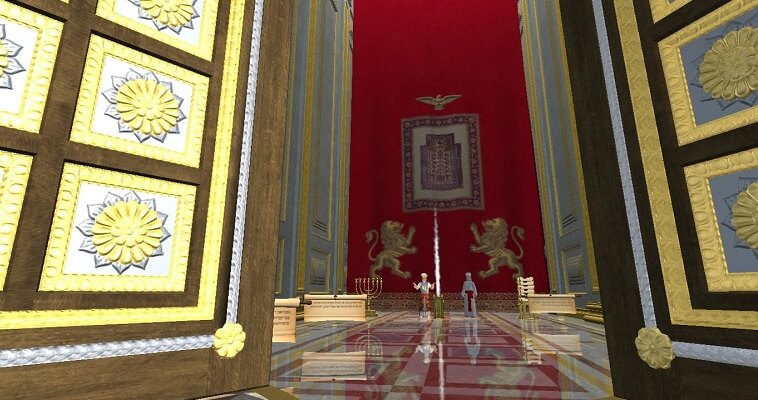
Boaz and Yachin
One notable innovation in the Jerusalem Temple, distinct from the Tabernacle, involved the erection of two large copper pillars at the entrance to the hall, named Boaz and Jachin. Positioned on either side of the entrance steps, these pillars were of equal size, crafted from copper, standing 8 meters tall and 1.72 meters in diameter, making them significantly thicker compared to the columns of Greek Temples—nearly twice as thick. Atop each pillar was a capital, intricately carved to resemble lily buds and measuring 2.5 meters in height. Above these capitals were lattices and a type of open metal flower split into seven petals. Copper pomegranates hung in chains from the capitals, adding to their ornate design. Given that the pillars were hollow, striking them would likely produce a resonant and clear metallic sound.
The pillars stood freely, underscoring their symbolic-magical significance rather than serving a practical purpose. Given copper’s properties as an efficient conductor of energy, the placement of two copper pillars at the entrance might have been designed to enhance and maintain the energy field within the sanctuary. Additionally, it’s conceivable that these pillars formed a sort of energetic electrical barrier between them, acting as a safeguard against negative influences.
The columns may also symbolize the duality principle that governs the world. Outside the Temple, this duality exists in separation and disconnection, but within the Temple, it merges and is embodied by the two cherubs in union, drawn together in a manner that generates and sustains an energetic presence between them. This theme of two columns at a temple’s entrance is a fundamental aspect of sacred architecture in the ancient world. Many Egyptian temples featured two obelisks, columns, or statues at their entrance, sometimes incorporating a blend of these dual architectural motifs..
The column serves as a symbol of divinity as manifested in this world, reflecting its inherent duality through the presence of two types of columns across various cultures. In Egypt, we observe two kinds of columns, distinguished by papyrus and Cyperus capitals, symbolizing different aspects of the divine. Similarly, in Greece, the two column styles, Ionic and Doric, represent the feminine and masculine orders, respectively. This theme of duality extends to the entrance of the Temple in Jerusalem, where two columns stood. Phoenician and Canaanite sacred architecture also features this dual-column motif at temple entrances. For instance, the Temple of Melqart in Tyre, as described by Herodotus, showcased two prominent pillars at its entrance, one adorned with gold and the other with precious stones. These pillars echoed the mythological Pillars of Hercules situated at the Strait of Gibraltar, with Melqart often equated with Hercules. Similarly, one of Israel’s most ancient temples, dating back 5000 years in Megiddo, featured two columns at its entrance, further illustrating the widespread symbolic significance of this architectural element.
In Kabbalistic tradition, the two pillars symbolize the legs of the spiritual entity created on the first day of Creation, known as “the ancient of all ancients” or the tree of life. The various components of this primordial being are mirrored in the Temple’s structure, correlating with the ten sefirot configured in the likeness of the spiritual man. Here, the two legs—and by extension, the pillars—represent the sefirot of Netzah (eternity) and Hod (majesty).
Boaz and Yachin also hold significant meaning among Freemasons, an esoteric society that purports to hold ancient knowledge passed down from the builders of Solomon’s Temple, notably Hiram Abiff. In their ceremonial gatherings, real pillars representing Boaz and Yachin play a crucial symbolic role, with one pillar bearing a symbol of the sun and the other a symbol of the moon. The association of Boaz and Yachin with the sun and moon likely stems from midrashic interpretations suggesting Yachin is linked to time and the lunar cycle, marking the occasions for holidays, whereas Boaz corresponds to the sun, illuminating the day. This interpretation draws on the remarkable celestial observation that the sun and moon appear as two identical circles in the sky from Earth’s perspective.
The Bible offers insights into the symbolic connection between Boaz and Yachin and the celestial bodies of the sun and moon. Yachin is associated with the moon and the kingship of the House of David, as Psalm 89:37 suggests: “It will be established forever like the moon, the faithful witness in the sky,” emphasizing the moon’s role as a symbol of constancy and faithfulness. Boaz, on the other hand, is linked to the sun, as illustrated in Psalm 19:5: “It is like a bridegroom coming out of his chamber, like a champion rejoicing to run his course,” portraying the sun as a hero, which aligns with Boaz’s attribute of “strength.” The sun and moon embody two distinct influences: the sun’s constant, unchanging nature, and the moon’s cyclical renewal, reflective of the dynamics of the lower worlds.
Thus, the sun and moon serve as portals to the kingdom of the stars and the universe’s depths. Similarly, the pillars of Boaz and Yachin symbolize a gateway to the divine presence housed within the Temple’s interior.

The Temple and the Sefirot
In the realm of Kabbalistic imagery, particularly within the teachings of Isaac Luria, it’s described that for God to initiate the creation of the world, a contraction of the Divine presence was necessary. This process, known as “Tzimtzum,” resulted in the formation of a vacant circular space termed “Tehiru.” Into this void, a primordial ray of light entered, differentiating into ten distinct energies or sefirot. These sefirot were organized in the form of a spiritual entity referred to as “Adam Kadmon lekol Kadumim” (ancient of all ancients) or depicted as “the tree of life.” This conceptual framework posits the structure of the universe and the process of creation in deeply symbolic terms, reflecting a divine blueprint.
The Tehiru, or circular space, was delineated into ten concentric circles, within which the figure of the “ancient of all ancients” emerged, embodying the ten sefirot. These sefirot were arranged to mirror the anatomy of this primordial being: Keter (Crown) positioned above the head, Chokhmah (Wisdom) and Binah (Understanding) on either side of the brain, Chesed (Kindness) and Gevurah (Judgment) represented by the right and left hands respectively, Tiferet (Beauty) signifying the heart. The sefirot Netzach (Eternity) and Hod (Splendor) corresponded to the two legs, Yesod (Foundation) represented the male aspect, and Malkhut (Kingship) the female aspect. This symbolic configuration maps the divine attributes to the human form, made in the image of God.
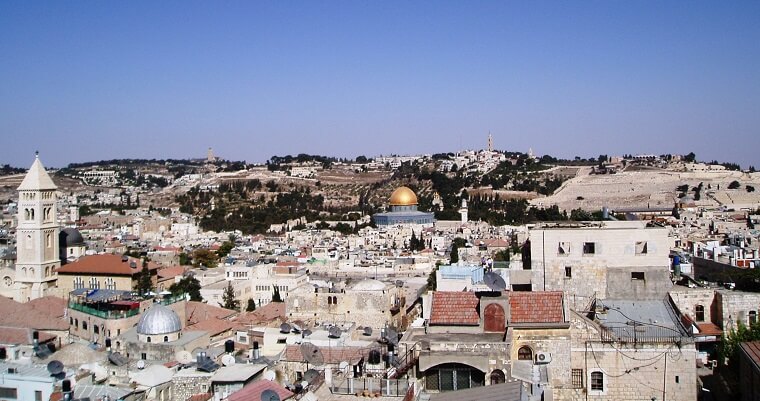
The interplay between a circular space and a linear ray of light, as depicted in Kabbalistic thought, mirrors the geographical layout of Jerusalem. Through the lens of Lurianic Kabbalah, the surrounding mountains of Jerusalem constitute the circular Tehiru, while the east-west axis, marked by the sunrise over the Mount of Olives that casts its initial beam directly onto the Temple entrance, symbolizes the infusion of spiritual light into this circular void. The Temple itself, under this interpretation, acts as the focal point where this divine light is segmented into the ten sefirot, thereby embodying the “ancient of all ancients” or the “Tree of Life.” This conceptual framework suggests that the very topography of Jerusalem and the positioning of the Temple within it are reflective of profound spiritual principles, aligning the physical realm with the divine structure of the universe.
The Temple can be interpreted as follows: The Holy of Holies symbolizes the head, with the divine glory residing between the two cherubim representing the Keter (crown) sefira and the realm above the head. The two cherubim, or the two tablets of the covenant, embody the sefirot of Chokhmah (wisdom) and Binah (understanding), paralleling the two hemispheres of the brain. The main hall of the Temple reflects the upper part of the body, housing the Menorah, which symbolizes the Chesed (kindness) sefira and the right hand; the table of showbread, representing the Gevurah (judgment) sefira and the left hand; and the Altar of incense, corresponding to the Tiferet (beauty) sefira or the heart. The Temple’s entrance area signifies the lower part of the human body, with the two pillars, Boaz and Jachin, denoting the Netzach (eternity) and Hod (splendor) sefirot and the two legs. The entrance and the courtyard of the Temple embody the Yesod (foundation) and Malkhut (kingship) sefirot, symbolizing the feminine and masculine aspects, reflected in the movement and rituals of the Priests within the Temple. The architectural design of the new entrance hall, which is broader than its length, hints at the pelvic area.
In the depths of Kabbalistic study, the heart of the “ancient of all ancients” is identified with the Sefirat Tiferet (glory), situated between Chesed (grace) and Gevurah (judgment). This places the Altar of Incense in a symbolic location between the Menorah and the Showbread table within the Temple. Tiferet represents the harmonization of opposites, balancing the acts of receiving and giving. It embodies the principle of receiving in order to give and knowing the right measure in giving. Therefore, another name for the Sefirat Tiferet is Rachamim (Charity), indicating divine abundance that is bestowed not indiscriminately, but upon those who merit it. The revelation of God’s glory through the Altar of Incense highlights the sense of smell as a direct connection to the divine, echoing the primal state of humanity in Eden.
The Menorah, associated with the Sefirat Chesed, symbolizes the right hand of the “ancient of all ancients,” embodying the act of giving. Therefore, the westernmost candle of the Menorah, positioned closer to the Holy of Holies, is perpetually lit, signifying its connection to divine grace. On the other hand, the Showbread table, linked to the Sefirat Gevurah (judgment), represents the left hand, which is associated with receiving. Consequently, it can be interpreted that the bread, which is renewed weekly, serves to absorb the negative energies present within the Temple.
The entrance to the Temple is flanked by two pillars, Boaz and Yachin, symbolizing the legs of the “ancient of all ancients.” The right leg, represented by the pillar Boaz, corresponds to the Sefirat Netzah (eternity and victory), while the left leg, symbolized by the pillar Yachin, aligns with the Sefirat Hod (majesty and splendor). Netzah extends from the right side of the Tree of Life, in harmony with the Sefirat Chesed (grace), and Boaz embodies “Oz” (valor or strength). Conversely, Hod branches from the left side of the Tree of Life, linked to the Sefirat Gevurah (judgment), with Yachin denoting preparation and establishment.
Beyond the two pillars, Boaz and Yachin, lay stairs leading to the Temple’s entrance. Each morning, the Priests entered the main hall to perform the daily service. Upon completing their duties and exiting, they would stand above the stairs and bestow the Priestly Blessing upon the people. This act was viewed as a positive, outward flow of blessings associated with the Sefirat Yesod—the masculine principle. Conversely, entering the Temple and conducting the daily worship was considered an act of receiving, linked to the Sefirat Malkhut and the feminine principle. The Shekinah, the divine presence, dwelled within the Ezra (courtyard), aligning both the Temple courtyard and the Altar with the Sefirat Malkhut. The Priests’ act of prostration during prayer and sacrifice signified a humbling before the divine, invoking divine abundance—a celestial response associated with Sefirat Yesod. The interplay between Malkhut and Yesod symbolized the connection between the upper and lower worlds, with Yesod representing the heavens and Malkhut the earth, facilitating a dynamic link between the divine and the mundane.
In Kabbalah, the unfolding of the Sacred through the Tree of Life involves four stages, corresponding to four Hebrew terms: Atzilut (emanation), Beriah (creation), Yetzirah (formation), and Asiyah (action). The sefirot of Keter (crown), Chokhmah (wisdom), and Binah (understanding) align with Atzilut and are thus associated with thought processes and the head, symbolized in the Temple by the Holy of Holies. The sefirot of Chesed (mercy), Gevurah (judgment), and Tiferet (beauty) pertain to Beriah, correlating with the thorax and abdomen of the human body, represented in the Temple by the main hall and its vessels.
Netzah (eternity) and Hod (splendor), corresponding to Yetzirah, relate to the creation of forms in the world and are symbolized in the Temple by the entrance hall and the two columns. The activities in the courtyard and at the Temple’s entrance have to do with the world of Asiyah (action), and are associated with Yesod (foundation) and Malkhut (kingdom) sefirot, reflecting the male and female reproductive organs and the pelvis. This worship by humans invokes divine powers, bridging Yesod and Malkhut—the upper and lower worlds. Thus, the Temple can be envisioned as a figure lying along the east-west axis with its head to the west.