This is a rudimentary translation of articles from my book “Touching the Sacred” While it is far from ideal, it serves a purpose given the significance of the topic and the distinctiveness of the information contained. I have chosen to publish it in its current state, with the hope that a more refined translation will be available in the future.
Part Six: Worship in the Temple
The daily rituals in the Tabernacle at Shiloh primarily involved offering sacrifices, and performing religious activities facilitated by the use of various sacred vessels and conducted by the Priests, who were organized into eight shifts. The Levites played a supportive role, tasked with the Tabernacle’s upkeep, though they also resided in their own cities scattered across the land. Notably, certain sacrificial practices were permitted outside the Tabernacle across the country. Following the construction of the Temple by Solomon, these traditional forms of worship continued, albeit with added elements that subtly shifted and enriched the nature of the sacred ceremonies, making them more complex and refined.
Solomon envisioned the Temple as a universal sanctuary, marking its dedication during the Sukkot holiday by offering 70 bulls to represent the 70 nations of the world—one for each nation. This act underscored the inclusive vision behind the Temple’s establishment, reflecting Solomon’s profound wisdom, as evidenced by his mastery of 70 languages, and his extensive connections, including a thousand wives from various nations worldwide.שמג
Before delving into the nuances of Temple worship, it’s crucial to acknowledge that the Temple in Jerusalem was far from being a mere structure; it was a vibrant entity, with worship serving as its animating force. In the following article we will explore the various aspects of the sacred service, including the significance of holidays, the duties of Priests and Levites, the phenomenon of prophecy within the Temple, the tradition of pilgrimage, and more.

The Cosmic drama of sunrise
Sun worship is a fundamental and universal theme present in the rituals of temples across the ancient world, and this practice, in various forms, was also incorporated into the activities of the Jewish Temple. It appears that the Temple in Jerusalem drew inspiration from other sacred architectural traditions, positioning it as the center of the world. This conceptualization allowed the Temple to serve as a stage for reenacting the Creation process and as a model of the cosmos and humanity. Moreover, the Temple’s location, west of the Mount of Olives, played into the cosmic drama of sunrise, being constructed along an east-west axis to face the sunrise over the highest surrounding mountain.
While the Jewish religion traditionally eschews sun worship, incorporating explicit prohibitions against such practices (e.g., sacrifices in the Temple were offered with their back to the sun), there are undeniable references to the importance of the sunrise on specific days of the year, such as the equinoxes. Consequently, the timing and execution of Holidays and daily worship in the Temple were closely aligned with the sunrise, illustrating a nuanced relationship with solar phenomena despite official doctrinal reservations.
The Temple worship routine commenced before sunrise, with the priests of the morning shift rising early to perform their duties. They would cleanse themselves, don their priestly attire, and conduct a thorough inspection of the courtyard to ensure readiness and vigilance among the guards. Lots were cast to determine the tasks for the day, and preparations were made to clean and consecrate the Altar, which was ritually purified for the day’s worship. Necessary tools and offerings, including animals designated for sacrifice, were readied, and the Temple doors were opened in a prescribed manner, always from the inside.
As soon as the watchman on the tower discerned the first rays of sunlight, he called out loudly, “Barkai,” signaling the commencement of worship. The Priests, adhering to their custom of facing away from the sun to signify their reverence solely to God, initiated the slaughtering of the animals and brought forth the Sacrifice to the Altar. Simultaneously, the Priests assigned to the day’s duties entered the main hall of the temple, commencing the Sacred rituals by burning incense and attending to the Menorah’s lamps. Positioned on the platforms before the Temple, the Levites, bearing musical instruments, sang the designated hymn of the day, while the assembled congregation prostrated themselves before the sanctuary, reciting the prayers “Shema Israel” and the “Eighteen blessings prayer.” During the era of the Second Temple, a lamp known as “Queen Helena’s lamp” hung above the Temple’s entrance. As it caught the first glimmers of sunlight, its brilliance radiated throughout the city, signaling the precise moment to commence the prayers and worship.
The recitation of the prayer “Hear, O Israel” at dawn held profound significance, best understood by examining its wording in the Torah. In Deuteronomy 6:4-9, it states: “Hear, O Israel: The Lord our God is one Lord: And thou shalt love the Lord thy God with all thine heart, and with all thy soul, and with all thy might. And these words, which I command thee this day, shall be in thine heart: And thou shalt teach them diligently unto thy children, and shalt talk of them when thou sittest in thine house, and when thou walkest by the way, and when thou liest down, and when thou risest up. And thou shalt bind them for a sign upon thine hand, and they shall be as frontlets between thine eyes. And thou shalt write them upon the posts of thy house, and on thy gates.” (Deuteronomy 6:4-9).
The essence of this prayer lies in its ability to reunite the mind and body after their separation during sleep. Each part of the prayer corresponds to a specific part of the body, facilitating this connection. “Shema” corresponds to the head, while “love” relates to the heart and thus the thorax. “Thou shalt teach them diligently unto thy children” is associated with the abdomen (stomach) and pelvis, emphasizing repetition and deep understanding. Finally, “when thou sittest in thine house, and when thou walkest by the way” pertains to the legs, signifying movement and action.
Indeed, the Temple serves as a symbolic representation of the “ancient of all ancients,” positioned along the east-west axis. In this analogy, the Holy of Holies represents the head, while the entrance to the temple, embodied by the two pillars Boaz and Yachin, symbolizes the feet. If we consider the sun as a representation of sefirat yesod – the masculine principle, then the entrance area, including the space between the two pillars, represents sefirat malkhut. In this context, malkhut serves as the feminine counterpart that attracts yesod.
The ancient world’s temples often aligned with the rising sun on significant days, shaping their worship around this celestial event. The cosmic spectacle of sunrise and sunset served as a metaphor for life’s cycle: birth, death, and the potential for spiritual rebirth. Jerusalem’s Temple, nestled in the valley facing the Mount of Olives, prominently featured a hill with a distinct rock formation, accentuating the significance of sunrise and sunset. Animal sacrifices performed under the first rays of sunlight fused the concepts of death and life. Prayers and hymns sung at dawn underscored the daily renewal of the cosmos.
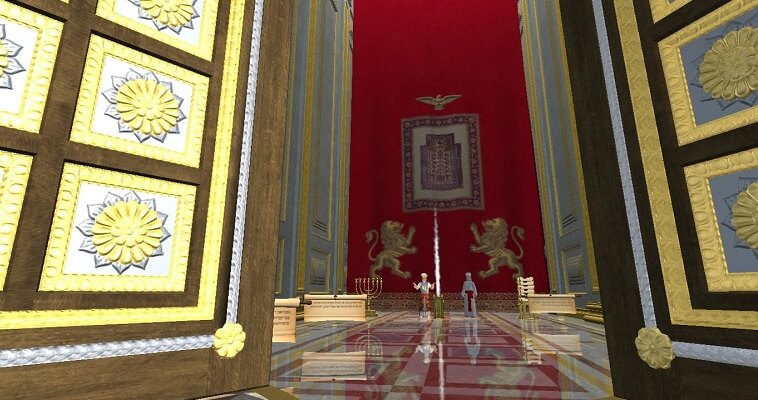
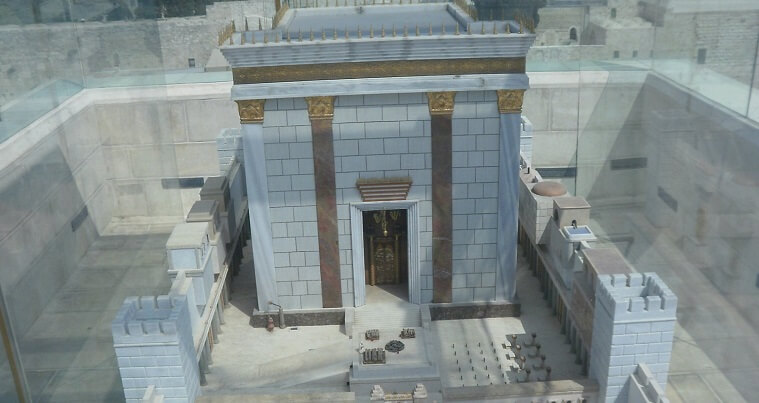
The Temple stood as a permanent fixture, distinguished from the Tabernacle by its grand doors that swung open at sunrise, seemingly welcoming both physical and spiritual light. The rhythm of day and night was accentuated by the opening and closing of these doors, a significant departure from the Tabernacle’s design. Positioned before these doors were steps and two imposing columns, serving as the threshold through which the Priests entered at daybreak to conduct the temple’s daily rituals. With the Priests’ emergence, sunlight flooded in, and upon completing their duties with the sacred vessels, they would step out onto the stairs, extending blessings to the people and the world, facing eastward towards the emerging sun.
However, Judaism makes a clear distinction, affirming it does not engage in sun worship but rather underscores the spiritual primordial light that emanates from the higher sefirot, compared to the light of the sun and moon, which is associated with the sefira of Malkhut. The symbolism of the rising sun marking the beginning of worship is rooted in the interplay between Yesod and Malkhut. As the first rays of the sun illuminate the Temple, it symbolizes the abundant flow from Yesod to Malkhut during Temple worship. The act of worship at sunrise, within a space symbolizing the connection between the linear and the circular, signifies a linkage between heaven and earth.
there are those who expand On this subject, and say that twice a year, on the days of the equinoxes, which fall more or less at the time of the important Holidays of the Jewish calendar – Passover and Sukkot, the doors of the Temple and the doors of the Tabernacle were opened at sunrise, and the first ray of sunshine penetrated into the darkness of the Holy of Holies, illuminated, and perhaps also awakened, the entity that resided between the two cherubim. This is a Sacred architecture tradition that appears in many of Egypt’s Temples, from Abu Simbel to the pyramids, and also in Megalithic Sacred stone circles such as Stonehenge in England and Rujum al Hiri in the Golan Heights. this dramatic occurrence symbolized the fertilization of the female by the male, the union between the two that resulted in the appearance of the Sacred.
The Priests and Levites and the Sacred work
The Priests and Levites were integral figures who served within both the Tabernacle and the Temple, with distinct roles and responsibilities. The Priests were primarily tasked with conducting worship rituals both within the sacred precincts and in the outer courts, which included performing sacrifices. On the other hand, the Levites had a broader scope of duties, encompassing various tasks such as music and singing during worship, guarding the Temple Mount, and overseeing the gates, among others. While sacrifices formed the central aspect of worship, they were complemented by the chanting of prayers, recitation of fixed liturgical texts, and accompanied by reverential prostrations.
The role of the priest in the temple was one of constant service and preparation for worship. The Hebrew word for priest, “Cohen,” contains the word “ken,” meaning “yes” in Hebrew, suggesting that the priest is the one who says “yes” to God’s service. Priests served in the temple in organized shifts, totaling 24, and they wore simple white linen robes adorned with blue or red belts. An ordinary priest possessed four sets of clothing, while the high priest had eight. Each day, priests for the sacrificial service were chosen by lot, with shifts changing weekly.
At the break of dawn, signaled by the call of “barkai” (the first sun ray) by the guard in the tower (likely a Levite), a priest would signal at the temple entrance, prompting others to gather and prostrate themselves before the building. Inside, priests attended to various duties: some tended to the Menorah, replenishing its oil and relighting its wicks, while three others offered incense at the Altar of Incense.
As the Temple’s doors swung open, and the rising sun from aboce the Mount of Olives illuminated the Temple Mount, it signaled the beginning of the daily Sacrifice. After the Sacrifice, the blood was carefully collected in ceremonial vessels and taken to the Altar, where it was either sprinkled on the corners or poured onto its base. A procession of nine Priests, chosen by lot, then carried the different parts of the slaughtered animals, along with wine and semolina batter, to the Altar.The morning Sacrifice, called the “Tamid” (eternal) Sacrifice, consisted of a lamb purchased with public funds and entirely dedicated to God. This offering, performed daily, regardless of weather conditions or seasons, earned its name for its unwavering and constant nature. Another Sacrifice was also offered at dusk.
The Levites served as guardians of the Temple, overseeing its maintenance and assisting in worship, with their most significant role being the singing during Sacrifices. Their melodies elevated the intent of the Sacrifices directly to heaven. Unlike in the Tabernacle, singing by the Levites was a notable addition to Temple worship, highlighting their increased importance in this setting. They lodged in designated chambers within the Temple courtyards, attending to duties such as guarding and cleaning. Some Levites would rise early in the morning, assembling with various musical instruments, including cymbals, trumpets, harps, and violins, and on special occasions, flutes.
As one priest poured out the wine on the outer Altar, another lifted a handkerchief, signaling the Levites to sound trumpets, ring bells, and commence singing psalms. During breaks in the singing, the trumpets would sound again, prompting the onlookers to bow before the Temple and recite the prayer “Hear, O Israel”. Yehezkel Kaufman argues that unlike other ancient Temples, the Temple of Israel maintained an atmosphere of silence, devoid of spoken words. He notes that while there are psalms designated for the Levites, there are none assigned to the Priests, and highlights the absence of singing and music within the Temple itself.
The musical instruments, like all elements within the Temple, held both a mystical power and a symbolic significance: the harp’s 22 strings represented the 22 letters of the Hebrew alphabet, while the ten strings of the violin (lyre) likely symbolized the ten sefirot. Flutes were reserved for Holidays, and trumpets were sounded on special occasions associated with spiritual awakening. Some argue that not only Levites but also Priests and notable figures from Israel participated in the music and singing. The performances were orchestrated on a grand scale, with a choir and orchestra comprising up to six harps, 12 flutes, 120 trumpets, numerous violins, and a single pair of cymbals.
The tradition of sacred singing and music dates back to the days of King David and is not explicitly mandated by the Torah. David, renowned as the “pleasant singer of Israel,” played the harp under the influence of the Spirit, using his music to soothe King Saul’s troubled spirit. He is also credited with composing the psalms found in the Book of Psalms, each accompanied by its own unique melody. Sacred music was a fundamental aspect of worship in the ancient Temples. In Egypt, priestesses of Hathor sang and danced in temples, while Miriam’s songs in the Bible may echo this tradition. Ancient Greece had its sacred Orphic music. However, one could argue that singing and music are innate expressions of humanity, dating back to our earliest ancestors, and naturally intertwined with worship and spirituality.
In addition to sacred music, there exists a tradition of sacred dance, although there is no evidence of such practices within the Temple. Michal’s rebuke of David for his dancing before the Ark of the Covenant may have discouraged such activities. However, in Christian Ethiopia, the tradition of dancing before the Ark of the Covenant has been preserved. It’s possible that similar ceremonies took place in the First Temple as well, but there is no concrete evidence to support this notion.
It can be challenging for modern individuals to comprehend and accept the extensive sacrificial practices that took place in the Temple. To an outsider, it might appear as if the Temple was akin to a large slaughterhouse, constantly permeated with the smell of roasted meat. However, amidst the apparent ritualistic slaughter, there existed a refinement in the form of extensive incense usage on the outer Altar and the offering of incense inside the Temple hall, concurrently with the sacrificial activities outside.
According to spiritual science, energy manifests in three forms: color, sound, and smell. The sacrificial practices outside the Temple, despite their outward appearance, contributed to the purification and sanctification of the material world. This purification enabled the existence of more subtle energies within the Temple itself, allowing for rituals associated with smell, color (light), and silence—the sound of silence being a conduit for connecting with the Divine. Through these refined rituals, individuals could establish a deeper connection with the divine presence.
The stark contrast between the interior and exterior of the Temple must have left a profound impression on the Priests fortunate enough to enter its sacred confines. Only they were privy to the temple’s secrets and experienced the palpable presence of God within its walls. Throughout the Temple’s existence, there were 24 shifts of Priests, compared to the eight shifts during the Tabernacle era, meaning that each shift served in the Temple twice a year for a week. In addition to their regular sacrificial and worship duties, they also facilitated personal sacrifices from the people of Israel during the day and tended to the incense offerings of sacrifices initiated during daylight hours. Alongside the Priestly shifts, there were also 24 Levitical shifts and 24 shifts of Israelite volunteers who assisted with temple operations, such as gathering wood.
The sacrificial rituals conducted in the Temple were deeply intertwined with the narrative of the binding of Isaac, a pivotal moment in the spiritual evolution of humanity. The significance of the Sacrifice of Isaac represents a shift from human sacrifice, prevalent among the Canaanite peoples, to the offering of animals and the sanctification of human life. The Temple itself was erected on the site where God instructed Abraham, “Do not lay your hand on the boy,” and provided a ram as a substitute sacrifice. The act of sacrificial offerings in the Temple mirrored this event, symbolizing a readiness to sacrifice for God with unwavering faith, trusting that all would ultimately unfold for the best.
Additional duties of the Priests
The traditional Priests were descendants of the tribe of Levi, specifically from the lineage of Aaron. According to Menachem Haran, they constituted a unique group within the descendants of Phinehas, Aaron’s grandson, who had earned divine favor by aligning themselves with God during the conflict against the Moabite apostasy that had permeated the Israelite community (Numbers 25:9). These Priests held a distinct status among the populace, akin to the priestly figures in the temples of Egypt and Mesopotamia. It is likely that, like their counterparts, they were involved in occult practices, including methods for tapping into prophetic visions.
The Priests served as intermediaries between the divine presence residing within the Tabernacle and later the Temple, and the people of Israel. They functioned as a gateway to the Sacred, an indispensable component of the Temple’s existence. Consequently, adherence to special laws of purity and lifelong dedication to the service of God were integral aspects of their role, supported by the community. Haran posits that the Priests were inherently imbued with sanctity, their lives consecrated to their sacred duties. Many prophets emerged from the ranks of the Priests or prophesied through their connection—be it physical or spiritual—with the Temple. Examples include Jeremiah and Ezekiel, both counted among the priesthood. Within the Temple, Priests enjoyed the privilege of direct communion with God, particularly the high priest, leading them to regard themselves as superior to prophets outside the priestly lineage.
Traditionally, prophecy constituted a facet of the Priestly role across various ancient civilizations, including Egypt and Greece, often intertwined with manifestations observed during worship rituals. In Egypt, for instance, the movement of the God’s ark in ceremonial processions and the interpretation of Sacrificial entrails in Mesopotamia were linked to prophecy. At the Thracian temple of Dionysus in Perperikon (modern-day Bulgaria), the rising smoke from wine poured onto fire was utilized for prophetic purposes. Similarly, in the Jerusalem Temple, wine was poured onto the Altar during morning services, suggesting a potential avenue for divination through the resulting smoke. While it’s conceivable that hidden signs could have been perceived within the smoke, akin to God speaking from within clouds, this aspect remains conspicuously absent from available Temple records. in fact Hebrew prophecy typically eschewed such methods. This hypothesis is speculative, drawing parallels from other cultural practices.
Prophecy in other cultures often did not hinge on dreams either, prompting the question of whether figures like Joseph, who interpreted Pharaoh’s dream, or Daniel, who dreamed about the fates of Babylonian and Persian kingdoms, should be classified as prophets.
One of the most renowned priest-prophets in biblical history is Ezekiel ben Buzi, known for his mystical vision of ascent. Another significant figure is Ishmael, a high priest from the era of the Second Temple, who underwent a celestial ascent upon entering the Holy of Holies. He is revered as one of the Merkabah mystics. Jewish prophecy, by and large, encompassed wakeful visions or direct communication from God, predominantly focusing on admonition and ethical guidance rather than foretelling the future. Nonetheless, instances of prophecy occasionally entailed mystical encounters, exemplified by Ezekiel’s visionary experience and the literature surrounding the Merkabah.
The pivotal inquiry revolves around the existence of an upper Temple in heaven corresponding to its earthly counterpart, and if so, whether the Priests possessed access to it. Michael Schwartz posits that the Hekhalot literature encapsulates an esoteric doctrine prevalent among priestly circles, potentially stemming from mystical encounters with higher realms. Proximity to the source of Holiness endowed the Priests with knowledge of the celestial hierarchy, including the magical names of angels. Their service within the Temple mirrored the celestial order, akin to the angels’ celestial ministrations and harmonious chants. In essence, they perpetuated the revelation experienced at Mount Sinai, aligning with Moses’s vision of the spiritual Temple and its accompanying vessels amidst the clouds. This conception of priesthood, characterized by divine empowerment and clandestine wisdom, resonated with the Essenes, who perceived themselves as heirs to the priestly legacy. They delved into the secrets of angelic names, botanical properties, and mineral compositions, harnessing Sacred names as a surrogate for Temple rituals.
Maintaining purity was paramount in the lives of the Priests, particularly during the Second Temple era. As Kaufman notes, within the Temple precincts, rituals of purification involved the use of earth and Sacred water, essential for the Priests to cleanse themselves before engaging with the sacred. However, purification extended beyond mere physical cleansing. Over time, spiritual dimensions were incorporated into these rituals, fostering states of spiritual elevation, facilitating mystical voyages, and even nurturing prophetic experiences.
While there may be dissenting views, I believe the Priests served as healers through the act of purifying individuals from impurity. It’s crucial to acknowledge that healing constituted an integral aspect of Temple functions in ancient times. Temples served as centers where people sought solutions to their afflictions, often through dream incubation chambers. Additionally, healer Priests conducted exorcisms and performed magical rites as part of their duties. Merely arriving at the Temple was perceived as a blessing and a stride towards healing, while offering Sacrifices served as a further step toward fulfilling wishes and petitions, including those for healing.
Indeed, Priests in the Jerusalem Temple refrained from practicing medicine for its own sake or engaging in magical medical interventions, and they were not directly involved in healing rituals such as exorcisms. These practices became integrated into Judaism in later periods. Unlike the priesthoods of other ancient cultures, the Israelite priesthood abstained from practical magic. This distinction arose from the monotheistic principles of Judaism, which attributed the existence of evil, including illness, to God. Consequently, the prescribed solution involved prayer, offering Sacrifices, and seeking divine favor, with the Temple serving as the central locus where prayers and Sacrifices were considered acceptable to God.
Undoubtedly, one of the undeniable roles of the Priests was to impart Torah knowledge to the people, serving as both judges and educators. The priestly source, a significant component of the Torah, comprising much of Leviticus and portions of Genesis, Exodus, and Numbers, primarily focuses on religious rituals. However, beyond their religious duties, the priesthood also played a part in crafting moral and prophetic literature, as evidenced by figures like Ezekiel. Consequently, Priests viewed themselves as a privileged aristocracy tasked with leading the people. Particularly toward the end of the First Temple period and throughout the Second Temple era, they perceived themselves as superior to the monarchy and its bureaucratic apparatus. This sentiment was manifest in the establishment of the Sanhedrin, the governing body that convened in the Gazit Chamber within the Temple precincts.
Among the Priests, the high priest held the most esteemed position, regarded as the spiritual heir of Aaron. Traditionally, this office was held by the Zadok family. The high priest donned distinctive garments, including a vest, a breastplate, a turban, a crown, a tunic, and an apron. Adorning the breastplate (Hoshen) were 12 gemstones of varied types, each inscribed with the names of the tribes. These names would illuminate when the High Priest entered the Holy of Holies to seek divine guidance on national matters, thus receiving God’s response. Additionally, on the high priest’s shoulders were two gemstones inscribed with the names of the tribes, while the crown likely comprised a band around the head bearing the inscription “Sacred to Jehovah.” The attire of the high priest, particularly the breastplate, facilitated a connection with the light of prophecy, elevating the high priest to the status of a prophet. However, the experiences and sensations of the high priests when standing in the sanctuary before the cloud – the presence of God – remain a mystery, known to none.

the Holidays
A significant aspect of Temple activities revolved around the observance of holidays and special occasions, including the three Pilgrimages, Rosh Hashanah, and Yom Kippur. The holiday cycle commenced with Rosh Hashanah, which also marked Rosh Chodesh, signifying the beginning of the month and synchronizing the yearly and monthly cycles. Rosh Hashanah was observed on the first day of the month of Tishrei, while Yom Kippur occurred on the tenth day of Tishrei.
Rosh Hashanah holds dual significance as a day of remembrance and a day of calling. It commemorates the creation of the world and involves the calling forth through the blowing of the shofar—the ram’s horn from the Aqidah (Sacrifice) of Isaac. Ezra and Nehemiah transformed Rosh Hashanah into a period of recounting, shaping it into a time for self-reflection and internal introspection. The blowing of the shofar comprises three alternating types of sounds: blasts, broken sounds, and jubilant cries. This ritual is believed to hasten the arrival of the Messiah, stir the dead from their slumber, evoke the memory of Creation, connect humanity to the prophetic tradition, and proclaim God as Sovereign over all creation.
In addition to the shofar, trumpets were also utilized in the Temple, establishing a reciprocal relationship between these two instruments: the shofar’s tones are prolonged, while the trumpets produce succinct sounds; the shofar is adorned with gold, whereas the trumpets are crafted from silver; the shofar is singular, while two trumpets are used; symbolically, the shofar embodies masculine attributes, while the trumpets embody the feminine principle.
Yom Kippur held unparalleled significance in the Temple, serving as the day when the high priest undertook rituals to atone for the sins of the people. It was a day when the Israelites symbolically rid themselves of sin by dispatching the scapegoat into the desert. On Yom Kippur, the high priest assumed the role of humanity in the act of Creation, transitioning divine judgment into divine grace. This concept finds expression in the narrative of Rabbi Ishmael, a high priest who, on Yom Kippur, entered the Holy of Holies and beheld Katriel, the minister of God’s heavenly armies, seated on a lofty throne. Katriel beseeched Ishmael for a blessing, to which Ishmael responded: “May it be Your will, O Lord our God, that Your compassion overcomes Your anger.” (Babylonian Talmud, Berachot 7:1)
Seven days preceding Yom Kippur, the high priest embarked on preparations for the solemn occasion, meticulously studying the laws and maintaining ritual purity. Yom Kippur stood as the solitary day of the year when the High Priest ventured into the Holy of Holies. On the eve of Yom Kippur, he devoted the night to Torah study, abstaining from sleep. Come morning, he underwent ritual ablutions and donned pristine white attire. Engaging in sacrificial rites, he placed his hands upon the head of a bull, symbolically transferring the sins of Israel onto it. The remaining sins were then symbolically dispatched with a goat to Azazel in the desert. Following these ceremonies, he retrieved a censer filled with coals from the Altar and a vessel containing incense, proceeding alone into the Temple. Passing through the veil, he stood in the presence of the Ark of the Covenant. With utmost care, he placed the censer upon the ground without spilling a single ember and sprinkled incense upon the coals. These moments were imbued with an overpowering sense of Holiness, permeating the sanctuary.
The high priest would wait until the incense smoke permeated the entire space of the devir, reminiscent of the cloud that filled the house. Standing in the presence of the Shekinah, he would be unclothed, with no option to retreat. Some accounts suggest a rope tied to his leg, serving as a precautionary measure in case of emergency. As the incense enveloped the devir, God’s presence would manifest in the mist, an awe-inspiring and profoundly sacred moment. Subsequently, the high priest would sprinkle blood from the sacrificial bull onto the Ark of the Covenant, collected the censer, and exited the Temple. He would then sprinkle blood on the curtain and the Temple vessels, offer prayers for Israel before the curtain, and depart from the Temple.
Despite our knowledge of the physical actions undertaken by the high priest during the ritual, the inner workings and communication methods remain shrouded in mystery. The nature of the priest’s communion with the divine, the manner in which he received instructions from God, and other such aspects remain elusive to us.
Following the conclusion of the worship within the Temple, the high priest would engage in teaching Torah. Simultaneously, the azazel goat would be led to the Judean desert and cast from a cliff. Subsequently, the remains of the goat’s body were brought back to the Temple to be incinerated alongside the remains of the sacrificial bull from the morning, purging any residual impurity from these sacrificial animals. As the day drew to a close, the young women of Jerusalem would partake in joyful dancing. Additionally, once every fifty years, during the jubilee year, slaves would be emancipated, adding an extra layer of significance to the day’s observances.
The Sukkot holiday, also known as the Festival of Tabernacles, spanned from the 15th to the 21st of Tishrei. It is reasonable to infer that those undertaking the pilgrimage to Jerusalem during this time sought to participate in all three Tishrei holidays, endeavoring to be present not only for Sukkot but also for Yom Kippur, given its significance, along with the other holidays. Sukkot served as a holiday of gathering, joy, and gratitude. People would dwell in sukkot, temporary shelters, to commemorate the wanderings of the Israelites in the desert. Additionally, 70 cows were sacrificed in honor of the nations of the world, symbolizing the inclusivity of Sukkot and its openness to other peoples. Thus, Sukkot emerged as a holiday that extended the reach of Judaism beyond its borders.
During the Sukkot holiday, pilgrims brought with them the four species: the etrog (citron), lulav (palm branch), hadass (myrtle branch), and aravah (willow branch), bundling them together as prescribed by the mitzvah of taking the lulav. They carried these items with them everywhere they went throughout the holiday. As part of the ritual, they circled the Altar for the duration of the seven days of the holiday, holding the four species in their hands and reciting the plea, “Please God, save us.” Over time, a specialized method of moving the four species during prayer developed. The willow branches were Pounded into the ground, requiring a significant quantity of willows, which were sourced from locations in close proximity to Jerusalem, particularly from Motza.
During the night, especially if it wasn’t Shabbat, they observed Simchat Beit HaShoeivah (the rejoicing of the Water-Drawing House) with lively music and dancing. Water drawn from the Shiloh pool was poured onto the Altar during this celebration. Surprisingly, this act of pouring water substituted the customary pouring of wine and sprinkling of blood on regular days, and it was believed to bring about abundant rainfall during the winter months. Many Temple rituals, including those involving the ashes of a red cow and Simchat Beit HaShoeivah, required drawing water from a nearby spring, underscoring the significance of the Gihon spring in Jerusalem. The Priests joyfully drew water, accompanied by the sound of trumpets and the placement of long willow branches on the sides of the Altar. As the water was poured onto the Altar, Levites provided musical accompaniment while the Israelites danced and rejoiced. These were indeed joyous days to be in Jerusalem.
During the Temple era, the celebration of Simchat Torah (Torah celebration done n the eighth day) did not occur in the manner we observe it today. This practice emerged later, during the period of the Geonim in Babylon. Instead, a unique tradition took place at the conclusion of every seventh year, known as the Shemita (sabbatical year). During this time, the King would read a series of passages. Shemini Atzeret (Eighth day of Assembly) was characterized by Sacrifices and the lighting of a bonfire. The smoke from this fire was believed to foretell the rains of the forthcoming year.
Pesach, also known as Passover or the Festival of Unleavened Bread, was synonymous with Sacrifice and drew the largest number of pilgrims to Jerusalem. It was a time when each family Sacrificed the Passover offering on the eve of Passover and consumed it together in communal gatherings of 10-20 people on the holiday night. The Sacrifice was hastily roasted, reminiscent of the Exodus. After the meal, participants would ascend to their rooftops to sing praises to God. Although there was no Passover Haggadah at this time, children would ask questions to which adults would respond. They would partake in drinking four cups of wine and eating unleavened bread, which likely differed from the unleavened bread (matzah) used in modern times.
During Pesach, pilgrims had the opportunity to behold some of the Temple’s treasures and vessels, including gold tables and other decorations. Another significant custom during this holiday was the “Omer.” As part of this ritual, the first grains of barley were gathered and roasted in the Temple. Oil and barley were poured over them, and the mixture was then incensed on the Altar. This marked the commencement of the counting of the Omer, a period of seven weeks leading up to the full harvest of wheat on Shavuot, the Festival of Weeks.
Shavuot was the time when the wheat and barley harvests concluded or were nearing completion. Wheat, being a primary staple in ancient times, warranted expressions of gratitude for its ripening. The essence of Shavuot lay in presenting two large loaves of bread crafted from the newly harvested wheat as an offering of thanks. Offerings of first fruits and plant offerings were initiated at this time. They served a dual purpose: to atone for the sin of the spies and to extol the virtues of the land. The ceremonial waving of the first fruits at the entrance of the Temple, accompanied by the recitation of verses such as “Land of milk and honey…”, was followed by placing the offerings in a corner of the Altar, with worshippers bowing before the Temple steps. Pilgrimages to Jerusalem and offerings of first fruits and harvest continued beyond Shavuot. However, five of the seven species—vine, fig, pomegranate, olive, and date—ripened later in the summer. As a result, their first fruits were presented at the Temple during Sukkot and likely on the ninth of Av, both significant celebrations.
The Hebrew Holidays are intricately linked with the agricultural seasons, yet they also align with significant solar events observed by other ancient civilizations, namely the equinoxes, when day and night are of equal length. The lunar Hebrew calendar was adjusted to synchronize with the solar cycles of the year by intercalating an additional month every two or three years. As a result, Passover typically falls around the vernal equinox, beginning on March 21st, while the cluster of Tishrei Holidays occurs around the autumnal equinox, commencing on September 21st.
Zvi Shua suggests a correlation between the Hebrew Holidays and the ancient practice of sun worship during the longest and shortest days of the year. For instance, the celebration of Hanukkah falls on the first day of Tevet, which coincides with the shortest day of the year, December 21st. Shua proposes that Hanukkah is rooted in an earlier holiday that has since faded from memory.
Similarly, the worship of the Mesopotamian Canaanite God Tammuz was observed among the Israelites on the first day of Tammuz, which aligns with the longest day of the year, June 21st. This practice is referenced in Ezekiel 8:14, where women are depicted mourning the God Tammuz at the entrance of the north gate of the house of the Lord. However, the prophet’s condemnation of pagan worship led to the eradication of any remembrance of this holiday.

Pilgrimage
The Temple served as a crucial Pilgrimage site for the Israelites, as commanded in the Torah, requiring them to visit it three times annually. “Three times a year all your men must appear before the Lord your God at the place he will choose: at the Festival of Unleavened Bread, the Festival of Weeks, and the Festival of Tabernacles. No one should appear before the Lord empty-handed” (Deuteronomy 16:16). Apart from these three designated Pilgrimages, individuals were also expected to make personal visits to the temple on special occasions, such as expressing gratitude for the birth of a child or offering a Sacrifice for guilt or sin. Moreover, they had the liberty to visit the temple whenever desired. The primary objective was to stand before God and immerse oneself in Holiness, thereby receiving the essential spiritual nourishment for daily life.
According to Otto Rudolph, there exists a distinct type of emotion that manifests solely within the Religious sphere, which he termed “the numinous.” Words like sublime, exalted, awe, wonder, and majestic hold significance exclusively within this context. However, Rudolph’s conception of the numinous does not pertain solely to formal religion but rather encompasses a sensation of encountering something greater than oneself, such as the awe-inspiring power of nature. In this state, individuals surrender themselves and merge with this greater force, thereby establishing a connection with the eternal and Sacred realm of existence, as well as tapping into the loftier aspects of their own being.
The spiritual essence of Pilgrimage transcended mere adherence to instructions or physical travel. It was not a mechanical process, but rather a transformative journey that lifted individuals out of their everyday routines and facilitated a connection with the Sacred through a specific place and time. Pilgrimage served as a path to evoke feelings of the sublime and exalted. The pilgrimage journey was one of sanctification, beautifully articulated in psalms attributed to David. These psalms, sung by pilgrims, express the profound reverence and longing the Israelites felt towards the Temple and its sanctity upon arrival or contemplation:
“You, God, are my God, earnestly I seek you; I thirst for you, my whole being longs for you, in a dry and parched land where there is no water. I have seen you in the sanctuary and beheld your power and your glory.” (Psalms 63:1-2)
“My soul yearns, even faints, for the courts of the Lord; my heart and my flesh cry out for the living God.” (Psalms 84:2)
“One thing I ask from the Lord, this only do I seek: that I may dwell in the house of the Lord all the days of my life, to gaze on the beauty of the Lord and to seek him in his temple.” (Psalms 27:4)
These lines encapsulate the sentiments of pilgrims returning to their spiritual home and the joy that accompanies such a journey. Arriving at the Temple and experiencing its inherent Holiness was akin to finding living water in a desert for a thirsty traveler. The sacred atmosphere within the Temple facilitated a connection with the divine essence within oneself. It is important to acknowledge that pilgrims embarked on the journey to Jerusalem multiple times throughout their lives. It can be presumed that this experience was pivotal, a moment when they felt the possibility of something greater, imbued with meaning and purpose. It instilled a sense of goodness and justice in the world and a feeling of being cared for by a higher power. Consequently, they yearned for those moments.
The experience that pilgrims had in the Temple provided them with comfort and assurance, imbuing them with strength and courage to confront life’s challenges upon returning to their villages. They understood that God resided in Zion and that in times of trouble and distress, even if only in spirit, they could find salvation and assistance there. In their eyes, the Temple served as a sanctuary from enemies and tribulations, from droughts and natural calamities, famines and wars—a place where individuals could pour out their hearts and make requests before God, knowing that God would listen.
The verses in Psalms convey the essence of the Sacred, although incompletely, as it is impossible to truly capture love without experiencing it firsthand. The taste of honey cannot be adequately described. However, what can be articulated is the manner in which one approaches the Sacred: “Lord, who may dwell in your Sacred tent? Who may live on your holy mountain? The one whose walk is blameless, who does what is righteous, who speaks the truth from their heart; whose tongue utters no slander, who does no wrong to a neighbor, and casts no slur on others; who despises a vile person but honors those who fear the Lord; who keeps an oath even when it hurts, and does not change their mind; who lends money to the poor without interest; who does not accept a bribe against the innocent. Whoever does these things will never be shaken.” (Psalms 15:1-5).
The Temple is revered as a sanctuary of purity, beauty, and order, evoking devotion, readiness, wonder, and awe. It is a place that illuminates the virtuous qualities in individuals, where the righteous feel at home, and those who are not righteous aspire to improve themselves: “Who may ascend the mountain of the Lord? Who may stand in his holy place? The one who has clean hands and a pure heart, who does not trust in an idol or swear by a false god. They will receive blessing from the Lord and vindication from God their Savior.” (Psalms 24:3-5).
During the Pilgrimage, they would recite, “I rejoiced with those who said to me, ‘Let us go to the house of the Lord.'” (Psalms 122:1-2). Upon arriving in Jerusalem, they would continue with the subsequent verse, “Our feet are standing in your gates, Jerusalem.” When reaching the Temple Mount, they would recite the opening verse of Psalm 150: “Praise God in his sanctuary,” and upon entering the ezra, they would conclude with the final verse of this magnificent song, praising God with drum, dance, organ, harp, violin, and more: “Let everything that has breath praise the Lord. Hallelujah.”
The pilgrims were warmly received by the inhabitants of Jerusalem and accommodated in the homes of the city’s residents at no cost, at least officially (the pilgrims often presented gifts to their hosts). Upon reaching Jerusalem, they underwent purification from impurity in designated purification facilities. A crucial purification ritual involved the burning of the red heifer on the Mount of Olives, with the ashes mixed into water from the Gihon Spring to cleanse impurity associated with death. Water from the Shiloh pool was transported to specific locations for these purification ceremonies.
The extensive preparations and adherence to purity laws were integral to the understanding that the Pilgrimage to the Temple, during its existence, served as a process of personal and national rectification. The purification and preparation process for entering the Temple typically spanned about a week. At its conclusion, the pilgrims would ascend to the Temple through the Huldah gates, where they were greeted by the Temple attendants and artisans. Upon arrival, they would remove their shoes and enter the Ezra with the sacrifices they intended to offer before God.