The five Luminous Mysteries
In the original rosary practice, as received by Saint Dominic in a legendary apparition of Mary, there were only 15 mysteries encompassing joy, sorrow, and glory. Notably absent were the five Luminous Mysteries. It wasn’t until the year 2000 when Pope John Paul II introduced these additional Mysteries. He explained that he felt the rosary lacked reference to the significant events occurring between Jesus’ baptism in the Jordan and his passion—a span of three years during which Jesus ministered on Earth, teaching and performing miracles. Seeking to incorporate these pivotal moments, John Paul II expanded the rosary to encompass the complete life cycle of Jesus. It’s noteworthy that a gap remains between Jesus’ adolescence, when he was found at the temple at age 12, and his adulthood at age 30, when he begins his ministry after being baptized by John the Baptist in the Jordan. During this period until the Passion, we have relatively detailed accounts of Jesus’ actions, particularly the miracles he performed and the lessons he imparted. The Luminous Mysteries encapsulate five of the most significant events from these years.
The Luminous Mysteries symbolize the period when divine illumination graced the world. This terminology draws from Jesus’ proclamation that he is the “light of the world” (John, chapter 1). The association with light echoes ancient beliefs, where the sun represented divinity, as Jesus mirrors the cyclical nature of the sun—dying and rising anew each day. This concept reflects a historical convergence: elements of ancient sun worship became intertwined with Christianity during the 4th century, under Emperor Constantine’s reign when Christianity gained recognition and adoption within the Roman Empire. Similar to depictions of sun gods, Jesus is often depicted with a halo, churches are traditionally oriented eastward, toward the rising sun, and Jesus’ birth date was aligned with December 25, believed to coincide with the birth of the sun god Mithras on the shortest day of the year.
Indeed, beyond the tangible light lies a realm of spiritual illumination. In mystical Christianity, there exists a belief in a spiritual light, transcending the physical sun. According to the Genesis creation narrative, while the sun was created on the fourth day, light itself already permeated the world from the very beginning. This primordial light holds a spiritual significance, representing the emanations of the divine into the spiritual realms, a concept also found in Kabbalah. The spiritual light is known in Christianity as “the light of Mount Tabor,” it represents the true essence of Jesus.
In Christian paintings depicting the birth of Jesus, a common motif is a ray of light emanating from the star, entering the infant as he enters the world. This light, initially white, transforms into blue and gold hues surrounding the newborn. Conversely, in depictions of Jesus’ resurrection (and his transfiguration on Mount Tabor), the blue and gold hues around his body shift into a brilliant white aura, symbolizing the return of spiritual light—emanations of God—to its divine source. White signifies spiritual illumination, while yellow (gold) and blue represent physical light, akin to the hues seen in the sky. In the tradition of iconography and church painting, light manifests in two forms: one linked with the physical world and the sun’s light, and the other with the spiritual realms and the hidden light. Similarly, fire, the source of light, holds a dual nature: it consumes, operates within the temporal and physical world, yet simultaneously emits eternal light, transcending the boundaries of the universe. This duality in the nature of light and fire reflects a deeper theological concept—the dual nature of Jesus, both human and divine. It prompts reflection on our own dual nature as beings existing in both the physical and spiritual realms.
The Luminous Mysteries are miraculous appearances of the divine that can transform us from the physical world to the spiritual world, preparing us for death and offering a means to overcome it. They serve as bridges between worlds, where the eternal and sacred intersect with the temporary and mundane. The mystery of baptism is a kind of new birth, following which the Holy Spirit joins Jesus and the human race as a whole. The wedding at Cana Mystery enables the refinement and development of substance from water to wine, symbolizing possible transformation within a person. The Mystery of Proclamation of the Kingdom of God is related to the appearance of Jesus as a divine being on Earth. The Mystery of Transfiguration on Mount Tabor means the appearance of the Kingdom of Heaven and the Son of God (part of God) here on Earth, an appearance that paves the way for the redemption and resurrection of the human race. The Institution of the Eucharist Mystery (the bread and the wine) at the Last Supper enables a transition from physical existence to spiritual existence, with Jesus remaining on Earth spiritually, and produces the ability to summon him at any time through a magical ritual.
It’s evident that all the Luminous Mysteries involve a transformation of form or state, a characteristic of the Sacred—a connection between different levels of existence, the Sacred and the Profane. However, the role of Mary in these events raises questions. While her presence and central role at the wedding in Cana are clear, she is not mentioned in the plain reading of the New Testament in the other events. Mary was not present at the Transfiguration, did not participate in the Last Supper, was absent during Jesus’ baptism by John the Baptist, and was not among the disciples and the crowd at the Sermon on the Mount and the proclamation of the Kingdom of Heaven. However, it’s worth considering whether, despite not being explicitly mentioned, she was present in some mystical or karmic way at these events. Even if not physically present, perhaps she was connected to these events in a deeper, spiritual sense. As someone who knew Jesus intimately, Mary may offer insights that help us understand these mysteries better.
It’s plausible that Mary may have been present at some of the Luminous Mysteries events, such as the Sermon on the Mount and the Last Supper, despite not being explicitly mentioned in the biblical accounts. Given her close relationship with Jesus and her role as the leader of the early Christian community following his death, it’s conceivable that she played a significant role in instituting sacraments like baptism and the Eucharist. Furthermore, as someone who intimately knew her son and recognized the presence of the Kingdom of Heaven in him, Mary’s insights and actions could have profound implications for understanding these mysteries.
Delving deeper into the mysteries, a profound connection to Mary indeed emerges. Starting with the Baptism Mystery, the act of being baptized in water symbolizes a new birth—a concept that Mary, as the mother of Jesus, would understand intimately. The dove, representing the Holy Spirit, is also a symbol of the Holy Feminine. If we view Mary not only as a historical figure but also as a representation of motherhood and the divine Feminine, it follows that she would have been imbued with the Holy Spirit even before Jesus’ birth. Thus, what resided within Mary would have been transferred to Jesus at the time of his baptism. Some even argue that the Holy Spirit could be identified with Mary herself, proposing her as the third aspect of the divine triangle alongside the Father and the Son—Father, Son, and Mother—rather than the traditional Father, Son, and Holy Spirit trinity. This perspective sheds new light on Mary’s role in the divine plan and her profound connection to the mysteries surrounding Jesus’ life.
The institution of the Eucharist was established to “remember” Jesus and to foster a connection with him. This act is inherently linked to Mary, as she most profoundly embodies the act of remembering him after his death. Moreover, she played a pivotal role in guiding the nascent Christian community, thereby preserving and perpetuating his spiritual heritage. The Acts of the Apostles (1:14) mentions, “These all continued with one accord in prayer and supplication, with the women, and Mary the mother of Jesus, and with his brethren,” indicating Mary’s significant position within the inner circle of disciples, possibly even as their leader following Jesus’ death. It’s plausible that she was present during the Last Supper, which Catholics recognize as the Passover meal. Although she might not have been seated at the table, she was likely in a nearby room with other women, possibly preparing the meal, since it’s unlikely that Jesus or the disciples would have undertaken this task. Mary’s presence at the crucifixion, less than 24 hours after the Last Supper, underscores her close proximity to Jesus and the disciples in Jerusalem during these pivotal events.
The Proclamation of the Kingdom of God occurred in Galilee before the wedding at Cana. Given Mary’s presence with Jesus at the wedding, and her subsequent efforts to find him with his brothers, it stands to reason she was nearby when he initiated his ministry in Galilee. Considering their close bond, it’s improbable that she wasn’t among the large crowd at the Sermon on the Mount or that she didn’t encounter Jesus during the three years he spent teaching, performing miracles, and working not far from Nazareth. While she may not have witnessed the Transfiguration on Mount Tabor, as the Mother of God who experienced a miraculous conception, Mary was intimately aware of Jesus’ divine nature. Her unique connection to him meant she didn’t need to ascend a mountain to recognize this truth.
It’s fascinating to note that in Hebrew, the word “Or” (אור), meaning light, shares a gematria value with “Raz” (רז), meaning mystery. In Jewish Kabbalah, the material world is perceived as enshrouded in darkness, with spirituality acting as a beacon of light piercing through this veil. The spiritual realms, or the Emanations of God, serve as vessels to contain and channel this divine light. This perspective positions Jewish-Christian mysticism predominantly as a mysticism of light. This thematic dichotomy of light versus darkness is not only a cosmic battle but also mirrors the internal struggles within each individual, emphasizing the concept of illumination—both literal and metaphorical—as a means of revealing and combating the mysteries and challenges of existence.
The Luminous Mysteries usher us into a realm often referred to as the “Kingdom of Heaven.” Initially, it may seem that the Transfiguration on Mount Tabor is the quintessential Luminous Mystery, where Jesus is seen radiant in light and a voice from heaven declares, “This is my Son.” However, the Proclamation of the Kingdom of God holds equal significance, marking the manifestation of the kingdom of heaven. This revelation first manifests with Jesus’ baptism in the Jordan, becomes evident through his initial miracle at Cana, and achieves full expression in the Institution of the Eucharist. The Eucharist facilitates the enduring presence of Jesus in Spirit, thereby actualizing the Kingdom of Heaven on earth within the Christian community.
Chronologically, the Joyful Mysteries come first as they relate to the childhood of Jesus. Following these, the Luminous Mysteries depict the maturity of Jesus, illuminating key moments of his public ministry. The Sorrowful Mysteries are third, focusing on the Passion and the final days of Jesus on earth. Lastly, the Glorious Mysteries follow, reflecting on the events after Jesus’ death and resurrection, celebrating the triumph of eternal life.
Geographically, three of the five Luminous Mysteries are linked to locations in the Galilee: the wedding at Cana, the Proclamation of the Kingdom of God on Mount Beatitude, and the Transfiguration on Mount Tabor. The other two mysteries involve the baptism site near the Jordan River close to Jericho, and the Church of the Nativity in Bethlehem. In contrast, most of the other mysteries of the Rosary are centered around Jerusalem or its vicinity. This distribution presents a unique challenge for those wishing to undertake a pilgrimage that encompasses the sites significant to the Rosary mysteries, highlighting the geographical spread of these sacred events across different parts of the Holy Land.
In crafting an itinerary that aligns with the Rosary’s geographical context, ideally, one would link the sites in Galilee. However, following the Rosary’s order necessitates visiting Galilee twice: initially at the start and again midway through the journey. It’s advisable to begin at the Annunciation’s site in Nazareth, proceed to the Visitation’s location in Ein Karem, move on to the Church of the Nativity in Bethlehem, and then visit the potential sites in Jerusalem’s old city associated with the Presentation in the Temple and the Finding in the Temple, as this book suggests.
The recommended continuation of the itinerary involves leaving Jerusalem to visit the baptism site near the Jordan River close to Jericho, then journeying back to Galilee to explore the site of the Proclamation of the Kingdom of God on Mount Beatitude, the wedding location in Cana, and the site of the Transfiguration on Mount Tabor. Following these visits, the route circles back to Jerusalem to the site of the Institution of the Eucharist on Mount Zion, and proceeds to other Jerusalem sites related to the Sorrowful and Glorious Mysteries. Although this path is lengthier and more complex, adhering to the chronological sequence enriches the understanding and connection to the story of Mary and Jesus significantly, revealing hidden aspects within their narrative, particularly through the sequence of events. This pilgrimage, by retracing Jesus’ movements from Galilee to Jerusalem and back, offers a profound experience of Jesus’ dual nature as both divine and human, and his role in bridging the earthly and the divine realms. As the adage goes, “learn through our feet,” implying that the physical act of following this sequence adds depth to the pilgrimage’s meaning.
The Baptism of Jesus in the Jordan Mystery
The fruit of the Mystery is openness to the Holy Spirit and healing
The baptism of Jesus in the Jordan stands as a monumental event in world history and a cornerstone of Christian faith and liturgy. It is at this moment that the Holy Spirit descends upon Jesus, marking the completion of the sacred trinity of the Father, the Son, and the Holy Spirit. With the descent of the Holy Spirit, Jesus is imbued with his earthly mission. As the heavens part, a voice is heard proclaiming: “Thou art my beloved Son, in whom I am well pleased”. The fruit of thinking about the baptism tap is openness to the Holy Spirit and healing. And so it is written in the New Testament: “John did baptize in the wilderness, and preach the baptism of repentance for the remission of sins. And there went out unto him all the land of Judaea, and they of Jerusalem, and were all baptized of him in the river of Jordan, confessing their sins. And John was clothed with camel’s hair, and with a girdle of a skin about his loins; and he did eat locusts and wild honey; And preached, saying, there cometh one mightier than I after me, the latchet of whose shoes I am not worthy to stoop down and unloose. I indeed have baptized you with water: but he shall baptize you with the Holy Ghost. And it came to pass in those days, that Jesus came from Nazareth of Galilee, and was baptized of John in Jordan. And straightway coming up out of the water, he saw the heavens opened, and the Spirit like a dove descending upon him: And there came a voice from heaven, saying, thou art my beloved Son, in whom I am well pleased.” (Mark 1:4-11).
The Baptism of Jesus in the Jordan is a significant event recounted in all four Gospels of the New Testament. While the accounts in Matthew and Luke are similar to that of Mark’s, John’s narrative introduces additional elements, saying thus: “The next day John seeth Jesus coming unto him, and saith, Behold the Lamb of God, which taketh away the sin of the world. This is he of whom I said, after me cometh a man which is preferred before me: for he was before me. And I knew him not: but that he should be made manifest to Israel, therefore am I come baptizing with water. And John bare record, saying, I saw the Spirit descending from heaven like a dove, and it abode upon him. And I knew him not: but he that sent me to baptize with water, the same said unto me, upon whom thou shalt see the Spirit descending, and remaining on him, the same is he which baptizeth with the Holy Ghost. And I saw, and bare record that this is the Son of God.” (John 1:29-34).
The baptism of Jesus marks the first significant event that is consistently featured across all four Gospels, establishing a rare moment of unity among them. In the synoptic Gospels—Matthew, Mark, and Luke—the Holy Spirit is described as descending like a dove, accompanied by a voice from heaven proclaiming Jesus as the beloved Son of God, in whom He is well pleased. This event raises several intriguing questions: What does it mean for Jesus to please God, especially considering He was sent by God? How can God have a Son, and why would Jesus, being divine, need to be baptized?
The role and significance of John the Baptist in this mystery cannot be overstated. John was a recognized, prominent figure of his time, living and working during Jesus’ era at the end of the Second Temple period, even mentioned by the historian Josephus Flavius. Viewed as a prophet, John’s ministry marked the resurgence of prophecy in Israel. However, John was not just any prophet. For Christians, he is seen as a manifestation of Elijah the prophet, akin to a “reincarnation.” The name John itself means “Jehovah Has Forgiven,” symbolizing that the path to salvation lies in God’s pardon and forgiveness. This divine forgiveness heralds the return of prophecy to Israel and the forthcoming arrival of the Messiah.
The book of Malachi, the final book in the collection of the prophets, concludes with a poignant promise: “Behold, I will send you Elijah the prophet before the coming of the great and dreadful day of the Lord” (Malachi 4:5). This prophecy sets the stage for a significant moment in the New Testament. After descending from Mount Tabor, following the Transfiguration, the disciples question Jesus about the expected arrival of Elijah before the Messiah, as prophesied. Jesus clarifies that Elijah has indeed come, but his presence was unrecognized by many. He reveals that John the Baptist fulfilled the role of Elijah, stating: “But I say unto you, That Elias is come already, and they knew him not, but have done unto him whatsoever they listed. Likewise shall also the Son of man suffer of them. Then the disciples understood that he spake unto them of John the Baptist” (Matthew 17:12-13).
Jesus speaks highly of John the Baptist, declaring that among men, there is none like him—none before and none to come. In this way, John’s role is somewhat parallel to Mary’s, as his existence facilitates the coming of the Son of God into the world. This pivotal role is often reflected in iconography, where John is depicted alongside Jesus, with Mary on the opposite side, emphasizing the integral part he plays in the divine narrative. John the Baptist’s core mission is to herald and prepare the way for Jesus through the act of baptism. He baptizes with water, setting the stage for the one who will follow—baptizing with fire and the Holy Spirit, marking a transition from the physical to the spiritual, from purification to empowerment and renewal.
The fundamental principle of baptism is preparation through purification, a concept that transcends time and is perpetually relevant. This preparation for divine encounter is mirrored in Judaism through the anticipation of the Messiah, a practice notably embodied by the Judean desert sects like the Essenes, who engaged in regular ritual cleansing and baptism in the Miqveh. The Essenes were known for their continual baptisms and purifications as part of their spiritual discipline. However, John the Baptist introduced a significant evolution in the concept of baptism. His approach transcended mere ritualistic practice by incorporating a call to repentance, marking a departure from traditional Jewish baptism. While Jewish baptism aimed at cleansing physical impurity, John’s baptism sought to purify individuals from spiritual impurity. This distinction highlights a deeper, more introspective process of preparation, emphasizing not just the external but the internal transformation necessary for the coming of God.
John the Baptist’s baptism is recognized as a pathway to the forgiveness of sins, whereas the baptism of Jesus introduces a further dimension—baptism not just in water but also in the Holy Spirit. The Baptism of Jesus is a pivotal moment that culminates in the heavens opening and the Holy Spirit descending to Earth, thereby forging a link between the divine and the mortal realms. The profound significance of this event lies in the newly opened avenue for humanity to receive the Holy Spirit, offering opportunities for healing and integration into the church. Given that Jesus is divine, the Holy Spirit was inherently with him prior to his baptism. The act of the Holy Spirit joining him during his baptism signifies the initiation of a pathway for humanity at large to welcome the Holy Spirit. This moment marks a transformation in the spiritual state of the world. Hence, baptism emerges as the inaugural sacrament of Christianity, symbolizing not just the purification and rebirth of the individual but also the advent of the Messiah. Through this sacrament, the church embraces its members into a new life, imbued with the Spirit’s presence and grace.
The Baptism of Jesus in the Jordan River carries profound symbolism associated with water, emblematic of birth and feminine qualities. Analogous to a baby enveloped in the womb’s waters before birth, the act of emerging from water signifies a new beginning. Similarly, as Jesus rises from the Jordan’s waters, the Holy Spirit descends upon him in the form of a dove, marking a rebirth. This imagery of rebirth is echoed in the Sacrament of Baptism for believers, symbolizing their new life in faith. Water’s significance extends beyond this event, as it is consecrated in the church as holy water. This sanctified water is used to sprinkle believers on various occasions, reinforcing its spiritual importance. Jesus’ miracles frequently involve water, such as turning water into wine and walking on water, highlighting its central role in his ministry. Within Christian esoteric traditions, there’s a belief that Jesus infused the world’s waters with healing energy. Consequently, springs known for their physical and spiritual healing properties have emerged, according to this perspective, underscoring the mystical and curative dimensions of water in Christian faith.
The place of baptism
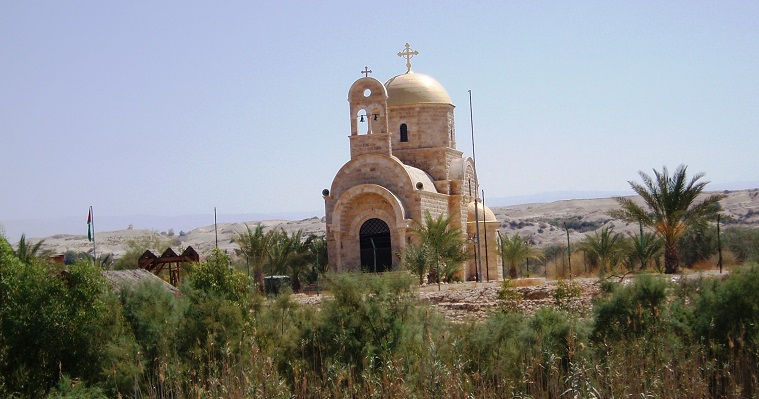
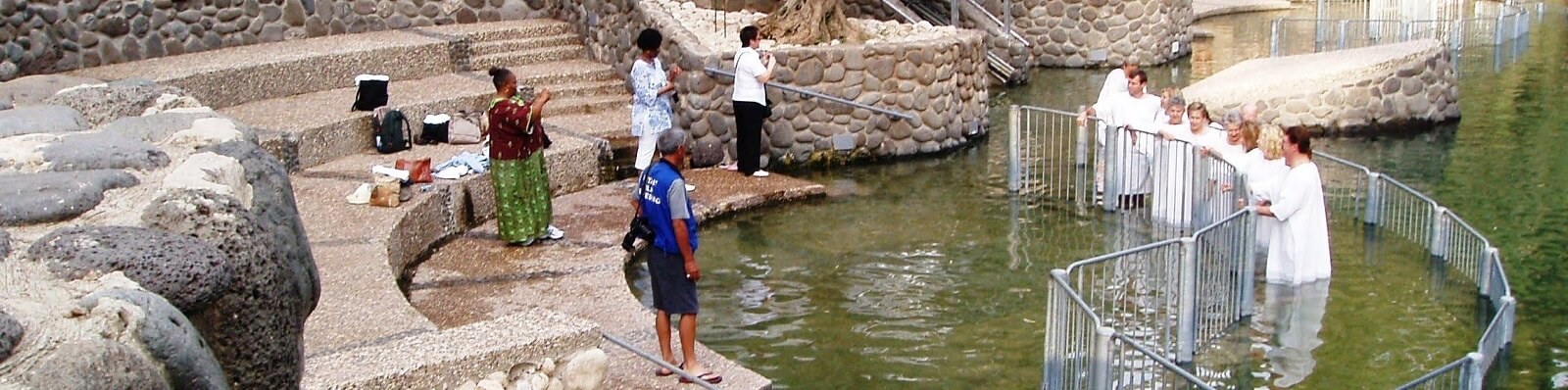
According to the New Testament, Jesus was baptized in the Jordan River, but the exact location along this extensive river, which flows from Mount Hermon in the north to the Dead Sea, is not specified. The Gospel of John mentions Beit Arava, though this reference is likely about the Jordan River crossing rather than a specific settlement by that name. Over time, the baptism site came to be associated with the Jordan River crossings near Jericho, at a place now known as “Qasr el Yahud.” This association may be attributed to its proximity to Mount Nebo, the site where Moses is said to have seen the Promised Land before his death. By the end of the 4th century, a pilgrimage route had been established linking Jerusalem, Qasr el Yahud, and Mount Nebo. Over the years, additional traditions have cemented the significance of this location, including its identification as the site of Joshua’s crossing of the Jordan and Elijah’s ascension to heaven. However, from a religious standpoint, believers can perform baptisms anywhere along the Jordan River. The most popular contemporary site for baptisms, particularly due to its closeness to the Sea of Galilee, is “Yardenit,” located at the river’s exit from the lake near Tzemach Junction.
West of the baptism site, the cliffs above Jericho are visible, where the Deir al Quruntal Monastery perches. Following his baptism and the descent of the Holy Spirit, Jesus faced temptation by the devil and was led to these cliffs for 40 days. Today, this site is marked by a magnificent monastery accessible via cable car from Tel Jericho, the world’s oldest continuously inhabited city, dating back 11,500 years. This juxtaposition of light and darkness, where the presence of divine light is invariably shadowed by challenges and temptations, mirrors the constant struggle between good and evil. This theme recurs throughout Jesus’ life, where after the Joyful and Luminous Mysteries come the Sorrowful Mysteries, leading ultimately to the Glorious Mysteries. These final mysteries complete the narrative arc, illustrating the triumph of good over evil, and underscoring the cyclical nature of light emerging amidst darkness, a pattern that tests, refines, and ultimately affirms the power of redemption and grace.
The baptismal site in Jordan offers a unique setting for reflection on the Mystery of the Baptism of Jesus in the Jordan, as well as an opportunity for personal immersion in the river’s waters. Engaging in this act doesn’t require one to be a Christian; instead, one can simply embrace the perspective of a Jew from the Second Temple period. While it may not lead to the descent of the Holy Spirit upon you, the experience of being in a different element—water—combined with the beauty of the surrounding landscape, can be profoundly inspiring. Such inspiration may foster healing, rooted in the realization that there is always the possibility to start anew, to be reborn, regardless of past circumstances. This notion isn’t about erasing previous experiences but rather gathering the courage to make a fresh attempt. This, in my view, captures the essence of receiving the Holy Spirit, which can also be referred to as Shekinah or divine inspiration.
The wedding in Cana Mystery
The fruit of the mystery is fulfillment through faith
The transformation of water into wine at the wedding in Cana marks the inauguration of Jesus’ miraculous deeds, symbolizing the infusion of spirit into matter. Wine has the power to alter our emotional state, unlike water, which maintains our neutrality, thereby representing the essence of the Spirit. This event at Cana can be seen as the spiritualization of matter, serving as Jesus’ first recorded miracle and the precursor to many that followed. Miracles signify the emergence of phenomena beyond natural laws, establishing connections to new realms of possibility and higher states of existence, akin to the Kingdom of Heaven. The conversion of water into wine not only demonstrated Jesus’ divine authority but also opened the hearts of his disciples, fostering a deep-seated belief in him. This act of faith underscores a human necessity for tangible signs of the divine to reinforce belief. Despite the daily miracles surrounding us—like the sheer miracle of life, the rising sun, and the birds’ songs—our human condition often craves more conspicuous manifestations of the miraculous to truly affirm our faith.
In John’s Gospel, Jesus performs seven miracles, echoing the fulfillment of biblical prophecies. The significance of the number seven is subtly hinted at during the first miracle at Cana, where Jesus turns water into wine using six stone jars, positioning Himself as the metaphorical seventh jar. The number seven is deeply entrenched in biblical symbolism, representing completeness and the world order, as illustrated in the creation narrative and throughout Scripture. The essence of these miracles is to defy the natural laws governing life on Earth. By enacting seven miracles, Jesus symbolically transcends the worldly order, indicating a divine intervention meant to challenge and surpass earthly governance. This transcendence signals the ushering in of the Kingdom of Heaven, associated with the number eight, which symbolizes new beginnings and the realm beyond the complete world perfection denoted by seven. Through these miraculous acts, Jesus not only asserts His divine power but also signifies the interjection of the divine into the mundane, marking the initiation of a new phase where the Kingdom of Heaven is made manifest.
The wedding at Cana, attended by Mary and Jesus, symbolizes the mystical union between God and His people, as well as God and the land of Israel, as depicted in Isaiah (7:4-5): “Thou shalt no more be termed Forsaken; neither shall thy land any more be termed Desolate: but thou shalt be called Hephzibah, and thy land Beulah: for the Lord delighteth in thee, and thy land shall be married. For as a young man marrieth a virgin, so shall thy sons marry thee: and as the bridegroom rejoiceth over the bride, so shall thy God rejoice over thee.” This represents the Hieros Gamos, the sacred marriage, intended to foster change, growth, and fulfillment. Marriage occurs when individuals discover their counterpart in another, whereas the sacred marriage unfolds when one finds their counterpart in God. Within a faith where God is manifest in matter, Jesus embodies the bridegroom, and Mary, though his mother, often embodies the role of the bride. Thus, Mary represents the feminine aspect missing in the masculine realm (anima), while Jesus symbolizes the masculine aspect absent from the feminine world (animus).
From my perspective, there’s an additional layer of significance here: within Catholic Christianity, marriage is revered as one of the seven sacraments, underscoring its importance. The miracle at the wedding in Cana illustrates how a harmonious marriage has the potential to transform the mundane (water) into the extraordinary (wine), infusing the couple’s life with a spiritual dimension. Conversely, a discordant marriage might cause the essence of the relationship (water) to become stagnant and polluted. The Mystery of the wedding at Cana underscores that marriage embodies commitment, loyalty, care, sacrifice, and love—qualities that imbue life with deeper meaning.
The story of the wedding in Cana is recounted in the Gospel of John, and it begins as follows: “And the third day there was a marriage in Cana of Galilee; “and the mother of Jesus was there: And both Jesus was called, and his disciples, to the marriage. And when they wanted wine, the mother of Jesus saith unto him, they have no wine. Jesus saith unto her, Woman, what have I to do with thee? mine hour is not yet come. His mother saith unto the servants, whatsoever he saith unto you, do it. And there were set there six waterpots of stone, after the manner of the purifying of the Jews, containing two or three firkins apiece. Jesus saith unto them, Fill the waterpots with water. And they filled them up to the brim. And he saith unto them, Draw out now, and bear unto the governor of the feast. And they bare it. When the ruler of the feast had tasted the water that was made wine, and knew not whence it was: (but the servants which drew the water knew;) the governor of the feast called the bridegroom, and saith unto him, every man at the beginning doth set forth good wine; and when men have well drunk, then that which is worse: but thou hast kept the good wine until now. This beginning of miracles did Jesus in Cana of Galilee, and manifested forth his glory; and his disciples believed on him. After this he went down to Capernaum, he, and his mother, and his brethren, and his disciples: and they continued there not many days.” (John 2:1-12).
The Wedding at Cana Mystery holds significant weight in the development of Marian doctrines within the Catholic Church, particularly due to Mary’s actions and words during the event. When Mary informs the servants, “Whatsoever he saith unto you, do it,” she effectively directs them towards Jesus, showcasing her role as a guide to her son. Additionally, by telling Jesus, “They have no wine,” Mary initiates her role as an intercessor for humanity, presenting their needs before God. Despite Jesus’ initial response, “Woman, what have I to do with thee? mine hour is not yet come,” suggesting a reluctance to intervene, he ultimately acquiesces to her request. This interaction illustrates Mary’s influential role and her capacity to mediate between humanity and the divine, embodying the notion that even in divine contexts, the persistence of a mother, particularly a Jewish one, cannot be easily dismissed.
There is another meaning in this Mystery and that is that when the guests at the wedding drink the wine that used to be water, they appreciate its good taste and say to the bridegroom: How is it that you saved the best wine for the end of the party? (The miracle happens on the third day), and the lesson here is that in order for good things to come, you have to give them time, and sometimes they only come at the end. This is the opposite to what is usually expected and done, usually people give the good wine at the beginning, present a pleasant and impressive appearance to the outside, and then, when everyone is already drunk, they bring out the cheap wine, allow themselves to show weakness. But in the spiritual worlds things work the other way around, the more you give the more you get, and the better you are more is expected of you. The Good wine is kept inside and needs a process of maturation, the more one goes inside oneself the more hidden treasures are discovered.
Another insight from this Mystery comes when the wedding guests taste the wine that was transformed from water. They are taken aback by its quality, asking the bridegroom, “How is it that you have kept the best wine until now?” This event, occurring on the third day, teaches that the best outcomes often require time to unfold and may only appear towards the end. This counters the common practice where the best is presented first to impress, followed by lesser quality once the initial impact fades. In the spiritual realm, the dynamics are often inverted: generosity begets abundance, excellence demands higher expectations, and the finest attributes one possesses are those that mature over time. The lesson here is that deep, personal exploration can reveal one’s most precious qualities. The conversion of water into wine underscores the value of patience and the inward journey to discover one’s true essence, highlighting that the most profound rewards are often reserved for those who are patient.
The wedding church in Kfar Cana
Kfar Cana is situated just a few kilometers north of Nazareth and has become part of the densely populated urban area surrounding Nazareth. However, venturing off the main road into the quieter back streets reveals alleys and homes that retain the tranquil, ancient Galilean charm. The name Kfar Cana brings to mind the biblical event where Jesus miraculously turned water into wine. Despite this association, historical studies suggest that the actual site of Kfar Cana might be located in Khirbat Cana, close to Yodfat near the Beit Netufa Valley’s border to its north. The identification of today’s Kfar Cana, lying south of the Turan Valley and approximately 12 km aerially from Khirbet Cana, was not established until the 16th century. Nevertheless, for the countless Christian pilgrims, this place is regarded as the genuine Kfar Cana, and we acknowledge it as such.
The village, though known by a different and undisclosed name during Jesus’ time, already existed then. By the 4th century AD, a synagogue was erected at its heart. Later, the Cana Catholic Wedding Church was constructed in the 19th century atop its ruins. Completed in the early 20th century by the Austrian Franciscan, Father Egidus Geissler, the church’s architecture draws inspiration from the Latin Church in Salzburg. Its facade features two towers, symbolizing a bride and groom, while a red dome crowns the structure, representing the love integral to marriage. Between the towers stands a two-story facade with balconies, adorned with statues of Jesus and, above him, Mary, signifying her precedence over the wedding and its participants.
In the church’s apse, a depiction of Mary as Our Lady of Fatima can be observed. This portrayal commemorates one of the most significant Marian apparitions of the early 20th century, which profoundly impacted Pope John Paul II. The apparition occurred in 1917 to several children in Portugal, following the aftermath of World War I, with the purported aim of restoring order to the world. During the apparition, Mary instructed the faithful to devoutly practice the Rosary and prophesied various significant events, including the outbreak of World War II, the Spanish flu pandemic, the rise and fall of communism, among others. Notably, she also foretold the advent of a comet that would precipitate apocalyptic catastrophes on Earth, though this celestial event has yet to materialize. In the depiction, Mary is depicted above a globe, with a sea of fire below, assumedly representing the turmoil foreseen in her prophecies. She is shown in a prayerful posture, adorned in a white garment, holding a rosary in her hand.
The upper inner hall of the church is dedicated to celebrating the sanctity of marriage. On one side, an image portrays the biblical first couple, Adam and Eve, who were instructed to propagate and populate the earth. In the center of the hall, a depiction captures the joyous moment of Jesus “capturing a moment” with the newlyweds at the wedding in Cana. On the opposite side stands an image of Tobit and Sarah, symbolizing a harmonious and prosperous union as recounted in the Book of Tobit. This representation of earthly matrimony serves as an allegory for the divine union between Jesus and the Church—the hieros gamos—the sacred marriage between God and humanity.
In the crypt, or basement, of the church hall lie Byzantine tombs alongside relics from the Crusader era. Among these artifacts are six sizable stone urns, one of which is believed to date back to ancient times. It’s crucial to grasp the historical context: during the Second Temple period, every household typically possessed an underground chamber used as a type of cold storage and pantry, where food and wine containers were stored. This is likely the scenario here as well. Archaeological excavations conducted at the site have unearthed remnants of a house, along with an inscription dating back to the 3rd century AD, indicating the presence of a Jewish community in the area during that period.
Adjacent to the Franciscan Church stands the Greek Orthodox Wedding Church, dedicated to St. George, boasting a grand and picturesque courtyard adorned with magnificent paintings crafted by a talented local artist. Erected towards the end of the 19th century, this church was built atop the site of an earlier structure. Within its premises are two ancient urns, revered by believers as the original vessels from the time of Jesus’ miraculous wedding. Another notable church in the vicinity, located on Church Street, is dedicated to St. Bartholomew, one of Jesus’ twelve closest disciples credited with spreading Christianity to India and Armenia. Situated at the heart of the village lies a spring, historically known as the source of water used for the wedding urns. Nearby stands a sizable Greek Catholic church, serving the religious needs of the local community.
Within the various spaces of the Catholic Church and the gardens of the neighboring Orthodox Church, visitors can discover serene sanctuaries ideal for reflecting on the mystery of the wedding at Cana and the profound significance of transforming water into wine. While we may not have the privilege of witnessing this miracle firsthand, the mere presence of wine in the world serves as a testament to the miraculous and reinforces the belief in the existence of a divine Creator.