Marian apparitions in Israel
Since the 13th century, Mary has been intervening in world events through apparitions to individuals and groups. During these apparitions, she seeks to steer humanity in a spiritual direction, convey messages, guide, and offer encouragement. Additionally, she endeavors to promote world peace and safeguard the Christian cause. While Mary has long served as a mediator and guide, her involvement in political and historical events intensified in the 13th century. She shows no hesitation in actively defending Christians and Christianity, even taking measures to prevent wars.
For this reason, Mary becomes the protector and patron of various countries. She appears worldwide in the guise of local women, speaking the native language, addressing the cultural and mental needs of diverse peoples, and fostering national pride and religious identity. Consequently, each nation developed its own figure of Mary. Simultaneously, Mary held a special place in her heart for the land of her birth and upbringing, the Land of Israel. Therefore, she appeared several times to various people in Israel, particularly during the land’s reawakening in the late 19th century and the return of Catholic presence. Mary endeavors to influence events and promote brotherhood and peace among the different groups and religions in Israel.
At the start of the 19th century, Israel was a distant province of the Ottoman Empire with a population of less than 300,000, lacking even basic infrastructure such as roads. However, the country began to stir, evolve, and expand. European powers took notice of the Land of Israel, acquiring diplomatic privileges. The Catholic Church obtained permission to establish a patriarchate in Jerusalem, along with churches and charitable institutions. Several apparitions of Mary occurred during this period, known only to a few Israelis.
In 1842, Mary appeared to a Jewish man from a wealthy banking family named Alphonse Ratisbonne in Paris. This encounter led him to relocate to Israel and devote his life to serving humanity and Christians in the Holy Land under Mary’s blessing and guidance. Inspired by the apparitions, Ratisbonne founded the Sisters of Zion Order, established orphanages in Jerusalem, and contributed to the establishment of Christian institutions and churches throughout the region.
In 1846, during the year of Mary’s apparition in the town of La Salette in the French Alps, a girl named Miriam Baouardy was born in Israel. When she was 12 years old, in 1858, Mary appeared in Lourdes. Just a year later, Mary appeared in Alexandria before Miriam Baouardy, who was lying bleeding and abandoned in one of the city’s alleys. From that moment on, Miriam Baouardy continued to experience apparitions of Mary, which eventually led her to establish the Discalced Carmelites order of nuns in Israel in 1875. This order was founded by Teresa of Avila in Spain, an important Christian saint and Doctor of the Church from the 16th century, who had her own revelations of Mary.
Miriam Baouardy continued to receive guidance and apparitions of Mary until her death in 1878. Four years prior, in 1874, another Arab woman named Mary Alphonsine from Jerusalem began to receive apparitions of Mary as well, which lasted for 53 years. The first of these occurred while she was serving as a nun in Bethlehem, the birthplace of Jesus. In 1875, Miriam Baouardy settled in Bethlehem with the first Discalced Carmelite nuns, so the two later recognized saints served together in the same small town. It is likely that they met each other during this time.
What Mary is endeavoring to achieve through her apparitions during the 19th century, from my perspective, is to instill a sense of care and responsibility for the people of this land among its inhabitants. This begins with her apparition to Alphonse Ratisbonne, followed by Miriam Baouardy, a native of the country, who brings nuns from an international convent in France to establish monasteries in Bethlehem and other locations throughout the land, providing education opportunities for young girls. Finally, through Marie-Alphonsine, who establishes a pioneering order of Arab women inspired by Mary’s apparitions. Through the efforts of these three individuals, the presence of Catholic Christianity in the Holy Land is bolstered.
In 1917, for the first time in 700 years, the Land of Israel was conquered by the Christians (the British), and Mary’s activity in Israel intensified, leading to more apparitions. In 1919, a young Italian named Barluzzi assumed responsibility on behalf of the Vatican for constructing churches in Israel. He remained in this role until 1958, drawing inspiration, and perhaps even revelations, from Mary. Under his direction, the most beautiful and impressive churches in Israel were built, many of which incorporated Marian doctrines.
In 1927, Catholic Patriarch Luigi Barlassina declares Mary as “Our Lady of Palestine” and establishes celebrations in her honor. Churches dedicated to Our Lady of Palestine are constructed in various locations across the country, such as in Deir Rafat near Beit Shemesh. Processions in Maria’s honor take place in different cities, particularly in Haifa. Maria endeavors to foster harmony and peace among people of the three religions and their various denominations, especially between Jews and Arabs. However, despite her efforts, tensions escalate in 1929, leading to riots. In 1947, the War of Independence erupts, plunging the region into a full-scale bloody civil war between Arabs and Jews.
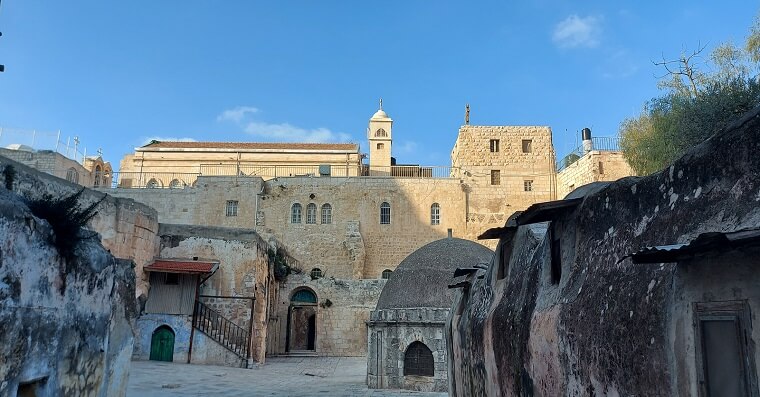
But Maria does not give up. In 1954, she appears multiple times before hundreds of people in the Coptic complex of St. Anthony near the Church of the Sepulcher in the old city of Jerusalem. She comes to bring comfort and peace to the children of war and to restore order in the world following the turmoil between Arabs and Jews in Israel. When her efforts seem futile, she reveals herself again in 1983 in front of many people in an apparition not yet confirmed as authentic by the Vatican. This event occurs in Beit Sahur in the West Bank, four years before the start of the Intifada (the Palestinian uprising).
Maria’s message remains relevant today, and it’s possible that she is appearing at this moment to someone somewhere in Israel, attempting to convey her message once again. However, in our current noisy and superficial culture, it’s difficult for me to believe that such a revelation would be received as it was in previous generations. The news of the apparition would likely be drowned out by the plethora of stimuli we are bombarded with, overshadowed by the spiritual consumerism where everything is purportedly possible, but in reality, nothing substantial occurs.
If Maria wishes to convey a message to humanity today, she’ll likely need to explore alternative avenues (and I don’t mean through platforms like WhatsApp or Instagram). Perhaps it could be through the emergence of new thoughts in people’s minds, fostering a new consciousness and love. Miracles may not have the same impact as before, but I am confident Maria will discover a pathway to the hearts of believers, as she has done in the past. Everyone harbors an archetype of the nurturing mother who looks after them, and in that regard, nothing has changed.

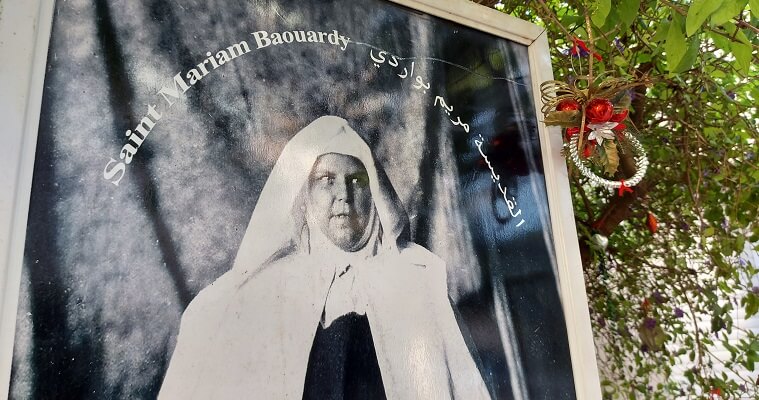
Saint Mariam Baouardy
Mariam Baouardy (1846-1878) was canonized by the Pope in 2015. She received apparitions of Mary, who guided and directed her throughout her life’s mission, leading her to establish the Discalced Carmelites order of nuns in Israel at the end of the 19th century. In addition to these apparitions, Mariam Baouardy experienced the miracle of the stigmata—manifestations of the wounds of Jesus on her body. She was also reported to have the ability to bilocate, levitate, and perform many other miracles. However, her life was marked by disasters, dramas, and unexpected turns, and she passed away at a relatively young age.
Her parents resided in Hurfeish, a small village in the upper Galilee. They were a grief-stricken family, having lost twelve children successively. Desperate for a child, they embarked on a pilgrimage to Bethlehem, where they prayed fervently in the Church of the Nativity. Their prayers were answered when Miriam Baouardy was born in 1846, named after her benefactor, the Virgin Mary. Two years later, another child joined the family. Tragically, both parents passed away when Miriam was only three years old. She then moved to live with her uncle in the village of I’billin in lower Galilee. However, her situation did not improve there either. At the age of eight, Miriam relocated to Alexandria, Egypt, to live with another uncle.
The stories recount that from a very young age, Mariam Baouardy fasted every Saturday and Sunday in honor of Mary and diligently prayed. One day, she received a gift of two birds in a cage. However, when she attempted to bathe them, they tragically drowned. Overcome with grief and wanting to bury them, the young girl heard a voice saying, “Everything ends this way, but if you give me your heart, I will be yours forever.”
At 13, her uncle arranged her marriage to a relative in Cairo, but after a vision of Maria, she refused. Her uncle responded with beatings, humiliation, and deprivation, subjecting her to harsh labor and withholding food and comfort. After three months, she pleaded with a former family employee to deliver a letter to her brother in Israel. They conversed, and when she confided in him, he proposed marriage and conversion to Islam. Mariam rejected this offer, but it led to dire consequences; the enraged young man attacked her, cut her throat, leaving her for dead in a nearby alley.
Mariam Baouardy, a 13-year-old girl, found herself abandoned by the world. Betrayed by those she trusted, she lay gravely injured in the streets of a bustling, indifferent city. With death looming, a miraculous intervention occurred: the Virgin Mary appeared to her disguised as a nun in blue. This mysterious and compassionate woman discovered Mariam, nursed her back to health over four weeks in a nearby shelter, tending to her wounds, nurturing her spirit, and providing sustenance and care. When Mariam recovered, she was taken to a new home in a Franciscan monastery.
Finally, Mariam Baouardy found solace in the knowledge that she had not just an ordinary mother, but the mother of God. This awareness of divine maternal presence gave her the strength to navigate life’s challenges. She served as a servant for a Christian family in Alexandria before embarking on a journey to Israel in search of her brother, the sole surviving member of her family. Along the way, she reached the Church of the Holy Sepulcher in Jerusalem and made a vow of celibacy. From there, she sailed from Jaffa to Acre with intentions of continuing to the Galilee where her brother resided. However, fate intervened when a storm at sea diverted the boat north to Beirut. During her time there, she encountered various miracles, including a 40-day bout of blindness that was ultimately cured.
After spending a year in Lebanon, at the age of 15, Mariam Baouardy found employment as a nanny for a Christian family from Syria who had immigrated to Marseille, France. There, at the age of 18, she entered the order of the Sisters of Joseph of the Apparition. This order had been established in Israel as early as 1848, coinciding with the reinstatement of the Catholic Patriarchate in the Holy Land. It was responsible for managing the Catholic school in the Christian quarter, attracting Christian Palestinians both locally and abroad (Marie-Alphonsine also received her education at the institutions of the Sisters of St. Joseph and began her career as a nun in this order). Therefore, it was natural for Mariam Baouardy to join this particular order in Marseille.
Upon joining the order, Mariam Baouardy began to exhibit stigmata wounds resembling those of Jesus on her body, and she experienced ecstatic episodes. Mother Honorine Piques, who oversaw the Sisters of St. Joseph convent in Marseille, recognized the uniqueness of the young woman under her care and took steps to safeguard her from herself and others.
She inquired about Mariam’s experiences, documented them, and interpreted them as signs of the Holy Spirit’s presence. After two years, Mother Honorine was succeeded by another nun named Veronica, who also recognized the unique nature of Mariam’s soul and the need to provide her with a more protected environment to nurture her spiritual gifts. Mother Veronica, also known as “Veronica of Sorrow,” was an extraordinary woman with a fascinating background. Born in Istanbul to an English colonel, she experienced visions in her youth that led her to become a Catholic nun. After serving in India in 1860 and focusing on education for the Order of St. Joseph, she encountered the Discalced Carmelite nuns, which inspired her to establish a new Carmelite branch dedicated to charitable work in India. Upon returning to France, she assumed the role of Mother Abbess of the Order of St. Joseph, of which Mariam Baouardy was a member, with plans to eventually transition to the Carmelite Order. In the meantime, she became Mariam’s guardian angel. It is believed that every person has an angel who watches over and guides them, and Mariam Baouardy was blessed to have several.
The stigmata began to manifest on Mariam Baouardy’s body in 1866, coinciding with her entry into the Order of St. Joseph. They appeared every week, starting on Wednesdays and persisting until Fridays, reminiscent of the days leading up to the crucifixion. Mariam Baouardy described the experience as follows: “It felt as though I was gathering roses to adorn Mary’s altar, and these roses seemed to have thorns on both sides, piercing my hands and feet. Upon regaining consciousness, I tasted bitterness in my mouth, my hands and feet were swollen, and there were dark marks in the center of my hands and feet.”
The sisters in the monastery grew envious of Mariam Baouardy due to her mystical experiences and became angered by her unconventional behavior. Consequently, in 1867, Veronica of Sorrow finally relocated to the Carmelite Monastery in Pau, taking Mariam Baouardy with her. At that time, Mariam Baouardy was 21 years old. Joining the Carmelite order, connected to Mount Carmel, stirred memories of her childhood in the Galilee, intensifying her visions and deepening her devotion to the Holy Spirit. Demonstrations of her advanced spiritual state included the ability to be present in multiple locations simultaneously (bilocation), levitation, prophetic insights, the appearance of stigmata, and the composition of wonderful poetry. On one occasion, she penned a prayer to the “advocate” (the Holy Spirit) and forwarded it to the Pope, firmly believing it should be embraced by the entire Christian community.
In 1870, encouraged by Veronica of Sorrow, Mariam Baouardy journeyed to Mangalore in southern India to join a pioneering female Carmelite monastery. During her time there, she grappled with inner struggles and temptations that urged her to defy the sisters and the order’s regulations. These challenges led to social tensions, prompting her eventual return to France after two years, driven by a dream that remained elusive to others: to establish a convent of Discalced Carmelite nuns in Bethlehem. Her experiences in India provided her with the necessary fortitude and spiritual resilience to fulfill her life’s calling, which was to carry out God’s work in her homeland of Israel rather than in India.
Mariam embarked on the mission to establish a Discalced Carmelite monastery, a pioneering endeavor in Israel. She encountered Berthe Dartigaux, a wealthy woman who offered financial support for this cause. Over time, their friendship blossomed, and in 1875, Mariam, Berthe, and seven other sisters embarked on a journey to Israel with the aim of founding a Carmelite convent in Bethlehem.
As the sole Arabic speaker among them, Mariam Baouardy played a crucial role in selecting the monastery’s location. She chose a site above the cave where David was anointed king of Israel by Samuel, situated on the hill facing the Church of the Nativity. This decision came after she witnessed a flock of pigeons flying away from the area. Guided by visions, Mariam envisioned the layout of the structure, which was designed in the form of King David’s citadel, hence its circular interior. Additionally, she took charge of overseeing the construction work.
In August 1878, while laboring at the construction site, Mariam Baouardy suffered a fall that resulted in a broken left arm. Sadly, the wound became infected, leading to a rapid decline in her health. Within three weeks, she succumbed to her injuries. During this period, she willingly accepted the role of a victim for Palestine and France. Mariam passed away at the age of 33, coincidentally the same age at which Jesus died, and was laid to rest in the monastery in Bethlehem.
Mariam Baouardy was renowned for her mystical experiences, which often led to prophetic visions, spontaneous bursts of singing, and ecstatic worship. During these encounters, her thoughts and ideas were instructive, wise, and profoundly meaningful for other believers. Despite her own struggles, Mariam exhibited a selfless love for the world, teaching the sisters that by loving each other, they were loving God, and by serving their neighbors, they were serving God. It was her boundless love that enabled her to endure the agony she faced.
Mariam’s entry into ecstatic states resembled falling into a coma. Amidst her daily tasks, she would feel as though her heart was open, exposing a wound within. When she had inspired thoughts about God, she felt as though someone touched this wound, weakening her, as if she were losing herself. According to the Carmelites, she taught the importance of surrendering the self and connecting to the spiritual light, to the Holy Spirit. This process represented a form of transfiguration, a profound change that could occur within individuals, connecting them to the moment before creation and leading to self-renewal.
An intriguing anecdote about Mariam is that a few months before her death, she had a vision of a place where Jesus met disciples at Emmaus. Up until then, Emmaus had been identified with the Village of Abu Gosh. However, a few days later, while walking on the road from Jerusalem to Jaffa, she recognized the place near Latrun as the location from her vision. Subsequent archaeological excavations confirmed this, and today it is accepted as the historical Emmaus. There stands a Church and a new Christian community on the site that Baouardy recognized.
Miriam Baouardy established the first Discalced Carmelite convent in Bethlehem in 1875. Around the same time, the Our Father in Heaven convent was founded on the Mount of Olives. In 1878, Miriam Baouardy and other nuns received permission from the Patriarch of Jerusalem to search for a location to build a convent in Nazareth. They found a suitable place near the Church of the Annunciation, but the convent itself was not built until 1910. The Carmelite convent on Mount Carmel was established in 1892. Today, there are four Carmelite convents of nuns in Israel, each with around 10-20 nuns.
Mystical Substitution
Louis Massignon (1883-1962) was one of the most important Islamic scholars in the world, and a devout Catholic believer. He brought a positive view of Islam to the West, which was expressed in the decisions and declarations of the Second Vatican Council. Massignon was a monk of the Franciscan third order (meaning he could marry and live among the congregation), and as such he prayed in 1934 in Damietta at the mouth of the Nile, where Saint Francis met Sultan Al Kamel. There he was inspired to found the organization Badaliya (alternative), a Muslim-Christian joint prayer group, whose members vowed to give their lives for the other from another religion, not in order of converting them, but so that God’s will be done through them. In 1949, Massignon met with the Pope and informed him of the Palestinians tragedy. In 1950 he became a Malachite Greek Christian so that he could pray in Arabic and become a married priest.
Massignon regarded Miriam Baouardy as an epitome of “mystical substitution,” wherein an individual, akin to Jesus, assumes the world’s sorrow and suffering on behalf of others—a sacrificial soul chosen by God to bear the wounds and pain of humanity for their protection (similar to Joan of Arc). Gandhi and his advocacy of non-violence also deeply influenced Massignon. He was profoundly troubled by the events unfolding in Israel and aspired for Jews, Christians, and Muslims to coexist peacefully.

Patriarch Barlassina
In 1927, the Patriarch of Jerusalem, Luigi Barlassina, initiated local festivities in honor of Mary, known as “Our Lady of Palestine.” These ceremonies aimed to seek Mary’s intervention in the affairs of her homeland, with the goal of fostering peace and harmonious relations among Jews, Christians, and Muslims. Additionally, they sought protection from calamities, including a recent severe earthquake. Barlassina designated Mary as Our Lady of Palestine and established the celebration to occur annually on October 25. His inspiration stemmed from revelations indicating that Mary had previously appeared before Marie-Alphonsine, who passed away that year.
Barlassina served as the Patriarch of Jerusalem for a considerable period (1920-1947), during which he also held leadership within the Order of the Holy Sepulcher, an institution continuing to play a significant role in pilgrimages to Israel. Although the official head of the Order is the Pope, Barlassina exercised considerable influence, fostering a deep connection between the Order and Mary, who became its patron. He established the day in honor of Our Lady of Palestine, reflecting his belief in Mary’s intervention in local Christian affairs. Barlassina’s devotion to Mary likely extended to practicing the Rosary, and he was believed to have a personal connection with her. He expressed gratitude for Mary’s support, which he attributed to the strengthening of the Catholic community and the emergence of Christian governance in Israel under British mandate after 700 years of Muslim rule. Serving as the Catholic patriarch of Jerusalem during what he perceived as Messianic times was seen as a profound opportunity.
To establish a lasting presence of Mary in her homeland, Barlassina commissioned the construction of a church named “Our Lady of Palestine” in Deir Rafat, near Beit Shemesh. Alongside the church, he initiated the establishment of a monastery and charitable institutions to serve the local community. Presently, an orphanage, run by the Bethlehem Sisters, operates in the area. Notably, the church features a unique display: the prayer “Ave Maria” is inscribed in 280 languages on ribbons carried by angels adorning the walls and ceiling.
Above the church building stands a tall statue of Mary, her outstretched hands symbolizing protection over the land from disasters. This statue is a replica of one found in a monastery of the Dorothy sisters in Italy. Originally, the Dorothy sisters, known for their expertise in cultivating flowers and dedication to learning, occupied the site. The order, named after St. Dorothy, who was consecrated in Caesarea Cappadocia during the persecutions of Emperor Diocletian, was invited to Israel by Barlassina as part of a broader effort to revive the Christian presence in the region and bridge the gap between the past and the present.
Barlassina’s involvement in Israel predates the First World War when he served as the bishop of Capernaum and as an assistant to the patriarchate in Jerusalem. He perceived the Byzantine era as a period of peace and harmony between Jews and Christians, and viewed the Crusades favorably, considering them a boon for the entire Christian world. He saw the British mandate as akin to a new crusade, a reconquest of the land for Jesus. In his eyes, the ceremonies honoring Mary were linked to the renewed Christian control of Jerusalem, continuing a tradition of Mary’s worship that began in Israel in 1229, during Frederick II’s conquest of Jerusalem. The Rosary, revealed to Saint Dominic in 1208, could have reached Jerusalem for the first time after Frederick II’s Crusade.
Barlassina passed away approximately two months before the United Nations’ decision on the establishment of the State of Israel and the onset of the War of Independence. He may have sensed the timing was right to depart and reunite with Our Lady of Palestine in heaven.
Apparition in Jerusalem 1954
In July 1954, tensions escalated between Israel and Egypt after the British agreed to hand over control of the Suez Canal to Egypt. Similarly, tensions between Israel and Syria heightened due to ongoing fire incidents since the early 1950s. Rather than progress towards peace agreements and resolving the refugee crisis six years after the war of liberation, the region seemed poised for another conflict. In the midst of this, two apparitions of Mary occurred in the span of two weeks at the Coptic complex dedicated to St. Anthony in Jerusalem. At the time, the entire Old City, including this complex, was under Jordanian rule. Some speculate that these apparitions were Mary’s attempt to foster peace between Jews and Arabs.
The Coptic complex, situated near the Church of the Holy Sepulchre, encompasses a monastery, a church dedicated to St. Anthony, a school for children, residential quarters, and serves as the seat of the Coptic Patriarch. On July 18, 1954, Monday morning, fifth-grade students at the school within the complex observed an apparition of Mary floating in the air outside their classroom window. Although the teachers initially dismissed the children’s claims, Mary then appeared inside the classroom itself for a brief period. Her form radiated a luminous white and blue glow, and she stood beside the wall, emitting increasingly intense light. Eventually, some adults also witnessed the apparition, leading to widespread rumors of the miraculous event throughout the city. Subsequently, Archbishop Jacobus of Jerusalem transformed the room into a church, adorned with frescoes and icons depicting Mary. Presently, prayers are conducted every Monday morning at the site in commemoration of this extraordinary occurrence.
In the subsequent days, a multitude of individuals flocked to the nearby Church of St. Anthony to offer prayers. A week later, during the evening prayer service on July 15, 1954, an astonishing occurrence unfolded. More than 300 individuals, including Muslims, were gathered in the church when a sense of great anticipation swept through the congregation. Suddenly, Mary was witnessed levitating above the assembled worshippers or moving amidst them. Overwhelmed by the spectacle, the priest paused the prayer service. Vibrant rays of light emanated from Mary, enveloping the people in a dazzling display of colorful sparks that danced across the walls. The apparition persisted for approximately 15 minutes before Mary’s figure gradually faded away, leaving behind only a luminous outline in shades of blue and white.
The significance of this apparition of Mary is profound for several reasons. Firstly, it occurred in close proximity to the site of Jesus’ crucifixion, where Mary herself stood witness, adding a layer of spiritual resonance to the event. Moreover, the duration of the apparition and the multitude of witnesses underscore its importance. As the apparition unfolded, additional individuals were drawn to the church from nearby buildings, each bearing witness to the extraordinary event. This collective experience further emphasizes the authenticity and significance of Mary’s presence.
It’s intriguing to observe that on April 2, 1968, Mary appeared in the Zaytoun neighborhood of Cairo before a sizable gathering, which the Egyptians perceived as a source of solace following their defeat in the Six Day War. This event underscores Mary’s tendency to manifest in conflict zones, perhaps in an effort to alleviate tensions. A similar occurrence took place in Bosnia in 1981, a decade prior to the outbreak of civil war, highlighting Mary’s role in such tumultuous times. This pattern suggests a consistent intervention by Mary in various parts of the world facing strife and discord.