
This is a rudimentary translation of articles from my book “Goddess Culture in Israel“. While it is far from ideal, it serves a purpose given the significance of the topic and the distinctiveness of the information contained. I have chosen to publish it in its current state, with the hope that a more refined translation will be available in the future.
A new approach to visiting Caves
Visiting ancient caves is a journey to reconnect with our human origins. Moreover, stepping into these caves feels like entering another realm, another dimension, characterized by a distinct temperature that provides respite in both summer and winter. In this environment, our sensory perception undergoes a shift; sight takes a backseat while hearing and sometimes touch become more prominent.
It’s a fascinating hypothesis that hasn’t been thoroughly explored yet. It’s plausible that sleeping and dreaming in caves differs from being outside due to the unique energy within them, especially in caves considered sacred and used as living spaces. The protective nature of caves, shielding humans from cosmic radiation, is well-documented—just observe the sudden loss of cellular phone connection upon entering one. This protection fosters growth, as seen in the alchemists’ preference for conducting experiments underground during the Middle Ages. Similarly, ancient initiation chambers were often located underground, harnessing the cave’s energetic protection to create special atmospheres for spiritual practices.
The upcoming chapters will delve into the caves of ancient man in the Land of Israel that are open for visitation. These are places where our ancestors lived, dreamed, thought, and loved. By exploring these caves, we aim to connect with the emotions that humans experienced in a time when humanity and the earth were deeply intertwined, when humans were an integral part of nature. Through visiting these prehistoric sites, we are reviving the tradition of the Sacred journey that our ancestors once embarked upon.
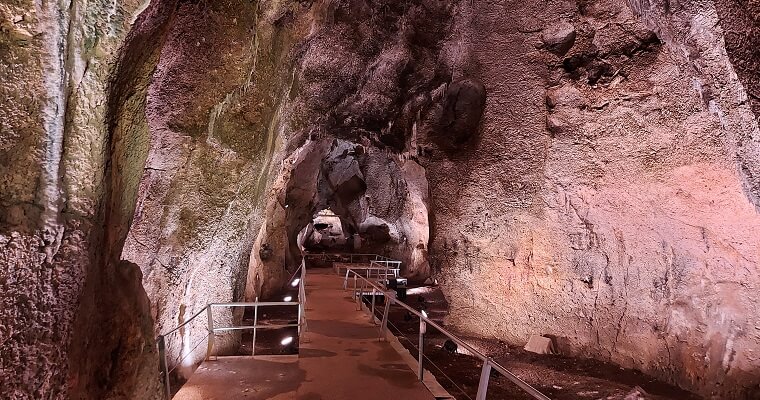
Nahal Mearot and Kebara cave
Mount Carmel has long been associated with Goddess culture, particularly in its western cliffs where caves seem to capture the sun’s rays during sunset over the sea. These caves, with many openings facing westward, can be likened to a womb fertilized by the rays of the setting sun. For hundreds of thousands of years, humans have inhabited this area, drawn in part by the allure of its sunsets. In addition to the practical benefits such as hunting opportunities in Carmel and the coastal plain swamps, gathering plants in the Green Mountain, and fishing in the Mediterranean Sea, I argue that there were also religious motivations that attracted people to the Carmel Caves.
Carmel stands out as one of the most significant areas globally concerning the presence and emergence of prehistoric humans. For those intrigued by unraveling the mystery of human origins and the dawn of human culture, Carmel serves as an ideal starting point. Along the western cliffs of Carmel, numerous caves have served as human dwellings since ancient times, perhaps more so than anywhere else in Israel. These caves have undergone extensive excavation by Dorothy Garrod and others, earning recognition as a “World Heritage Site.”
In the southwest corner of Carmel, above the junction leading to Ma’agan Michael, lies Kebara Cave, which housed an ancient human settlement for tens of thousands of years until the agricultural revolution. Within the cave lies “Moses,” the most complete Neanderthal human remains found in Israel and among the most complete globally, dating back 60,000 years. Surprisingly, “Moses” possessed a tongue bone similar to ours, indicating that Neanderthals, at least technically, could speak like us (though “Moses” might have had a bit of a stutter).
This discovery is significant because it challenges previous assumptions about Neanderthals’ linguistic capabilities. Prior to the discovery of “Moses,” researchers believed that Homo sapiens were able to outcompete Neanderthals, who were physically stronger, due to their advanced language skills. These abilities allowed Homo sapiens to communicate effectively, work together in large groups, and plan ahead. It was previously assumed that Neanderthals did not possess language in the same way modern humans do. However, the discovery of “Moses” contradicts this notion, indicating that Neanderthals were physiologically capable of speech. This suggests that if Neanderthals did not communicate verbally, it may have been due to other factors rather than a lack of physiological ability. Or maybe they just didn’t have much to say
The discoveries in the Carmel caves reveal that Neanderthals were more similar to modern humans than previously believed. They crafted flint tools using the Levallois technique, similar to how modern humans did. Additionally, they demonstrated the ability to light fires and bury their dead, behaviors previously thought to be unique to modern humans. The skeletons of Neanderthals found in the Cave of Kebara were buried in symbolic positions, suggesting a potential religious significance. For example, one adult man was buried with his left hand resting on his chest and his right hand on his stomach. After burial, someone removed the skull from its original position, possibly indicating religious or ceremonial practices. This suggests that Neanderthals may have had beliefs regarding the afterlife, similar to a Neanderthal paradise.
Kebara Cave is located on the southwestern side of the cliff strip overlooking the coastal plain and the sea, adjacent to the orchards of Kibbutz Ma’agan Michael. However, access to the cave is currently restricted due to its location within private areas of the kibbutz, and the entrance is blocked. Therefore, visitors interested in exploring the Carmel Caves should begin their tour at the next accessible site, which lies to the north – the Nahal Mearot Nature Reserve, a designated national park.
Nahal Mearot, nestled in the heart of the western cliffs of Carmel, is home to some of Israel’s most significant caves for prehistoric research, recognized as a World Heritage Site. It was in this area that Dorothy Garrod conducted excavations, revealing remnants spanning half a million years of human habitation within the cliffside caves. Additionally, the discovery of remains from a settlement associated with the Natufian culture provided valuable insights into this pre-agricultural society.
Before the time of the Natufian culture, the caves served as temporary residences for nomadic humans of various kinds, who would stay for a few months at a time. The social unit during the hunter-gatherer era was akin to a tribe, consisting of around 25 individuals who roamed the land and returned to the same caves year after year as part of their sacred journey. This likely occurred during the winter months when hunting and gathering were abundant in the area, and the caves offered shelter from the weather.
Today, Nahal Mearot is a national park with paid entrance fees. The park features a regulated and structured tour route that includes several key sites: the Gedi Cave, the Furnace Cave, the Nahal Cave, and the Camel Cave. Visitors can explore these caves along an enlightening path, guided by informative signboards. Additionally, there are reconstructions of prehistoric figures and an audio-visual presentation that provides insight into the life of ancient humans in the area.
The journey begins at Furnace Cave, the westernmost and highest cave in the area, where the oldest layers of archaeological remains date back to half a million years ago, spanning up to the end of the Mousterian culture around 40,000 years ago. Visitors can explore the archaeological section and view reconstructions depicting the cave’s appearance during different periods. Notably, the cave yielded the burial site of a Neanderthal woman dating back tens of thousands of years. Intriguingly, archaeological evidence suggests that Neanderthals and Homo sapiens coexisted harmoniously for tens of thousands of years. Eventually, due to natural factors such as the accumulation of human and natural waste and a portion of the cave ceiling collapsing, people moved to nearby caves like Camel Cave, Nahal Cave, and Gedi Cave.
From Furnace Cave, the route leads to Camel Cave, named for its distinctive bell-shaped entrance. Here, visitors encounter reconstructions of ancient human life, including dolls dressed in attire reminiscent of garments worn 20,000 years ago, skins drying, freshly hunted deers, and various food items. This cave, once inhabited in ancient times, was eventually abandoned.
Below Camel Cave lies Nahal (or Al-Wad) Cave, the longest and most significant cave in Carmel. Stretching approximately 90 meters, it extends deep into the mountain through a series of halls and corridors. At its entrance sits a wide rock ledge, where burial remains dating back to the Natufian culture have been unearthed. Nearby, in Gedi Cave, similar burial remains from the Natufian period were discovered, along with remnants of round huts that once formed a Natufian village. A reconstruction of one of these huts can be seen nearby. This indicates that around 15,000 years ago, a permanent Natufian village thrived within the Carmel Caves, alongside another settlement near the entrance of Nahal Oren.
The settlement within Nahal Cave has a much earlier origin, spanning extensive periods. Significant discoveries within the cave date back mainly to the Aurignacian culture, around 40,000 years ago, marking the advent of modern man in Israel. This culture is renowned for initiating the tradition of intricate rock paintings in Europe, along with the creation of figurines depicting female Goddesses, like the Venus of Hohle Fels, musical instruments, and advanced stone tool technology. Notably, one of the earliest art objects in the world was unearthed in Nahal Cave: a bone-carved sickle handle adorned with the likeness of cattle. This discovery resembles another bone-carved sickle handle found in the nearby Kebara Cave, adorned with a depiction of a deer.
The discovery of the Aurignacian culture in Israel came as a surprise to archaeologists, marking the first appearance of Human and animal figures, along with the development of a complex language, art, and religion. This culture’s presence in Israel may have coincided with the arrival of Cro-Magnon people from Europe. Within Nahal Cave, visitors can experience an impressive audio-visual presentation depicting life during that period.
Outside the cave, on the stone ledge, lie remnants from the Natufian period, which occurred much later. Here, visitors can observe a reconstruction of a woman’s tomb discovered at the site. The woman’s skeleton was found in a contracted position, with shell necklaces adorning her head. Nearby, large circular alcoves carved into the rock and a stone retaining wall can be seen. It’s speculated that the woman buried there may have been a shaman, interred in a fetal position symbolizing belief in death as a form of rebirth.
Additional remains from the Natufian culture were discovered both inside the cave and at its entrance, including craters and basalt leaves brought from a considerable distance (80 km from the Golan Heights). Evidence of the world’s oldest broad bean seeds was also found, suggesting the presence of small-scale agriculture. Human figurines, reminiscent of astronauts or, with some imagination, male genitalia, were unearthed in the cave. These small statuettes featured meander-like decorations and geometrically incised robes, similar to those found in Ein Gav and other settlements from the same period.
It’s worth mentioning that to the east of the cave lies a large rock cliff with a prominent slot running from top to bottom. The rocks in this area are slightly lighter, giving the slot the appearance of female genitalia. This feature is characteristic of other prehistoric Human sites worldwide. Interestingly, many prehistoric sites in Israel also feature grooves or depressions in the rock resembling female genital organs. This suggests that the choice of caves as settlement locations may have been influenced by their proximity to such natural features.
The places of dwelling of ancient men were always Sacred places and therefore chosen for a Religious reason, they were Sacred places for the Goddesses and therefore also burial places, so there should be no surprise at the appearance of female vaginas in the cliffs and rocks. Such is the case in the witch’s cave in Nahal Hilazon, such is the case in the pillar cave in Nahal Hamud, and it is possible that this is also the case in the Nahal cave in the Carmel. In the Natufian culture, and possibly even earlier, sex was regarded as sacred, as evidenced by Breuil’s discovery of lover’s figurines from that period in Ein Sahari.
If you continue along the cliff to the east for a few dozen meters, you’ll reach a small opening at the bottom of the rock, the location of a small cave called Gedi Cave. Its significance lies in what was discovered on the rock ledge in front of it: graves of Homo sapiens, the oldest known graves in the world dating back 100,000 years. The only comparable findings in Israel are similar graves found in Kapza Cave near Nazareth. Inside the graves, marine shells processed into beads, lumps of red ochre, and on the chest of one of the skeletons lay a whole wild boar jaw, likely an offering. These graves indicate that Homo sapiens populations existed in Israel in ancient times, exhibiting religious beliefs, art, and abstract thought. Alongside other caves in Carmel, these are the earliest remains of modern humans outside of Africa, marking the northernmost appearance of Homo sapiens and the southernmost appearance of Neanderthals. It’s quite a wonder they coexisted and gathered around the fire.
In the caves of Nahal Mearot, an exquisite type of beads was discovered, composed of bone drops interspersed with seashell beads. Crafting beads of this nature required the ancients to drill into bone, showcasing their advanced technological skills. Additionally, they fashioned green stone beads, indicating a symbolic significance of color and religious thought.

Nahal Oren and Myslia Cave
A few kilometers north of Nahal Me’arot lies the mouth of Nahal Oren, flanked by cliffs housing two caves: Oren Cave on one side of the valley and Finger Cave on the other. Oren Cave and the surrounding rock and soil surfaces yielded significant remains of the Natufian culture, including an ancient village with huts, a burial complex featuring 60 skeletons arranged in religious burial positions, and various artifacts such as beads, statues, vessels, and human figurines. Many of these discoveries are now showcased at the Israel Museum.
Researchers believe that during the Natufian period, this site served as the primary settlement in Carmel. With the transition to agriculture around 11,000 years ago, a permanent agricultural village was established in the place, boasting twenty round houses, grinding craters, tools, blades (some crafted from obsidian), and various other artifacts. Thus, Nahal Oren presents a continuum from primitive man and cave dwellers through the Natufian culture to the advent of agriculture—a sequence of settlements marking one of the most significant periods of historical change.
Close to the caves lies a parking lot, from which a path ascends to the Oren Cave on the north bank of the valley. While this cave is sizable and somewhat sooty, it may not strike visitors as particularly impressive. A more appealing path climbs the south bank to Finger Cave, renowned for its beauty and grandeur. This cave features multiple levels, a narrow entrance, and a rock ledge offering panoramic views. A trail extends from the cave to a circular route above the cliffs, providing an opportunity to experience the energy of Carmel.
The most captivating prehistoric site in the Carmel Range is Myslia Cave, situated at the northernmost point of the western cliff escarpment near the town of Tirat Carmel. Although relatively new, this site is reshaping our understanding of prehistory. Previously, it was believed that Homo sapiens first appeared in Israel around 100,000 years ago, based on remains found in Nahal Cave in Carmel and Kapza Cave in Nazareth. However, recent discoveries in Myslia Cave have unveiled a Homo sapiens jaw dating back nearly 200,000 years, challenging previous notions of early human presence in the region.
The discoveries in Myslia Cave suggest that Homo sapiens migrated out of Africa much earlier than previously believed. This raises the possibility of previously unknown periods in human history and ancient civilizations that may have vanished, as suggested in alternative circles. Additionally, evidence found in the cave indicates that during that time, Carmel experienced snowy and cold climatic conditions, implying significant climatic changes or even cataclysmic events in the past that could have contributed to the disappearance of these cultures.
The cave lies within a cliff south of Nahal Safun, marking the southern border of the Tirat Carmel area. Accessible via a relatively easy ascent path, taking about fifteen minutes on foot, it offers an adjacent cave with a captivating arched hall adorned by a carob tree at its entrance—a serene spot ideal for relaxation and meditation. The path, marked by blue signs, extends from the cave to the rocky platform above, where an array of unique spice plants, including the fringed rue plant, thrives, creating a captivating natural tapestry.
Standing upon the rock platforms above the cliffs and Carmel caves, one can sense the sanctity of the surroundings—the distant sea, the untamed wilderness of the mountain, and its lush forests on the other side. It’s undeniable that the ancients ascended here from their cave dwellings to witness the majestic sunset. Indeed, there’s significance in exploring the connection between a cave and its surroundings, both above and beside it. I’m confident that future discoveries await those who delve into the mysteries hidden in these elevated realms.
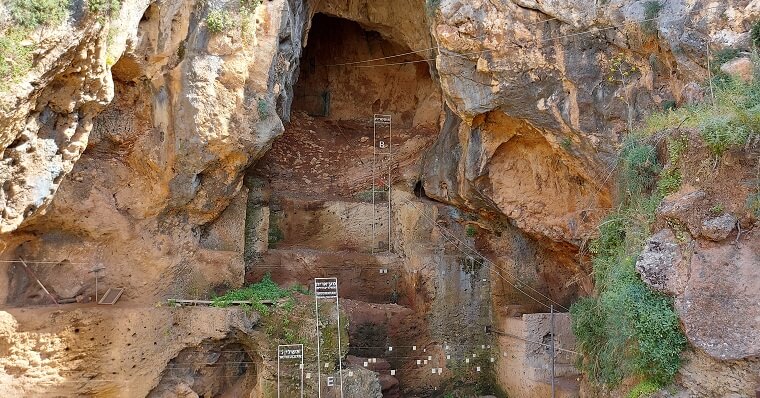
Kapza Cave and Moshe Shtekalis
To the south of Nazareth lies a mountain steeped in tradition—the site from which Jesus, according to legend, walked into the air, evading the wrath of those in Nazareth who sought his demise. This mountain, with its impressive rise toward the Jezreel Valley, takes on the distinctive shape of a pyramidal triangle, offering a breathtaking vista from its summit. Nestled beneath this sacred peak lies one of the country’s most significant prehistoric caves—the Kapza Cave. Once adorned with a spring and a pool within, today it serves as a dry refuge for countless bats.
In the Kapza Cave, burial grounds dating back nearly 100,000 years were unearthed, showcasing the final resting places of Homo sapiens—both children and adults. These graves, reminiscent of those found in the Nahal Cave in Carmel, were meticulously carved into the heart of the cave, with red ochre powder carefully inserted, hinting at practices of Religious reverence and abstract beliefs. Notably, atop the chest of a 14-year-old boy lay the horns of a fallow deer, likely serving as a symbol of the ancient “Lord of the Beasts,” as described by Eliade, or “the horned God,” as Margaret Murray posited.
The significance of horns as a symbol of nature’s power in ancient times is profound and widely recognized. Later on, I’ll delve into the reasons behind this belief. They were perceived as embodying the energy of nature manifested through animals, an essence necessary for success in the hunt. This motif is evident in prehistoric art and paintings across various regions worldwide. However, the Kapza cave stands out as one of the earliest instances, offering insights into the Religious sentiments of our ancestors who opted to dwell and find their eternal rest in this sacred space.
Professor Moshe Stekelis played a pivotal role in uncovering a significant portion of the discoveries within the Kapza Cave. Known as the father of Israeli prehistory, Stekelis (1898-1967) was raised and educated in Russia, where he encountered prehistoric sites and nomadic societies in Siberia. In 1928, he immigrated to Israel, initially engaging in pioneering efforts in kibbutz settlement. However, he swiftly returned to excavations and research, ultimately completing his doctoral thesis at the University of Paris under the esteemed guidance of Henri Breuil. Interestingly, Stekelis arrived in Israel around the same time as Dorothy Garrod, and both pursued their doctorates under Breuil’s mentorship. Their paths likely crossed during this period, leading to subsequent collaboration, including the shared experience of Henri Breuil’s visit to Israel in 1933.
Moshe Stekelis emerged as a central figure in Jewish archaeology and prehistoric research in Israel during the Mandate period and continued to make significant contributions after the establishment of the state. Renowned for his expertise in megaliths across Jordan and Israel, Stekelis made pivotal discoveries, including unearthing the Yarmukian civilization and leading excavations at sites such as Gesher Bnot Ya’akov, Tel Beit Yerah, Tel Ovadia, and Kefaza Cave, among others in the Mount Carmel region and beyond. His lasting impact is commemorated by the Museum of Prehistory in Haifa, named in his honor.

Nahal Amud Caves
The Amud Stream, with its perennial flow of water, boasts picturesque pools and lush greenery, making it one of Israel’s most enchanting hiking destinations. Amidst its natural splendor lies a hidden treasure: the renowned stone pillar. Yet, many hikers are unaware that some of Israel’s oldest and most significant sites related to the emergence of the human species can be found along Nahal Amud. Along the canyon’s cliffs, particularly in its lower reaches near the Sea of Galilee, are caves once inhabited and thriving with ancient humanoids.
Adjacent to the renowned rock pillar stands Amud Cave, which has hosted various human populations for approximately 70,000 years. Among them, the most noteworthy were the local Neanderthals, distinct from their European counterparts (a bit smaller in size) and likely possessing superior intelligence. A skeleton unearthed at the site, dating back 60,000 years, suggests that the Galilean Neanderthal was perhaps the tribe’s genius, boasting a cranial capacity of 1,750 cc, surpassing that of many contemporary humans. Additionally, he stood relatively tall at 170 cm. Skeletons of other Neanderthals found in the cave date back to 55,000 BC, a relatively late period for this hominid species. It is suggested that the air of the Land of Israel may have contributed to the intelligence of the local Neanderthals, who demonstrated advanced capabilities such as fire-making, tool crafting, and the practice of burial rituals indicative of religious beliefs.
The burial of the baby with a deer jaw as an offering is indeed fascinating and provides insight into the Religious beliefs and practices of the ancient inhabitants of the Amud cave. The symbolism of the deer jaw as an offering to a deity associated with animals, possibly akin to the “Lord of the Animals” depicted in later Cro-Magnon cave paintings, suggests a reverence for nature and a belief in supernatural forces governing the animal kingdom.
The intriguing alignment of the cave with the nearby rock pillar and the resemblance of a groove on the cliff face to a female genital organ spark speculation about the symbolic significance of the site. If the rock pillar represents a phallic symbol associated with male fertility or power, then the groove on the cliff could indeed be interpreted as a symbol of the female genital organ, symbolizing fertility, creation, or the divine feminine. This alignment could suggest a deeper spiritual or Religious significance to the location, perhaps indicating that the cave served as a sacred space or temple dedicated to the Goddess.
The potential that Galilean Neanderthals possessed a degree of intelligence and spiritual awareness, encompassing beliefs associated with fertility and the sacred union of male and female energies, presents an intriguing viewpoint on their selection of the Amud cave as a settlement. The symbolic importance of nearby natural formations resembling genital organs could have had resonance with their cultural or religious practices, possibly impacting their choice to inhabit the area. Moreover, their admiration for the natural splendor of the landscape may have played a role in their decision to settle there, echoing motifs observed in subsequent Homo sapiens cultures.
When you continue downstream for about a kilometer and a half, you reach the foot of a cliff where another cave, called Zuttiyeh Cave, is located. The excavation of this cave was conducted by an intriguing individual named Francis Turville-Petre, who was a friend of Dorothy Garrod and embarked on adventurous journeys with her across the Middle East. He was involved in a British homosexual order that advocated for the values of literature and culture. The reason why he chose not to excavate Amud Cave remains unclear, but his decision to commence digging in Zuttiyeh Cave proved fortuitous. In 1925, at the outset of the excavation, he encountered beginner’s luck, discovering the oldest skull in Israel, dating back 400,000 years. This skull belonged to an unknown type of man, possibly an ancestor of the Galilean Neanderthal or even Homo sapiens, and was dubbed “the Galilean Man”.
Another cave excavated by Francis Turville further down the stream in Ginosar is Amira Cave, nestled near the mango groves. There, too, he discovered remains of early Humanoids. From Amira Cave, one can trek on foot to the picturesque beaches of the Sea of Galilee. However, during the Neanderthal period, the landscape likely featured a different type of water body in this area.

Sea of Galilee, Ohalo and Ein Gev sites
The Jordan Valley surrounding the Sea of Galilee is renowned for its fertility and rich soils, attracting Human settlement since ancient times, some even dubbing it an ancient paradise. South of the Sea of Galilee lies Tel Ovadia, boasting the oldest evidence of Human presence in Israel, with Homo erectus remains dating back 1.4 million years. To the north, in the mountainous Jordan River region, lies the world’s oldest evidence of fire use. At the Benot Yakob Bridge site, dating back 780,000 years, archaeologists unearthed remnants of an ancient Human campsite, including traces of a campfire. Additionally, as mentioned earlier, the Nahal Amud caves near the Sea of Galilee yielded remains of “wise” ancient people from 400,000 years ago.
Until 20,000 years ago, the area now occupied by the Sea of Galilee was not a lake at all. Instead, it was part of a vast saline sea known as the “Tongue Lake,” which encompassed not only the Sea of Galilee but also extended over the Jordan Valley and the Dead Sea region. Over time, due to global warming and climate shifts, this ancient sea receded, leaving behind the Dead Sea, while the Sea of Galilee emerged in its place as a freshwater lake.
With the emergence of the Sea of Galilee, human settlements began to dot its shores. Initially, the lake was slightly smaller than its current size, but as time passed, rising water levels submerged some of these settlements, inadvertently preserving them. One such site is the Ohalo area, where a 20,000-year-old settlement was discovered. Among its remnants were six round straw huts measuring 4-5 meters in diameter, a Human grave covered with stones, and early signs of small-scale agriculture, including a mortar and a grindstone. The underwater preservation provided archaeologists with a unique window into the plant life of ancient communities. Analysis revealed that the inhabitants of the Sea of Galilee region at the time relied on a diverse diet that included acorns, hawthorn fruits, jujube, almonds, as well as barley and wild wheat. Additionally, evidence of plant fiber string suggests the use of trees and branches in construction practices.
The question of whether Ohalo was a permanent settlement remains open to interpretation. Evidence suggests repeated use of the site, indicating some level of renovation. Its proximity to the lake, a vital source of nutrition from fish, along with findings of seed storage and dried fruits (such as raspberries) and the grinding of wild grains, suggests that agriculture and settlement may have begun much earlier than previously thought. However, it’s uncertain whether Ohalo functioned as a typical village. The huts could have served as a Sacred birthing place, drawing women from across the Galilee region. This hypothesis is supported by the presence of ancient birth temples in other parts of the world, such as Lepenski Vir in Serbia, which were often situated near water bodies, similar to the location of Ohalo.
On the eastern shore of the Sea of Galilee, archaeological evidence reveals ancient Human settlements. Near Ein Gev, remnants of Human activity from the Kebaran culture (16,000 years ago) have been unearthed, including structures reminiscent of the huts found at Ohalo. Among these discoveries was the burial of a woman in a fetal position beneath the floor, possibly regarded as the shaman or spiritual leader of the tribe.
In the Ein Gev stream valley, further to the east, an important settlement dating back to the Natufian period (14,000 years ago) was unearthed by archaeologist Lior Grossman. Her excavations revealed the existence of a permanent village settlement alongside a facility for processing limestone into lime, a process requiring high temperatures (around 700 degrees Celsius) and collaborative effort. This marks the earliest known instance of alchemical use of fire in human history. Notably, three key products of prehistoric high-temperature firing include lime, ceramics, and copper, with the Natufian culture demonstrating the earliest evidence of this technological advancement. The lime produced likely held religious significance, as evidenced by its use in burial practices. Adjacent to the settlement, a cemetery was discovered where individuals were interred in a crouched position, coated with lime and adorned with beads.
In addition to lime production, Ein Gev housed a bead-making workshop where beads were crafted from oysters sourced from nearby mountain deposits or the Sea of Galilee. Alongside beads, numerous artifacts were uncovered at the site, including the first sculpted human face on a pebble. Within one grave, a man was discovered with deer horns positioned atop him, suggesting a possible shamanic role and indicating the contemporary belief in the sanctity of horns, symbolizing the “lord of animals.”
[1] Fazenda, Bruno, et al. “Cave acoustics in prehistory: Exploring the association of Paleolithic visual motifs and acoustic response.” The Journal of the Acoustical Society of America 142.3 (2017): 1332-1349.


