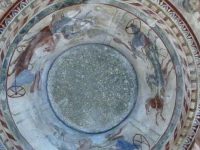
Generators of Sacredness in the Church of the Holy Sepulchre
The Church of the Holy Sepulchre in Jerusalem is the holiest place for Christians on earth, a center of pilgrimage and devotion[1]. Many studies have been written about historical, cultural, religious, political, social, and other aspects of the church, about the pilgrimage to it, the traditions associated with it, its development during the periods, and also about the symbolism and art that exists in the place, its various parts, and more.
The current article is based on some of these studies and offers another perspective of seeing the church, which has to do with religious experience triggered in some of the people visiting the place, it argues that in the layout of the site there are Sacredness generators that support a change in perception of the environment in a way that can lead to religious experience, this is also one of the reasons for the popularity (charisma) of the place. It should be noted in this context that the full beauty of the building is not fully apparent these days because of the separating walls built around the central Catholicon hall, which do not allow one to see the transept of the church (its width) and hide other features as well, but even so, the various parts of the Church leave a deep impression on the visitors to it, and also on those who are not Christians.
Sacred generators are archetypal arrangements in holy places that trigger a different kind of perception in us, because they echo archetypal patterns in our unconscious mind. the most prominent example is perceiving the environment as having a dual nature: darkness and light, sky and earth, we divide the space into two – above and down, forward and backward, and perceive reality through a dual process of absorption and interpretation of what we perceived. This reflects the duality in us: good and evil, spirit and matter and so on.
In the studies I conducted on the subject of holy places in Israel I showed that having a physical or symbolic duality in a holy place helps sharpen the perception of duality in us, and in the case that it is a unifying duality (the different parts complement each other and do not oppose each other), it can lead to the experience of uniting the opposites within ourselves, and consequently to areligious experience of unity and the Sacred, what Jung called the “self”.
In the same way, the existence of other Sacredness generators in charismatic Sacred places can trigger religious experience among some of the people visiting them. The generators I point out to, as part of my PhD thesis are: unifying duality, sublime extraordinary, connecting center and fractal complexity, but there are others as well.
Before we start relating to the Sacredness Generators, we need to agree on some basic assumptions; First of all, that there is an affect of a place on a person, and therefore not all places are the same, influencing us in the same way and to the same degree. This leads to the understanding that there are Charismatic Sacred places and those that are not, in other words from phenomenological point of view not all sacred places are “sacred”. secondly that there is a possibility in a person of transpersonal religious mystic experience, that is described in the religious studies, transpersonal psychology and the psychology of religions, and that this is a natural faculty in the human, same as art and music, the human is Homo Religious ad Eliade put it, seeking the connection with the sacred which is achieved in special places and times, hence the importance of visiting charismatic Sacred places.
Structure of the Church of the Holy Sepulchre
The Church of the Holy Sepulchre unites within it the hill of Golgotha on which Jesus was crucified, the stone on which his body was anointed with oil and prepared for burial, the empty tomb where he was buried for a short time until he resurrected, the place of his meeting with Mary Magdalene, the place where the true cross was found, a central hall called the Catholicon, an Ambulatorium (corridor) around the Catholicon, and many other parts, some are open and some closed to the public. Around the Church there are monasteries and churches of various denominations. The courtyard leading to the building is small and not particularly impressive, but inside a whole other world is revealed.
The ancient part of the building is a large circular hall covered with a dome called Rotunda, which contains in the middle of it the empty tomb, this classical model was built in the 4th century (the church began to be built in 325 and consecrated in 335), during the reign of Constantine the Great and is one of the first Christian monumental buildings in the world. Alongside it a great basilica was built on the eastern side to accommodate the many worshippers, and in between the two massive buildings there was an open courtyard with the Golgotha rock exposed in it. Overtime the basilica was destroyed and a new structure containing the courtyard was built in its place by the Crusaders of the 12th century.
Most parts of the building, including the Catholicon, the Ambulatorium and the Golgotha, were built as part of an overall design, incorporating the rotunda in it, by the King of Jerusalem Baldwin III and his mother Melisande in the 12th century, and they are the height of Crusader architecture. The crossed arches express a new religious concept that was later developed in the Gothic cathedrals across Europe. The Crusaders decorated the building with complex and delicate sculptures which can be seen on the capitals and jambs in the building, and also with wonderful artistic mosaics of which only few remain. They introduced color, subtlety and complexity to architecture, thereby expressing the mysticism that permeated Christianity at that time[2].
The overall design of the complex has sacred proportion, numbers and geometry in it, it incorporates elements of Sacred architecture taken from the Jewish temple in Jerusalem and in the case of the rotunda from the Pantheon, and relates in some aspects to the dome of the rock. It is a unique church built like no other church in the world, designed according to its importance and the events that happened in it, during the process of design Sacredness generators were created consciously or unconsciously in the place.
Sacredness Generator Unifying duality in the Church of the Holy Sepulchre
One of the Sacredness generators that is at work in the Church of the Holy Sepulchre is the unifying duality. A major motive in the architecture is the difference between round and a straight line (male and female). This is expressed in several ways: first of all, the church has two main parts, the rotunda and the catholicon, the rotunda is round and the catholicon rectangular, built according to straight lines on an east-west axis. The Rotunda – the ancient round building around the tomb of Christ was built in the Roman-Byzantine period, and the Catholicon – the central hall was built in the Crusader period. The structure did not always look like this, but it always had two components[3] based on the duality of a circle (rotunda) and a straight line (basilica)[4].
This division into two buildings, one straight and the other round, that exist as part of one complex, is a common feature in the classical world[5]. It is also a hidden feature of the Jewish temple, which had a pattern made out only of straight lines, but inside it, in the holy of Holies, between the two Cherubim, there was a possibility of connecting to another reality, described in Jewish mystic teaching as circular. According to Nurith Kenaan-Kedar [6], the church is a reflection of the heavenly Jerusalem and the Temple is a prefiguration of it, and indeed the planners of the Church of the Holy Sepulchre wanted to establish a connection between the two buildings, in a hidden and apparent way, and one of the ways is the usage of straight and circular lines.
The central part of the Church of the Holy Sepulchre is the rotunda, a round building surrounding the Holy Sepulcher itself, built in the fourth century in the pattern of the Pantheon in Rome[7]. According to Barrie, the Pantheon was built I a way that light will enter from the opening in the ceiling and will enliven the place, linking it to the movement of the sun and moon in the sky[8]. The light entering from the top of the dome looks like a ray of light penetrating a globe. And so a connection of a circle and a straight line, earthly and heavenly, is established. The Pantheon is a perfect semicircle, and this is one of the most impressive things in it, its walls are constructed so that they react to the light penetrating from the ceiling, and this creates a play of light and shadow. The rotunda in the Church of the Holy Sepulchre was built on the model of the Pantheon, at the top of it there is an opening that lets in a ray of light, in the same way as the Pantheon, the affect of it is a bit similar, but the interpretation is different. In the case of the Church of the Holy Sepulchre the ray of light can be interpreted as the spirit (Jesus) incarnating in this world. Either way this is an appearance of Sacredness Generator Unifying Duality
Indeed, the most impressive aesthetic experience in the eyes of many visitors to the Church of the Holy Sepulchre is the penetration of the light from the opening of the rotunda dome into the round space below, seen as an expanding ray of light. This light and darkness show, visible during parts of the day, impresses a feeling of the Sacredness in many of the visitors, so it should not be surprising that quantitatively it is the most popular photographic feature of the Church[9], the numbers of pictures of it indicate the excitement it arouses, part of the popularity of the place stems from this performance, which not many considered to be central.
In the original structure of the Church of the Holy Sepulchre, there was another meeting between the straight sunbeam line and the circle of the rotunda. When it was built, in the days of the Roman Emperor Constantine (335-325), elements of the ancient Roman solar religion entered the Christian religion. And so, in the original structure of the Church, there was an opening to the east that faced the sunrise over the Mount of Olives[10], as the sun appeared above the mountain horizon it first rays penetrated the rotunda from the opening in the east and a connection between sky (sun) and the earth (church) was established, similar to what happened in stone circles and temples of the ancient world. This arranged echoed the Jewish temple that faced east, towards the mountain of olives, as well.
In Christianity, the circle symbolizes the cycle of life, death and resurrection. It is also associated with the sun and the cycles of the sun. Jesus is the Sun figure and this is why he has a round halo around his head. The identification of Jesus with the sun Hero that dies and gets reborn starts from the 4th century when pagan roman religion motives were incorporated into Christianity be the emperors, and for these reasons the newly built churches face east.
The rising of the sun over the Mount of Olives can be said to bring to life into the cosmic drama of Jesus’ death and resurrection at the place where it happened. The sun emits a ray of light from it (identified with the Holy Spirit), and it materializes (incarnates) in the building. The tradition of relating to the sun rise over the mount of olives also appears in the Jewish temple, that was oriented on an east-west axis towards the mountain. Every morning the sun rising over the Mountain would illuminate the entrance to the temple, and that was the sign for the beginning of the worship, the light spread throughout the city due to it being reflected by a golden lamp hung above the entrance to the temple (Helena’s lamp)[11]. In the same way, church worship has to do with the sunrise, the Mount of Olives is the place of Jesus’ ascension, rising of the dead and the coming back of Jesus at the end of times (the Jewish Messiah), so the sunrise over it seen from the Church of the Holy Sepluchre must have had great meaning to the Christian worshipers who noticed it from the Church of the Holy Sepluchre, especially if you take into account that the holy sepluchre was considered by them the center of the world, a place from where the creation process started as well as the new spiritual creation brought about by Jesus resurrection
The meeting of straight line and circle, happening when light beam penetrates circular (or other, mainly rectangular) architectural space, is Sacredness Generator of the Uniting Duality type, which exists in many charismatic churches. Furthermore, all churches in the world are oriented on an east-west axis, so that their colored glass windows allow the light in dramatically, especially at sunset or sunrise, and thus the rosette windows in the Gothic churches face the west and inject magical colored light into the space, and at some special places there are colored glass windows in the east that let in light at sunrise, as is the case in the Church of the Transfiguration on Mount Tabor.
The meeting of a straight line and a circle simulates the meeting between the male and the female, the spiritual world and the physical, with the spiritual (male) being a straight line that fertilizes the physical (female) which is the circle, and thus the space is sanctified and actually reborn. The physical ray of light entering the rotunda from the dome symbolizes a spiritual ray of light, its appearance within the round space is the incarnation of the spirit in this world.
In the Christian icon paintings, a beam of white light, coming from the divinity, is seen entering the forehead of the newborn baby Jesus, and this is yet another expression (this time in painting) of the Sacredness Generator Unifying Duality [12]. It can be said that the sunray is the Holy Spirit, and that the circle is the earthly world in its lower sense and divinity in its higher sense, the earth becomes sacred (sun) after it is purified and sanctified by the ray of light. This can be imaged as if the rotunda, the burial place of Jesus, symbolizes his physical body, and the sunray from the opening in the ceiling is the Holy Spirit impregnating it, the Word incarnating in the Flesh, and by this a new birth (resurrection) is made possible. And so, the pagan symbolism of the meeting between male and female, round and straight line, present in the pantheon in Rome and other temple structure of the classical world, passes into Christianity through the architecture, because it expresses universal archetypes.
The meeting of the Sunray and the Rotunda space is not just a meeting between circle and straight line, but also a meeting between light and Matter (shadow). another appearance of this architype in found in the Holy Fire ceremony at Easter, the most important ceremony in the Church of the Holy Sepulchre, as well as in the whole Orthodox and Christian world in general, it is a meeting between spiritual (light) and physical space, Jesus (or his representatives) and the community. The believers circle the Holy Sepulcher holding extinguished candles in their hands[13]. The patriarchs are in the middle, inside the Holy Sepulchre itself, at the time of resurrection holy fire – another manifestation of light – descends from heaven and lights their candles, they pass the fire to the people around them lighting their candles, and from there it is taken all over the world, all this is happening at the Saturday (of light) night and is considered miraculous, because the fire comes from nowhere and is cold (according to their Belief). The play of light and darkness in this case as well is a Sacredness Generator Unifying Duality, in an instance the whole space that was dark before is being lit with numerous candles, and everybody is celebrating the miraculous event of the meeting of the worlds _ the Sacred and profane.
The Sacredness Generator Unifying Duality appears prominently not only in the relationship between light and darkness, the sunbeam and the rotunda, but also in the relationship between the two main buildings of the complex, the rotunda and the Catholicon (central hall). The Crusaders added to the Rotunda, which has been standing since the fourth century, a large hall where the courtyard was in the Byzantine period. This is the Catholicon, which is as long as the rotunda and the diameter of its dome above its western part is half the diameter of the rotunda’s dome[14].
According to Nurit Canaan-Kedar, the motif of duality was deliberately introduced into the cruciform design of the Church of the Holy Sepulchre at that time, and in my view it is just simple Duality but a unifying duality[15]. Canaan-Kedar explains that the duality of the buildings reflects the duality of the Dome of the Rock and the Al-Aqsa Mosque, the two main buildings in the Temple Mount complex, one built according to a radial plan and the other in a straight line; One was seen by the Crusaders as a temple and the other as a palace, a symbol of the church’s dual rule – earthly and spiritual. Similarly, the Catholicon was the Place (Church) of the kings, while the Rotunda was a temple to God. The connection between the buildings is expressed by the fact that the diameter of the dome of the Catholicon is half the diameter of the rotunda. In the same way, the diameter of the Al-Aqsa Mosque dome is half the diameter of the Dome of the Rock.
The dimension of the buildings are not arbitrary: the diameter of the catholicon dome is the size of the holy of holies in the Jewish temple (10.4 meteres – 20 cubits), this unit measure is repeated throughout the building, the dome of the rotunda is twice this measure, and in this way the two buildings are geometrically connected, the duality is unified.
And so, when a person enters the Church of the Holy Sepulchre, he is impressed by the harmony of its two parts, or at least was impressed before a high dividing wall that hides the transept of the church was built around the Catholicon. The visitor to the church feels the cohesion between the rotunda and the Catholicon thanks to the common module for both, and also thanks to the large arched opening between them that symbolizes victory[16].
Moreover, the architectural center of the building is in the Catholicon (the rectangular church), under the dome that symbolizes the earthly sky, in a place considered to be the center of the world – Omphalos. In ancient times the place was marked with a circle on the floor, while today a stone cup stands there[17]. And so the Catholicon symbolizes the world, from where the center of the world exists[18]. whilst the nearby rotunda – similar to the Pantheon – represents universality and the spiritual sky. The straight lines of the Catholicon symbolize the sequence of time and the journey of the world and man from the fall to redemption. The round shape of the rotunda symbolizes eternity, the divinity, the connection between the planes. In the relationship between the two parts the Sacredness Generator Unifying Duality operates.
The unifying Duality is not just between straight line and a circle, the Catholicon and the Rotunda, but borrowing from that between the eternal and the temporal. The Sacred permeates the world through the earthly drama of Jesus’ way of suffering and death, and by the resurrection it is revealed and redeemed, and thus the material world is sanctified. The empty tomb reveals that death only exists temporarily, while the resurrection of Jesus is a proof to the eternal, it indicates the possibility of reaching eternal life. The duality of death and life is expressed in the architecture of the church in the form of a double gate at the entrance to the compound, whose magnificent sculptured gables are now in the Rockefeller Museum[19]. These glyphs reveal the dual nature of incarnation mystery: On one side appears the complex tangle of vegetation, animals and humans trapped in time (life and death cycles) before the incarnation, and on the other side – scenes from Jesus’ work ministry on earth, his life and the resurrection, a kind of statement about the possibility of eternal life[20].
According to Sheldrake, one of the characteristics of Christian holy places is the relationship between the chaos outside and the holiness inside[21]. The church is an island – or a ship – of order in a stormy sea, because the world is full of passions and demons. This is expressed in a classical way in the two door gables at the gate of the Church of the Holy Sepulchre, the proximity of the two different representations of the two different states of the world (before and after, temporal and eternal) and their presence between the inside and outside of the building suggest a possibility of unification between the two plane (modes) of existence. It is a Sacredness Generator of Unifying Duality type.
Sacredness Generator Sublime extraordinary in the Church of the Holy Sepulchre
One of the things that moves a person from his normal state to a different kind of experience is an encounter with something extraordinary, and if that extraordinary is sublime, then there a possibility for Religious mystical experience, and hence the importance of sublime extraordinary feature or story in a Sacred place as a trigger of connection to the Sacred. In this context, what could be more extraordinary than the victory over death, the resurrection of Jesus after three days.
This extraordinary event took place in the Church of the Holy Sepulchre, and it is repeated every year by the ceremony of the Holy fire. The original church planners wanted to emphasize this wonder by highlighting the empty tomb within a structure that symbolizes victory over death. And they used as a model the classical architectural pattern of rotunda, which was associated in the Roman period with the principle of divine creation (female order)[22] and life after death, therefore used as design pattern in mausoleum structures, especially in cases of apotheosis, turning of men into Gods after death, as in the case of Augustus, who’s tomb was circular.
Emperor Constantine, who built the church of the Holy Sepulchre, used this architectural motive in other places in the world, such as the mausoleum for his mother Helena and the tomb of his daughter Constance[23]. According to Coüasnon [24], the usage of the rotunda model was meant to symbolize the victory of Christ the Conqueror over death. In a sense it is Like the Heraion (temple of heroes) in ancient Greek cities that commemorate their hero founders, so the rotunda is commemorating the Hero Christ founder of the new Jerusalem. But he is a different kind of Hero, a loving suffering Hero, and it is a different kind of victory, the similarity just emphasizes how extraordinary the events that happened in the place are.
The Church of the Holy Sepulchre is not about death and burial, but about resurrection[25], the place has to do with double creation, in it is the center of the world that has in it the Foundation rock (Golgotha) from where the world started being created and underneath of which is the Skull of Adam, but it is also a place of second creation, this time of an eternal world, brought about by the resurrection of Jesus. The resurrection is a renewal of the world, an infusion of spiritual substance into it. The ceremony of the holy fire reenacts yearly a return to primal sacred creation time, and so does the play of light and darkness present in the building
Although today the characteristic of darkness (the mystique of darkness) is more emphasized in the place, in the past, during the Byzantine and the Crusades periods, when the building was more complete and more homogeneous, there was a greater emphasis on the light. The organizing principle of the structure is the victory over death, the miracle of resurrection on the one hand and the suffering and sacrifice that made it possible on the other. According to Sheldrake[26], holy places in Christianity are associated with miracles, and that is indeed the case here[27].
In the heart of the rotunda stands the Holy Sepulcher, which was once a rock with a hewn tomb inside[28]. Today the tomb seems to rise from the floor, but until the time of Constantine, it was inside a rocky hill, during the building process the surrounding rocks were cut down exposing the tomb and the area leveled, and in this way the tomb resurrected, just like Jesus. The unusual thing about the tomb is that it is empty and near it the builders identified a place where the resurrected Jesus
In addition to this, and starting from the Middle Ages, there are miraculous objects in the Church of the Holy Sepulchre such as the spear of Longinus and the Holy Grail, the sword of Godfrey de Bouillon, the true cross, and more. The sword of Godfrey de Bouillon and its spurs are considered to have a special importance for members of the Order of the Holy Sepulchre, founded by Godfrey himself, and they are used in consecration ceremonies, thereby transferring the mana[29]. Some of the rituals are done at night in the Church itself, and are described by the participants as having a special atmosphere. During the day, when the church is open, there are processions and special ceremonies of the different denominations, especially on Fridays and holidays, which add to the Charisma of the place.
[1] The Church is held by six Christian denominations, three holding large parts of it – the Armenians, the Greek Orthodox and the Catholics (Franciscans), and three in small parts – the Syrians, the Copts and the Ethiopians.
[2] פלביו קונטי, מן האמנות הגותית עד הרוקוקו: גותיקה, רנסנס ברוק ורוקוקו, תרגם: עדי בסוק, תל־אביב: דביר, 1992, עמ’ 12.
[3] At the time of construction, during the reign of Constantine in the fourth century, a large basilica was first built, and at the same time the Holy Sepulchre was exposed in a circular space. A short time later, the rotunda structure was erected around the tomb.
[4] Similar to the buildings of the Dome of the Rock and the Al-Aqsa Mosque on the Temple Mount
[5] ויטרוביוס, על אודות האדריכלות, תרגם: רוני רייך, תל־אביב: דביר, תשנ”ז, עמ’ 87, 100.
[6] Nurith Kenaan-Kedar, “Symbolic Meaning in Crusader Architecture: The Twelfth-Century Dome of the Holy Sepulcher Church in Jerusalem”, Cahiers archéologiques 34 (1986), p. 113
[7] Charles Coüasnon, The Church of the Holy Sepulchre in Jerusalem, tr. J.-P. B. and Claude Ross, London: Oxford University Press, 1974, p. 28
[8] Barrie, The Sacred In-Between, p. 172
[9] in Google search engine it appears in ten of the first forty-five images,
[10] שילר, כנסיית הקבר בירושלים, עמ’ 23
[11] ישראל אריאל, בית המקדש בירושלים, ירושלים: מגיד, 2005, עמ’ 135
[12] Leonid Ouspensky and Vladimir Lossky, The Meaning of Icons, tr. G. E. H. Palmer and E. Kadloubovsky, Boston, Mass.: Boston Book & Art Shop, 1969, p. 159
[13] שילר, כנסיית הקבר בירושלים, עמ’ 134.
[14] Ibid P. 110
[15] Kenaan-Kedar, “Symbolic Meaning in Crusader Architecture”, p. 110
[16] Ibid P. 112
[17] Ibid P. 111
[18] Similar to the Church of the Holy Sepulchre, the Hagia Sophia in Istanbul is a combination of a cube and a dome, which complement each other geometrically. The circle of the dome fits inside the square of the building and equals it in circumference. Also, it has different levels that symbolize the world of angels, and in the middle stands Omphalos (ὀμφαλός, navel in Greek), which symbolizes the center of the world, and where the Byzantine emperors were crowned. See Barrie, The Sacred In-Between, p. 176
[19] Kenaan-Kedar, “Symbolic Meaning in Crusader Architecture”, p. 110
[20] על האמנות בכנסיית הקבר ראו, למשל, ביאנקה קוחנל, “אמנות צלבנית בירושלים”, בתוך: יהושע פראוור וחגי בן־שמאי (עורכים), ספר ירושלים: התקופה הצלבנית והאיובית, 1250-1099, ירושלים: יד יצחק בן־צבי, תשנ”א, עמ’ 342-332.
[21] Philip Sheldrake, Spaces for the Sacred: Place, Memory, and Identity, London: SCM Press, 2001, p. 111
[22] Ibid
[23] The Rotunda in the Church of the Sepulcher was built in the form of the great Roman mausoleums, such as that of Helena in Rome. It differs from them, however, in the delicate stonework. Its ceiling was initially made of wood, so thick walls were not required for its construction. Also, the supports of the building are light and the passageways are open, and this creates free movement in a semi-circular space in most of the complex.
Charles Coüasnon, The Church of the Holy Sepulchre in Jerusalem, tr. by J.-P. B. and Claude Ross, London: Oxford University Press, 1974, p. 35
[24] Ibid P. 34
[25] It is possible that the development of the resurrection motif in the Church of the Sepulcher is related to its centrality in different periods of history. Whenever it was at the center of Christian culture, the motif of resurrection and creation became stronger. On the other hand, whenever it was under Muslim control, then the motifs of death and transition, of the edge and the border, became more dominant. This is a subject that calls for examination.
[26] Sheldrake, Spaces for the Sacred, p. 43
[27] Similar to the tomb of Rabbi Meir Baal Hans or the tomb of Rabbi Shimon bar Yochai.
[28] In 1009, the Fatimid caliph al-Hachem ordered the destruction of the Byzantine structure and it was completely dismantled. The rock around the tomb was also dismantled but parts of the rotunda, a rather massive structure, remained intact
Coüasnon, The Church of the Holy Sepulchre in Jerusalem, p. 34
[29] George Jeffery, A Brief Description of the Holy Sepulchre, Jerusalem, and Other Christian Churches in the Holy City: with some account of the Mediaeval copies of the Holy Sepulchre surviving in Europe, Cambridge: Cambridge University Press, 2010, p. 109