
This is a rudimentary translation of articles from my book “Goddess Culture in Israel“. While it is far from ideal, it serves a purpose given the significance of the topic and the distinctiveness of the information contained. I have chosen to publish it in its current state, with the hope that a more refined translation will be available in the future.
Energy Lines – Ley Lines
In the 1990s, the “Gaia hypothesis,” a scientific theory, emerged, positing that the Earth (named after the ancient Greek earth Goddess Gaia) functions as a living and sentient entity. One supporting argument is that the planet has maintained a stable temperature throughout its entire evolutionary history of approximately 3 billion years, despite a 30% increase in solar radiation. This capacity to sustain consistent conditions amidst environmental changes suggests a form of intelligent behavior characterized by regulatory and control mechanisms. Gaia achieves this equilibrium by generating life forms (such as plants) that produce oxygen for the atmosphere and absorb carbon dioxide. Essentially, Gaia engenders life to self-regulate and influence its surroundings.
The oxygen generated by plants led to the formation of an ozone layer in the stratosphere, shielding the Earth from harmful radiation from space. Consequently, life was able to transition from water to land—an adaptation akin to the presence of a discerning membrane, characteristic of living organisms.
If the Gaia theory holds true, it may be plausible to extend its principles to the energetic domain, proposing that various regions of the vast organism known as “Earth” serve distinct functions. This theory suggests the existence of an intricate network of energy lines, akin to meridians, traversing the surface of the Earth’s body. Certain locations may possess unique qualities of radiation, prompting the construction of megaliths by individuals attuned to these energetic phenomena.

The arrangement of these energy lines has been theorized by some to follow straight paths, coinciding with what are known as Ley lines, which connect various sites in a linear fashion. The term “Ley lines” was coined by Alfred Watkins (1855–1935), a surveyor and amateur archaeologist who explored the southwestern regions of England along the Welsh border. In 1921, while surveying the landscape from a hilltop, Watkins experienced a sudden revelation: he observed that many historical and sacred sites appeared to align along straight lines. Notably, numerous sites bore names containing the word “Ley,” leading to the designation “Ley Lines.” Watkins hypothesized that the landscape was imbued with a network of ancient sacred sites arranged along these lines in geometric patterns. Modern sites, including churches, are often constructed in alignment with these ancient lines, preserving the structure of the ancient network.
Watkins posited that these lines served as ancient trade routes, but his followers, including his son Alan Watkins, expanded upon this concept and introduced a new perspective. They associated the lines with ceremonial procession routes, adding a deeper layer to the understanding of their significance.
John Michell (1933–2009) emerges as another pivotal figure in the realm of energy lines, particularly within the English context during the early 1960s. A central figure in England’s New Age movement, Michell was notably active within the Glastonbury community. Renowned as a prolific author, he enjoyed close associations with the Rolling Stones band and various musicians and luminaries from the hippie generation. In 1969, Michell published “View over Atlantis,” a seminal work connecting ley lines—especially England’s primary ley line, the Michael Line—with sacred geometry, numerology, Feng Shui, and other esoteric concepts. The book explores the notion of a bygone golden age characterized by an advanced civilization akin to Atlantis, emphasizing humanity’s intimate bond with planetary energies—a connection that was lost but holds the promise of rejuvenation toward a new, modern golden age.
Michell draws parallels between ley lines and the Chinese Dragon Lines, known as “Lung Mei,” positing a global, pre-Christian belief in energy lines. He suggests that ley lines run parallel to the Earth’s natural energy lines, forming part of the planet’s magnetic field. According to Michell, during the era of the ancient civilization of Atlantis, a highly advanced priesthood mapped these magnetic fields and strategically constructed sacred sites, such as megaliths, along these lines to enhance Earth’s energies for the betterment of humanity. These lines, he argues, represent a universal, ancient, and authentic belief system in Earth’s energies that once pervaded ancient cultures worldwide but was eroded over time due to moral decline and humanity’s loss of knowledge, sensitivity to and utilization of these energies.
In the 1970s, “The Hunters of the Ley Lines” newspaper emerged as a pivotal platform for the burgeoning theories surrounding Earth’s energy lines. In 1976, Paul Devereux assumed the editorship of the publication and held the position for numerous years, distinguishing his approach from that of earlier proponents. Devereux challenged the mystical interpretations of energy lines, advocating instead for a blend of critical scientific inquiry and receptivity to alternative theories. Over time, he shifted towards an academic orientation, receiving support for his research from various academic institutions worldwide.
Devereux critiqued the fantastical elements present in alternative theories concerning energy lines. He proposed an explanation suggesting that these lines were associated with varying states of consciousness among ancient peoples, stemming from supersensory experiences during shamanic trance rituals. According to Devereux, shamans, in altered states of consciousness, would leave their bodies and soar in straight lines akin to birds. Such trance ceremonies are found across diverse cultures, each describing a similar experience. This suggests a connection between human consciousness and the manifestation of specific geometric shapes observed during trance states, a concept paralleled in the work of Lewis Williams.
Due to the association of the trance state and shamans with the realm of the deceased, straight paths were believed to be the routes taken by the spirits of the dead. Consequently, these paths were revered and embraced in various cultures worldwide. Thus, “Ley Lines,” along with energy lines and Sacred geography in general, are intertwined with our perception and human consciousness. This understanding sheds light on a range of phenomena, from Chinese Feng Shui (which advises against constructing houses in alignment with other monuments) to the Nazca lines in Peru, and extending to the “Ley Lines” in England (and one could also include the K line in the Negev and sites in the Jordanian deserts).
Shamans describe an experience of leaving the body and navigating spiritual space in a linear fashion, distinct from earthly space. Thus, the construction of straight lines on the earth’s surface was aimed at establishing a spiritual pathway and aiding spirits in their travels. Conversely, structures like labyrinths are designed to impede spirits on their journey. In essence, a straight line facilitates the passage of spirits, whereas a curved line obstructs their movement.
The perception of spiritual movement influenced the physical realm, leading to the construction of straight roads for use in funerals and ceremonies related to the deceased, with sacred sites established along these straight lines. In cultures such as those in South America, where hallucinogenic cacti like San Pedro or plants like ayahuasca were widely used, straight lines are commonly associated with spiritual experiences.
Sometimes, the orientation of these sites and the roads connecting them align with the sunrises and sunsets during special times of the year. It’s important to consider that in this context, a straight line represents an archetype of the appearance of a sunbeam, and orientation plays a crucial role in our perception of space.
Today, there’s a tendency to dismiss the topic of energy lines and classify it as pseudo-science. I believe this is partly because of our increasing disconnection from nature due to urbanization. However, even today, for those who venture into the wilderness, the importance of orientation is evident. Many ancient sites in Israel and around the world exhibit an element of orientation toward prominent features on the Earth and celestial bodies in the sky. This orientation is a hallmark of sacred places, leading to a sense of the sacred, as I demonstrate in my research at the University of Haifa. Energy lines can be viewed as a form of continuous orientation, providing a sense of direction.
The energy lines often originate from specific points, such as a prominent mountain peak or a natural or man-made protruding rock (megalith). Along these lines, various types of megalithic structures can be found, including tumuli, cairns, dolmens, stone circles, and menhirs. These lines are evident worldwide, dating back to the time of Goddess culture and perhaps even earlier. As history began, temples were constructed on these ancient sacred sites, later followed by churches and other religious buildings.
Whether energy lines truly exist or not, ancient civilizations firmly believed in their presence, and some individuals continue to hold this belief today. In alternative circles, evidence for the existence of these lines and methods for detecting them are often sought through practices such as dowsing. Dowsing involves the use of divination rods (typically bent wooden or copper rods) or a pendulum to locate these purported energy lines.
The practice of using divining rods is deeply intertwined with ancient traditions related to earth energies. Historically, these rods were employed to locate water, metals, minerals, and to discern the sacredness or energetic qualities of certain places. In contemporary times, divining rods are utilized by New Age adherents to detect energy lines, magnetic fields, areas of positive and negative energy, and even to perceive the aura (electromagnetic field) surrounding objects, plants, and individuals.
Artifacts associated with the dowsing technique can be found worldwide, with continued usage observed among indigenous tribes in regions traditionally considered “primitive,” such as Australia, the Americas, and Africa. Historical records from civilizations like the Egyptians and Celts provide evidence of the practice of using divining rods as part of magical rituals. Typically taking the form of the letters V, Y, or L, these rods operate through the unconscious mind’s sensitivity to energy, which in turn influences the movement of the hand. Contrary to common belief, the rods are not manipulated by an external force but rather respond to the subtle energies perceived by the individual.
If the Goddess is viewed as synonymous with the planet, then acknowledgment of and belief in the Earth’s energy lines becomes an intrinsic aspect of Goddess culture.

Energetic Radiation
If the planet is considered a living entity, it is believed to possess electromagnetic radiation and fields in addition to energy lines. Various methods have been employed by individuals to measure the radiation emitted from the Earth’s surface, including magnetism, ultrasound, and Kirlian Photography, in attempts to elucidate the phenomenon of Megaliths. Paul Devereux extensively investigated claims regarding the energetic properties of prehistoric Sacred sites and established “The Dragon Project” in 1977 for this purpose. Through numerous studies conducted under this project, many claims regarding the mystical properties of specific locations have been debunked. However, some Megalithic sites have shown evidence of magnetic anomalies or other anomalous radiations. It was noted that Megalith builders tended to favor locations where phenomena such as “balls of light” were more frequently observed, believed to be connected to the Earth’s magnetic fields.
Devereux posits the existence of a natural phenomenon akin to the aurora borealis, known as “balls of light,” which manifest in specific locations on Earth. These luminous phenomena, resembling circular formations, exhibit transient characteristics and can traverse the sky, occasionally serving as the basis for reported UFO sightings. Devereux suggests that these occurrences result from magnetic fields that may influence brain activity, leading to hallucinations or mystical encounters. He theorizes that these events might originate at the atomic level, translating into sensory perceptions for humans. Notably, these phenomena display peculiar attributes, such as visibility from one perspective but not from another, and occasionally exhibit behaviors suggestive of intelligence or living entities.
Devereux correlates the occurrence of balls of light with geological fault lines, noting that many reports of UFO sightings originate from these areas. Similarly, he identifies a correlation between Megalithic sites in England and geological fault lines. In 1990, he conducted a study on sleep and dreams in Sacred Megalithic locations, revealing a higher incidence of hallucinatory visions and dreams among volunteers who slept in these sites compared to a control group in nearby areas. This research aimed to explore the hypothesis of a “memory field” associated with specific geographic locations and demonstrated the influence of geological fault lines on human sleep patterns. These intriguing findings warrant further study and exploration in the future.
Archaeo Acoustics
This emerging field sheds new light on the study of Megaliths and stone circles. Leading this effort is Paul Devereux from England, who investigates the acoustics of archaeological sites. Devereux suggests that the positioning and composition of stones at sites like Stonehenge are influenced by their acoustic and musical properties. He theorizes that prehistoric cultures utilized giant shells, stones, and other natural materials to produce music. Devereux’s examination of the sounds emitted by the stones at Stonehenge and other stone circles, such as Avebury, culminated in his book titled “Stone Age Soundtracks.”
Devereux argues that music and songs held significant importance in prehistoric societies, with activities like pottery-making and agriculture often accompanied by musical accompaniment. Studies of ancient rock paintings in caves suggest that early humans selected their Sacred sites based on the acoustic properties of the environment [1]. Devereux’s research on Stonehenge led him to propose that the stone circle served as a massive prehistoric xylophone used during festivals and rituals. This explains the transport of stones from distant quarries. Devereux examined the type of stone used in Stonehenge (blue stone), sourced 300 km away in the Welsh Mountains, and found that it possessed sound-producing qualities. Therefore, it is believed that ancient people vigorously struck these blue stones while dancing and singing during ceremonies, especially when the sun illuminated the circle of stones.
Devereaux’s research revealed that prehistoric cairns resonate at a frequency of 111Hz, which is considered a Sacred frequency. He suggests that Pythagoras derived his acoustic scale from this frequency, as one of its effects is to deactivate active parts of the brain, such as the frontal lobe and oral perception, facilitating deeper states of meditation. Based on personal experience, I can attest that thinking becomes challenging when listening to music at a frequency of 111 Hz.
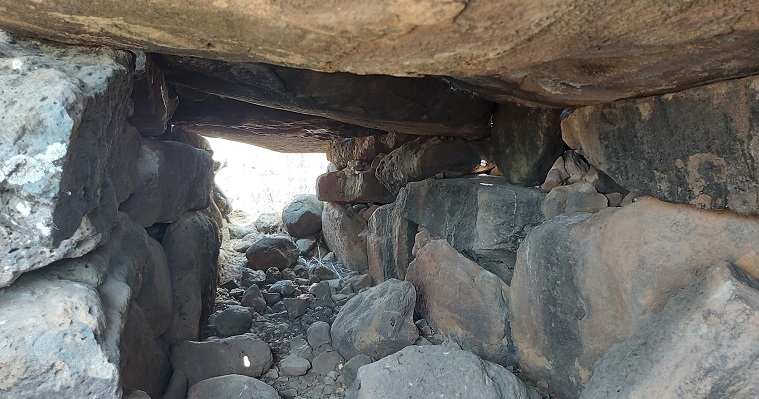
Building on the research conducted by Devereux and others, we now propose a hypothesis that the construction of Megalithic sites and the rituals performed within them are linked to shamanic practices aimed at altering states of consciousness. It is believed that during the time of the Goddess, similar rituals were conducted at these sites using drums, music, and other instruments to produce sounds at low or alternating frequencies. Freikman supports this theory and suggests that the “burial chamber” at Rujum Hiri served as an amplification chamber for low-frequency sounds [2].
I had the opportunity to engage in sound meditation at Rujum Hiri and several other Dolmens and Tumulus’s in the Golan, and based on my personal experience, I can attest that it is effective. This underscores the possibility of exploring Megaliths and stone circles from perspectives beyond traditional research paradigms.
Devereaux suggests that the sounds produced during rituals at stone circles were somehow captured or imprinted in clay pots. In the future, it may be possible to reproduce these sounds, akin to playing back a tape recording, thereby connecting with the auditory experiences of the past.
Energy lines in Israel
The “Gaia hypothesis” offers a different perspective on the significance of the Land of Israel and helps explain why Human civilization originated here. If we view the planet as a living organism, different regions play specific roles. For instance, the Andes-Central America-Rocky Mountains form a lengthy Mountain range extending from the North Pole to the South Pole, resembling the Earth’s backbone. Similarly, the Syrian-African rift, the longest valley on the planet stretching over 6,000 km from Turkey to Mozambique, can be likened to a womb, the birthplace of Mother Earth. Along this rift, the first Humanoids, including Homo sapiens, emerged, marking the genesis of agriculture, the construction of early cities, the emergence of world religions, and other pivotal events.
Israel occupies a unique position along the Syrian-African Rift, notable for its physical and energetic characteristics. Physically, it encompasses some of the lowest places on Earth, with a significant concentration of minerals, salt, and crystals, particularly in the region of the Dead Sea. Moreover, from an energetic standpoint, the Arava and Jordan valleys exhibit a strong energetic influence. These factors contribute to various historical and religious events, such as the settlement of the Essenes in the desert and the baptism of Jesus in the Jordan River. Additionally, the presence of the oldest known settlement in the world, Jericho, near the Dead Sea, further underscores the significance of this region.
From a geodesic perspective, Israel occupies a remarkable position on the Earth. Situated at the beginning of the second third of the northern hemisphere, around 30 degrees north latitude, it shares the same latitude as the Great Pyramid at Giza. Furthermore, Israel serves as the convergence point for three continents: Asia, Africa, and Europe, as well as two seas: the Red Sea and the Mediterranean Sea. Adding to its intrigue, if one were to combine the entire landmass of the planet, connecting the Americas to Africa and Europe and Australia to Asia, the calculated center of this landmass falls within the vicinity of Israel. Consequently, Israel is often referred to as the center of the world, and its significance is underscored by the notion that events occurring here resonate globally, including those related to the Megalithic culture.
It appears that, akin to the measurements observed in Megalithic sites, the dimensions of the Land of Israel resonate with those of the Earth and its connection to the universe. Notably, the average width of the shadow cast by the Moon on the Earth, as observed during events like solar eclipses, is approximately 100 kilometers (though this can vary by location and time). Remarkably, this aligns with the width of the Land of Israel. This correlation may be further emphasized by the geographical alignment of Israel: on its western side, place names such as Beit Shemesh or Apollonia are associated with the sun, while on the eastern side, names like Beit Yerah or Jericho are linked with the moon. It’s worth noting that from our perspective, the apparent diameters of the sun and the moon in the sky are equivalent.
Given the factors we’ve outlined and others, if there exists a network of energy lines across the Earth, then Israel would likely play a significant role within it. Indeed, the primary energy line of Europe, known as the Saint Michael/Apollo line, initiates in Israel—specifically, in the Carmel region—and traverses through key sites in Europe. These include Rhodes, Athens, Delphi, Monte Saint Angelo, and Sacra Saint Michel in Italy, Mont Saint Michel in France, the island of St. Michel in England, and Skellig Michael in Ireland. Interestingly, these locations are associated with apparitions of Archangel Michael in the Middle Ages, heralding new eras, and with prophecies linked to Apollo in ancient times. Importantly, many of these sites were constructed atop earlier Megalithic sites, underscoring their historical and spiritual significance.
English geomancers recognize a divergence of the Saint Michael’s energy line in Cornwall, leading to notable sites such as the expansive stone circle at Avebury, the ancient mounds of Glastonbury and Cadbury, and the Megaliths of Cheesewring, among others. If such patterns exist in England, it would be prudent to explore potential branches of this line in Israel. Regardless, Israel holds a pivotal position within this energy network.
Carmel serves as one of the primary origins of the energy line network in Israel. However, another crucial starting point, arguably the most significant, is Jerusalem. Positioned centrally within Israel, Jerusalem holds the symbolic status of the world’s navel. It stands as the singular holy site revered by three major monotheistic religions: Judaism, Islam, and Christianity, all of which regard it as the epicenter of creation. This designation is often associated with the “Foundation Rock” beneath the Dome of the Rock, believed to mark the genesis of existence. Alongside this sacred rock, Jerusalem boasts two other natural “Megaliths” sanctified by religious significance—the Rock of Golgotha within the Church of the Holy Sepulcher and the Rock of the Ascension atop the summit of the Mount of Olives.
I must confess my initial skepticism regarding the concept of energy lines when I began my research. However, my perspective underwent a profound shift when I connected the Foundation Rock in Jerusalem with the Great Pyramid in Giza, tracing a straight line on a map. To my astonishment, I discovered that the sole pyramid in Israel, located in the ruins of Hurbat Madras in the Judean Lowlands, lies precisely on this line. This alignment seems far from coincidental. Continuing along this line, on its opposite side, lies Jericho, near which stands the pyramid-shaped holy mountain of Quruntul—a pivotal energy point associated with one of the earliest settlements in the world, as detailed in the chapter on Jericho.
At Tel Gezer in the coastal plain, significant standing stones are present, one of which was transported from Jerusalem, located 50 km away. Naturally, I established a connection between these sites, and to my surprise, I discovered that the Ark of the Covenant Monastery, the Benedictine Monastery at Abu Gush, and the ancient city of Emmaus—where Jesus appeared to his disciples after his death—are all situated on the straight line connecting the Foundation Rock in Jerusalem with the megaliths at Gezer. In essence, all the significant locations associated with Jesus outside of Jerusalem align along this line. The stone in Gezer appears to link the energy of these places with Jerusalem, potentially facilitating apparitions supported by the energy line.
The notion of straight energy lines is not merely a fantasy, especially when viewed through the lens of ancient sacred architecture. Orientation played a pivotal role in the creation of holy sites, suggesting a deliberate alignment along specific axes. It’s conceivable that this alignment occurred incrementally, with additional sites being incorporated along the same line, extending in a consistent direction.
Furthermore, as previously elucidated, the shamanic spirit journeys of the Goddess culture were often associated with linear trajectories. It’s worth noting that alternative doctrines, such as those of the spiritual community of Damanhur, propose that the earth’s energy lines are not strictly linear but rather possess curved and winding configurations. These lines are likened to rivers or the arteries of a circulatory system, serving not only to interconnect different parts of the earth but also to establish a connection between the earth and the broader universe, facilitating the flow of information and synchronicity along their pathways.
One tangible expression of the belief in straight energy lines is the construction of lengthy, linear walls that extend for kilometers. These walls are prominent in prehistoric sites across Jordan and northwestern Saudi Arabia, as well as in other regions worldwide, including Israel. In desert areas, ancient low walls can be found stretching across vast distances, serving no practical purpose but rather holding ritual significance. Israel is home to several such walls, with the most renowned being the K line in the Negev. This low stone wall, erected by enigmatic individuals millennia ago, originates from the highest peak in the Negev, Mount Ramon, amidst a field of remarkable tumuli. It proceeds toward another mountain, adorned with its own collection of tumuli, aligning with the direction of the sunset on the longest day of the year.

Mount Ramon and the K Line
Located on the southwest side of the Ramon Crater, not far from the Lotz pits, lies the summit of Mount Ramon, the tallest peak in the Negev at 1,040 meters. Its elevation may not be immediately apparent upon approach, as it ascends gradually, seamlessly blending with its surroundings. It’s only when you reach the summit that its towering stature becomes evident, particularly as you peer over the steep drop-offs on the opposite side. The panoramic vista from the mountaintop is truly breathtaking. On one side, the expansive Ramon Crater stretches out below, while on the other side, in the direction of the Sinai Desert, the distant rounded peak of Mount Hillel comes into view (which some speculate to be Mount Sinai).
Atop the elongated summit of Mount Ramon lies a collection of perfectly round tumuli, encircled by large stone slabs and featuring a central space akin to a grave, open to the sky. Even from afar, these tumuli, situated at the highest point of the ridge, stand out against the backdrop of the sky, resembling stars rising above the horizon. As you draw nearer, you’re struck by their abundance and craftsmanship. Adjacent to them lies a rock surface, both natural and crafted, serving as a suitable site for rituals and worship. It’s from this location that the enigmatic K line begins—a low stone wall stretching 5 kilometers towards the sunset, extending beyond the summit of the opposite Mount Romem, marking the path of the longest day of the year.
In essence, the summit of Mount Ramon houses a sacred complex with multiple elements that interact with both its nearby environment and the distant landscape. It features tumuli and remnants of other structures, possibly temples or dwellings, along with rock surfaces designated for worship. The mysterious K line wall extends from this site, connecting it to neighboring mountains and other sacred complexes in the vicinity.
Most archaeologists date the compound and the tumuli to the Middle Bronze Age, around 4,000 years ago. However, alternative researchers suggest an earlier origin for the tumuli phenomenon in the Negev, tracing it back to the dawn of history, some 5,000 years ago, or even to the Chalcolithic period around 6,000 years ago. There are also arguments proposing an even more ancient origin, pointing to the tumuli in Ramat Saharonim as evidence.
The ridges of Mount Ramon bear a striking resemblance to those of Ramat Saharonim, located on the opposite side of the Ramon crater. The orientation of the K line on Mount Ramon towards the sunset on the longest day of the year mirrors the alignment of temples on Ramat Saharonim. This similarity between the two sites, coupled with their connection to the crater, suggests that they are integral parts of a larger network of sites designed to bridge the world of the deceased with the living. They likely served to enhance the earth’s energies in accordance with the ancient understanding of the earth as a nurturing mother figure.
Due to their proximity, orientation, and shared use of tumulus structures, it is reasonable to speculate that a connection exists between the two sites. Given that both sites are part of the same geographic feature, the Ramon crater, and considering that the site in Ramat Saharonim has been reliably dated to the 6th millennium BC, it is plausible that the site on Mount Ramon was also constructed, at least partially, during this period.
As you traverse the path of the K line’s stone wall, there’s a palpable sense of its presence, even when it vanishes underground, based on my own experiences. While the wall appears intact from a distance and can even be observed on platforms like Google Earth, upon closer inspection, it might seem like nothing more than a heap of stones. However, a more thorough examination reveals deliberate arrangements of the stones, suggesting intentional construction. There are segments where the line seems to fade away, likely due to damage over time, but its existence is still perceptible, and it often reemerges further along the route.
Yigal Garnot, who discovered the K line, proposes that besides aligning with the sunset on the longest day of the year, the Tumulus’s atop Mount Ramon are also oriented towards the sunrise on the shortest day of the year, suggesting that the entire site served as a Sacred complex doubling as an astronomical observatory and calendar. From the perspective of energy lines, it’s intriguing to observe that extending the K line southeastward leads directly to Petra and Mount Aaron, the most Sacred site in southern Jordan. It’s not difficult to envision ancient worshippers atop Mount Ramon, revering the sun’s descent along the K line on the longest day of the year.
Near the summit of Mount Ramon, accessible via a dirt road, there’s a parking lot adjacent to a sign displaying a map detailing the K line and the nearby summit site. From there, a path guides visitors to the remnants of ancient buildings and temples, offering panoramic views of the crater, access to the Tumulus’s, and the rock platform.

[1] Fazenda, Bruno, et al. “Cave acoustics in prehistory: Exploring the association of Palaeolithic visual motifs and acoustic response.” The Journal of the Acoustical Society of America 142.3 (2017): 1332-1349
[2] Freikman 2014, p. 188.


Thank you. I have a lifetime association with the Michael mary ley line in the U.K.and was aware of the Michael Apollo intersection but have recently become aware of the energetic importance of Israel in a number of ways and your post has clarified this beautifully. It seems that all that no longer serves humanity is pouring through this genesis point right now (as well as in other places)!and we will be able to enter a rebirth and resurrection on a collective level. I have never visited Israel but feel strong connections, including parallel lifetime with the Essenes. Thank you again. I will be visiting a pint on the line near st Michael’s mount in April with the intention of forging unity and resolution through the grid.