This is a rudimentary translation of articles from my book “Two that are One – the story of Omar Rais and the Shadeli Yashruti Zawiya in Acre”. While is far from ideal, it serves a purpose given the significance of the topic and the distinctiveness of the information contained. I have chosen to publish it in its current state, with the hope that a more refined translation will be available in the future.
The Story of Omar Rais Part Three
See – The Story of Omar Rais Part One
See – The Story of Omar Rais Part Two
The works in the Zawiya
The Zawiya stands out as a remarkable example of preserving ancient architecture while seamlessly integrating it into new construction. Situated in the heart of the historic city of Acre, it spans approximately five Dunams and comprises several key structures: the Takiya hall, featuring the city’s second-largest dome, the Mashhad hall for sacred graves, the original residence of Sheikh Ali Nur Al-Din Yashruti, as well as the dwelling and assembly area of Sheikh Al Hadi Yashruti. Additionally, the complex includes remnants of Crusader halls, spacious chambers, and a courtyard adorned with pillars. Altogether, it forms a splendid and aesthetically captivating site poised to welcome numerous pilgrims and visitors upon its opening.
During Omar’s stewardship of the Zawiya, his presence permeated the entire space, whether he was physically present or not. Many, including myself, felt drawn to the Zawiya because it seemed as though someone awaited us there. It was as if the spirit of the Sheikh lingered in the air, channeling through Omar, who held authority over the site, creating a sense of security and protection. Omar himself cherished moments spent at the Zawiya, whether engaging with visitors or simply sitting in quiet reflection, practicing Ta’amul and allowing time to unfold. This distinctive atmosphere was palpable to the regular workers, construction collaborators, numerous visitors, and followers of the order who frequented the site for pilgrimage and ceremonies alike. At the center of it all stood Omar, embodying the essence of the Zawiya’s significance.
A significant challenge in our world lies in our inability to sustain fleeting atmospheres, causing special moments, acknowledged and cherished by many, to dissipate as if they never occurred. The profound sense of camaraderie and interconnectedness among individuals, vividly felt in the moment, often fades from memory for some while lingering as a poignant recollection for others. Regrettably, what was once palpable and cherished can be dismissed by some as though it never existed at all.
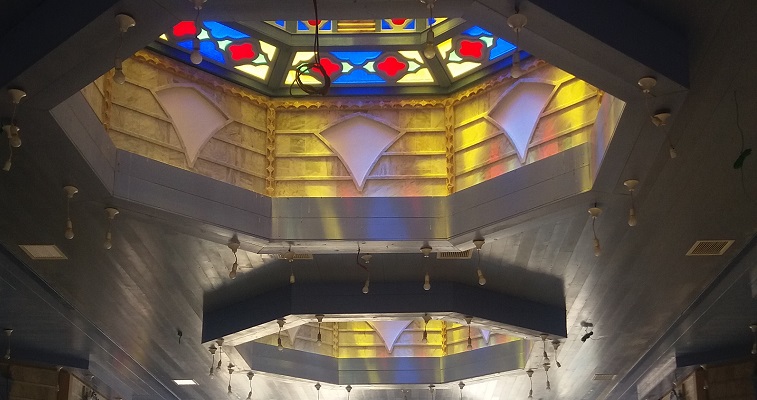
During Omar’s lifetime, the Zawiya exuded an atmosphere of openness and promise, largely owing to his strength of character. Even amid the disruptions of construction, there remained a palpable vitality and uniqueness to the place. This ambiance was not solely attributed to the spiritual energy of the Sheikhs but also to the various events surrounding the project, including other assets of the Shadeli Yashruti endowment in Acre. The restoration of the Zawiya contributed significantly to the city, enriching its cultural fabric. The distinct blue dome of the Takiya hall, standing out against the skyline of the old city, served as a tangible symbol of this transformation.
Despite dedicating himself fully to the Zawiya project, often extending beyond regular hours, Omar steadfastly refused any monetary compensation for his efforts. He held firm to the belief that the sacred realm should remain untainted by material concerns. For him, working on the Zawiya was an act of service rather than a means of financial gain. To support himself financially, he took on occasional shifts at the family’s factory and provided private tutoring to students.
Faten (Omar’s wife) recounts that according to the Sheikh, Omar’s passing occurred upon the completion of his earthly mission. Each individual, the Sheikh believed, has a distinct purpose to fulfill, and upon its fulfillment, transitions to another existence where new tasks await. Omar’s task was the construction of the Zawiya—a feat others couldn’t or wouldn’t undertake. Possessing a resolute character, he possessed a farsightedness extending beyond the Zawiya to encompass all aspects of life. Contemplating the sky or sea, he was often visited by thoughts and visions, foreseeing events that unfolded as he had predicted, while others are still unfolding. Yet, many of his insights remained private, shared with no one.
Faten reflects that Omar’s purpose was intricately tied to the construction of the Zawiya, encompassing its manifold implications. Possessing virtues of patience, wisdom, and compassion, he quietly extended assistance to others without seeking recognition. A profound thinker, he approached matters with deep contemplation. Though occasionally stubborn, his steadfastness often proved justified, rooted in his intuitive understanding of unfolding events and his commitment to ensuring their proper realization.
The Zawiya construction initiative commenced in 1998. Its initial phase involved relocating the inhabitants residing within the complex and securing alternative accommodations for them. Faten recalls how Omar diligently devised solutions for each resident. Actual construction work commenced around the year 2000, albeit progress was initially slow due to the discovery of significant antiquities beneath the Zawiya. It was revealed that the site overlaid the crucial Knights’ Halls of Acre, including the Place of the Covenant, which served as the headquarters of the Hospitaller Order. Procuring the necessary approvals and permissions took considerable time, but momentum began to build after 2006.
As construction began on the Mashhad, the initial and most demanding undertaking was the construction of the burial chambers, a task expertly handled by Hatem. Witnessing Hatem’s success in this endeavor bolstered their collaboration, prompting Omar to entrust him with greater responsibility. Hatem subsequently became a key partner in overseeing the construction of the entire Mashhad, followed by the Takiya and the surrounding structures. Concurrently, efforts were underway to rebuild the house of Ali Nur Al-Din Yashruti, alongside other halls and rooms within the Zawiya. Additionally, various buildings belonging to the order in the historic cities of Acre and Tarshiha underwent reconstruction.
Approximately ten workers were regularly employed at the construction site, supplemented by specialist workers assigned to specific projects. According to Faten, what many failed to grasp was the considerably greater challenge posed by reconstructing an old building compared to erecting a new one, particularly when the structure holds religious and historical significance and efforts are made to preserve its heritage.
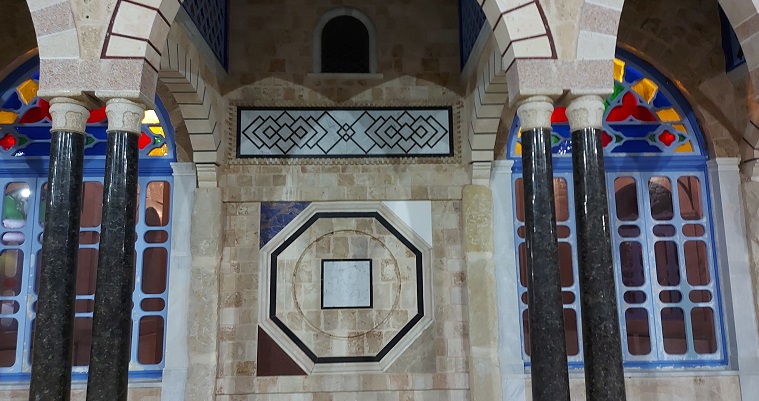
Sheikh Ahmed Yashruti envisioned the Zawiya to be constructed in the North African Andalusian style, a preference stemming from Sheikh Ali Nur Al-Din Yashruti’s affinity for this architectural tradition. For Sheikh Ahmed, this style served as a symbol of the region from which Sheikh Ali Nur Al-Din Yashruti originated (Tunisia). He remained intricately involved in every aspect and phase of the construction process, overseeing the construction of a splendid portico adorned with marble columns and arches surrounding the Mashhad, and the design of canals and water fountains reminiscent of the Alhambra style in the courtyard.
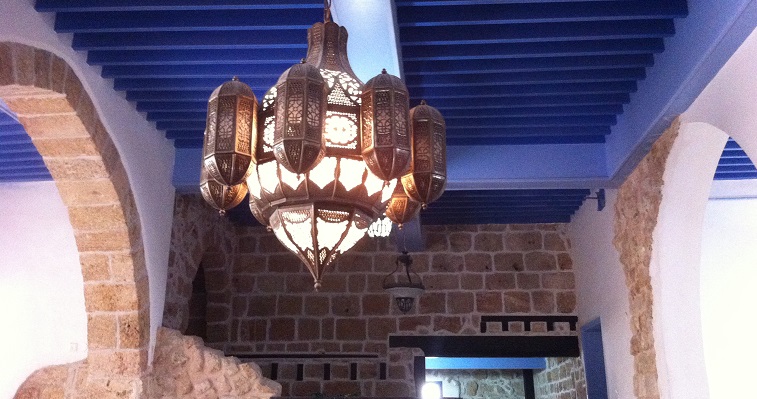
The concept of the blue dome for the Takiya originated from Hatem, who proposed the idea to Sheikh Ahmed Yashruti. Initially considering options to refurbish the dome externally, Hatem consulted with a planner on potential materials like copper or lead, who suggested titanium. Upon further investigation by Hatem and Omar, they delved into the possibilities of titanium and even received samples from a family member, leading to the creation of the striking dome coating. Blue prominently features throughout the Zawiya, inspired by Sheikh Ahmed Yashruti’s directive to incorporate everything beloved by Sheikh Ali Nur Al-Din Yashruti into the Zawiya, as the latter had a fondness for the color blue.
The marble columns were sourced from a company in China (likely brought from Tibet), which also handled the engraving based on provided plans. A skilled wood artist from Tarshiha village dedicated several years exclusively to crafting the intricate woodwork for the windows and doors of the Zawiya. The windows featuring colored glass were designed with repeating schemes imbued with symbolic significance, mirroring the symbolism found in the diagrams and marble mandalas adorning the walls and floors.
The Zawiya brims with symbolic meaning, intricate diagrams, effectively a stone-bound tome conveying profound esoteric philosophy. Omar delved into every detail of the construction, engaging in deep dialogue with Sheikh Ahmed Yashruti and the unseen realms about its significance. His profound desire, as I perceive it, was to establish a sanctuary that would radiate holiness, positively impacting the entire world and serving as a spiritual beacon. A subsequent chapter in the book delves into the meanings of the symbols, colors, and numbers within the Zawiya.
Beyond the grandeur of its construction, Omar’s deepest aspiration, from my interpretation, was to transform the Zawiya in Acre into a “Kaaba of the heart” for all: from casual tourists to Israelis (Jews and Arabs, including Palestinians), and extending to members of the order from around the globe. This vision encompassed honoring the sacred graves of the revered Sheikhs and establishing a spiritual hub for Sheikh Ahmed Yashruti. Omar envisioned the Zawiya not only as a site for pilgrimage, worship, and ceremonies for the faithful but also as a nexus for intercultural and interreligious dialogue, reaching every individual and benefiting society at large.
In line with Muzkara, the Sufi tradition of the Shadeli Yashruti order, Omar staunchly advocated for dialogue. He believed that our differences exist to facilitate mutual learning, with each individual possessing a fragment of truth, and only collectively can we attain the complete truth. He often remarked, “If I challenge your existence, I challenge my existence.” Recognizing our interconnectedness, Omar placed humanity at the focal point of existence, viewing the entire universe as designed for human benefit. Guided by this principle, he dedicated numerous hours to engaging with people in meaningful discussions.
Omar’s sister, Huda, revealed his aspiration for the Zawiya to serve as a global destination, welcoming visitors from diverse backgrounds. He envisioned it as a multicultural research institute fostering interreligious dialogue and housing a museum chronicling the history of the order and Sufism in Israel.
A leader in Acre’s Christian community attested that Omar was a unifying force, bridging divides between Christians and Muslims. Thanks to his efforts, Quranic verses about Mary were recited for the first time in a church, and Zawiya hosted a Christmas dinner, fostering harmony and understanding.
Omar envisioned the Zawiya as a significant hub for the people of Acre and the Tariqa alike. His aim was for individuals to visit and gain insight into the presence of Sufism, advocating for the recognition of the order and embracing inclusivity among disciples. Drawing inspiration from Sheikh Ali Nur Al-Din Yashruti, Omar emphasized the primacy of humanity over physical structures. He echoed the sentiment that “we did not come to build stones,” highlighting the intrinsic sanctity of humanity as the true essence of the place.

Restoration of the Order’s properties
In addition to the Zawiya in Acre, the Waqf of the Shadeli order maintains numerous other properties and buildings in Acre and its vicinity, including the historic Zawiya in Tarshiha. These properties encompass thousands of square meters of buildings, some of which hold historical significance. Omar took on the responsibility for the renovation and upkeep of these properties. Under his leadership, many houses and spaces throughout the old city were renovated, with some being rented out to meet the needs of the local population.
One of Omar’s aspirations was to establish a tour in Acre that would trace the evolution of the Shadeli Yashruti Order. This tour would encompass visits to the historical residences of the order’s founders, the Olive Mosque, the original Zawiya, and the bakery, culminating in a visit to the renovated Zawiya itself. Additionally, he envisioned repurposing other buildings in possession of the order for suitable activities, such as creating a hostel for order guests and providing space for secular public activities.
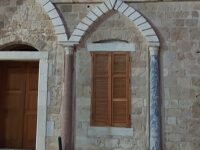
Not far from the Moshe Chaim Luzzatto Synagogue, situated along the alley leading from the Al Mualek Mosque, lies a courtyard containing several rooms and halls belonging to the Shadeli Yashruti order. According to Omar, this area, also known as “The Old Zawiya,” once housed the initial followers of Sheikh Ali Nur al-Din Yashruti upon his arrival in Acre. Notably, on the lower floor stands a spacious area that once served as a bakery in those early days, while the second floor boasts a larger hall constructed as part of subsequent reconstruction project. Characteristic of Shadeli Yashruti buildings are their doors and windows, painted in a distinct shade of blue. Yet, as Omar often pointed out (paraphrasing), while Shadeli Yashruti buildings are indeed blue, not every blue-painted building belongs to the order; other groups, such as the Bahá’ís, adorn their doorways in blue as well.
On Beit Lusinian Street, adjacent to the Monastery of Our Lady of Nazareth, stands another cluster of buildings belonging to the Shadeli Yashruti Waqf. This complex comprises several halls and apartments, one of which is currently leased to a children’s daycare center. In one of the larger halls within this complex, I arranged a series of workshops and performances in 2012, featuring a branch of the Order of the Whirling Dervishes from America. Omar graciously permitted us to utilize the space, aligning with his vision of the Zawiya’s role in Acre to support cultural endeavors. The workshops garnered significant success, drawing hundreds of attendees to the performances, which were integrated into the Akko Festival program.
Apart from the endowed properties in Acre, the order also holds possessions in the village of Tarshiha, centered around the historic Zawiya. This exquisite complex, for reasons yet unclear, became embroiled in a dispute between the Shadeli Yashruti order and the state. Omar took charge of the partial renovation of this remarkable site and successfully led the legal battle against the government’s attempt to confiscate some of its territories.
Overall, before the war of Independence, the Waqf of the Shadeli Yashruti order in Israel was quite wealthy, boasting extensive lands, buildings, and centers across the Galilee and in other locations like Jerusalem. When Sheikh Al Hadi Yashruti and his followers departed Israel during the conflict, they left behind the legal representative responsible for managing the properties—the Head of the Executive Committee. This strategic decision helped to prevent their assets in Israel from being classified as absentee property, a matter that will be explored further in the next chapter.
Today, the Shadeli Yashruti order stands as a relatively large organization with a considerable following, including affluent and influential individuals who regularly contribute a portion of their earnings to the order. These generous donations have played a significant role in funding the renovation and construction endeavors of the Zawiya in Acre. When queried about the source of funds for the construction of the magnificent complex, Omar consistently maintained that the Shadeli Yashruti Order steadfastly refuses donations from outside sources. He often recounted an instance where the Saudis offered a substantial sum, only to have the Sheikh decline it. Instead, Omar underscored that the project is being financed solely by the resources of the order, relying on contributions from its devoted adherents.
However, in 2016, progress on the project came to a halt due to financial constraints. Omar justified this setback by pointing out the ongoing humanitarian crisis in Syria, where people were losing their lives and Zawiyas were being destroyed. In light of such pressing needs, he questioned the wisdom of investing in lavish halls when there were more urgent priorities to address.
Omar often recounted a joke that reflected his views on honesty and greed. According to the tale, God tasked Moses with finding an honest man who wasn’t driven by greed. After an exhaustive search, Moses returned to God, admitting the difficulty in finding such a person. God, however, remained unfazed, suggesting that the offer of a suitable sum of money might sway someone’s inclination.
Despite this joke, Omar never sought financial gain for the numerous gatherings he hosted at the Zawiya. He adamantly refused any offers of monetary assistance. Living modestly in a simple home, he adhered to the principles of the Shadeli Yashruti order, advocating that individuals should engage in productive work to earn their livelihood. For Omar, prayer and work were not mutually exclusive; rather, they were complementary aspects of a fulfilled religious life.
legal battle
Omar held a significant role within the executive committee of the Shadeli Yashruti order in Israel, serving as the Matawali—the individual legally entrusted with overseeing all the order’s assets. This position mandated him to spearhead the legal campaign aimed at reclaiming the order’s properties. Before the War of Independence, Sheikh Al Hadi Yashruti, the grandson of Sheikh Ali Nur Al-Din Yashruti, departed the country, relocating to Lebanon. This move, seen as a classic case of absenteeism, prompted the state to assert ownership over historical sites in Acre and Tarshiha, leading to the confiscation of numerous properties and lands owned by the order across the country. However, according to the legal framework during the mandate period, each endowment had an appointed Matawali, who did not necessarily need to be the spiritual leader. This practice was consistent with the situation of the Shadeli Yashruti order in 1948, where the appointee remained in Israel.
For decades, the Shadeli Yashruti order effectively maintained control over their sacred compounds, dutifully paying property taxes despite the unclear legal status. This arrangement persisted, unchallenged, until a sudden bureaucratic twist led certain government officials to assert state ownership over the lands of the Zawiya in Tarshiha. This development compelled the order to embark on a legal battle to assert their ownership rights, a campaign spearheaded by Omar Rais. Assisted by Israeli legal experts and scholars, including Professors Sara Sviri and Yitzhak Reiter, Omar navigated the complexities of the legal landscape with wisdom, determination and resolve.
The legal battle led by Omar held immense significance, as a ruling against the Shadeli Yashruti order in Tarshiha could have set a precedent affecting the Zawiya in Acre as well. Omar’s leadership proved instrumental in achieving what seemed impossible: securing victory for the order in court. Through his efforts, the Shadeli Yashruti order successfully demonstrated its non-absentee status, thereby legally reaffirming its rightful ownership of lands and properties.
Omar’s ability to rally public figures in support of the legal cause, alongside his astute understanding of Israeli legal processes, played a pivotal role in the outcome. Despite the departure of Sheikh Al Hadi Yashruti during the War of Independence, the court recognized the ongoing presence and stewardship of the order, thwarting attempts to confiscate its lands. This landmark decision sets a precedent with far-reaching implications for the future.
Meetings with Jews
Omar devoted numerous hours to meetings with various groups of Israelis, predominantly Jewish, eager to explore the enchanting Zawiya compound and learn about Sufism. While Muslims, Christians, and Druze occasionally joined these gatherings, the primary interest stemmed from Jewish groups seeking insight into “another Islam.” My initial encounter with Omar occurred during the filming of “Arabesque,” a television program delving into Sufism, in which I participated in 2001. Since then, I have led countless groups to the Zawiya, including two training courses for tour guides sponsored by the Ministry of Tourism, marking a significant highlight.
During these visits, Omar was the focal point of the gatherings. Following the initial surprise upon discovering the presence of Sufis and exposure to their moderate worldview, recurring questions emerged: “Why aren’t Sufis more widely known? If they advocate love and tolerance, why isn’t their voice heard more often? Why don’t various Sufi groups unite against extremist interpretations of Islam? Why don’t they engage in politics?” To these inquiries, Omar consistently emphasized that Sufis, in principle, refrain from political involvement. When pressed further with “Why not?” his response was simple: “You don’t mix apples and pears!”
Sufism, particularly the Shadeli Yashruti tradition, focuses on spirituality. Attempts to intertwine spirituality with politics are futile. The two realms are fundamentally incompatible, as political engagement can distort spiritual teachings. However, it’s unrealistic to entirely disregard our surroundings. Omar firmly believed that everything happens for a reason, even amidst the challenges of the War of Independence and the Nakba. We may not comprehend God’s intentions, but we must accept all occurrences, including the hardships, as part of God’s will.
Omar emphasized the importance of abiding by state laws, yet he also questioned the notion of the nation-state, considering it a construct of the 19th century. Instead, he advocated for multiculturalism as a more inclusive alternative. According to him, embracing multiculturalism could naturally alleviate many national conflicts. However, alongside multiculturalism, he underscored the need for justice and humanity to address the challenges faced by Arabs in Israel and Palestinian refugee problem.
Omar had a deep understanding of the Jewish trauma stemming from the Holocaust and showed empathy towards it. He recognized that establishing dialogue required fostering a sense of security in the other party. He believed that building trust was essential for addressing significant challenges. Moreover, he held the view that the solutions to the region’s problems lay not in the realm of earthly matters, but rather in the spiritual domain, where all individuals are regarded as equal and valuable.
Omar embraced the notion that a Sufi adapts to the customs of their time and place, stressing the importance of behaving in accordance with the prevailing culture. In his vivid expression, he would say, “In Brazil, I wear a bikini; in Saudi Arabia, I wear a veil.” He clarified that followers of the Shadeli Yashruti order aimed to avoid provoking hostility in their society, thus adhering to local customs. However, he emphasized that the paramount concern was the relationship between individuals and the divine. In comparison, worldly matters paled in significance. Nations may rise and fall, but one must accept the present circumstances and focus efforts on the primary purpose of existence: drawing closer to God. Omar acknowledged the freedom of worship afforded by the State of Israel while simultaneously engaging in a strategic and persistent campaign to reclaim the order’s property and lands.
One day, a grand mawlid ceremony honoring the Prophet Muhammad took place at the Zawiya in Acre. A friend of mine, aware of the event, arrived uninvited and sought entry to participate. Unfortunately, he was turned away, likely in a discourteous manner, by a member of the order stationed at the entrance. The following day, Omar contacted me, visibly distressed. He revealed that the Sheikh had temporarily expelled this individual from the order, expressing deep dismay over the incident. Omar emphasized that such behavior was disgraceful, asserting that the Zawiya is a sanctuary of God open to all, not the exclusive domain of any individual.
Throughout history, cooperation between Jews and Muslims has been prevalent. In Egypt, for instance, Jewish communities were fluent in Arabic, reading and writing in the language. Following the era of Maimonides, a sect of Jews known as the “Hasidim” emerged in Egypt. Their aim was to rejuvenate Judaism through the lens of Sufism. They asserted that Sufis had adopted their dances, songs, and rituals from ancient Jewish prophets, and it was now incumbent upon them to reintegrate these practices into Judaism. Their focus was on matters of the heart, devotion, as well as practices of celibacy and ecstasy. This movement, which endured for two centuries, was initiated by Rabbi Avraham ben Maimon, the son of Maimonides. He expressed, “Do not think that it is inappropriate to compare their behavior (of the Prophets) with the behavior of the Sufi dervishes, since the Sufis imitated the Prophets and did as they did and not the other way around…”.
In another passage, it is mentioned: “And do you know what the custom of the Prophets is like among the Sufi dervishes of Islam that is practiced among them in the iniquities of Israel, a custom of the first righteous of Israel which is not practiced among us now or is almost abolished among us – because the rabbi dresses his disciple in his robe…” This is corroborated by writings found in the Geniza in Cairo dating back to the 12th century, which include translations into Hebrew of works by the Sufi sage al-Ghazali, among others.
Another notable instance of spiritual cross-fertilization and cooperation occurred during the Golden Age in Spain. Rabbi Chai Ben Yosef Ibn Pakuda’s book “The Obligation of the Hearts”, for instance, exhibits clear Sufi influences.
Omar discovered a shared interest with a group known as “Derech Avraham,” which sought to revive Sufi-Jewish collaboration by convening to study Kabbalistic and Sufi texts. Comprising Jews (including scholars and rabbis) and Arabs (including Sufi sheikhs and academics), the group provided a platform for cultural exchange and mutual understanding. Omar extended invitations to members of the group to do their Hanukkah gatherings at the Zawiya, much like he welcomed Christians during Christmas. Attending the group’s meetings was a priority for Omar, and despite facing health challenges, he made a determined effort to participate, even attending his final meeting held at the Zawiya in 2017, where he arrived with his foot half-amputated, relying on crutches.
Building on this connection, Omar forged a unique bond with Professor Avi Elkayim, who led the Mosayuf Center for the Study of Kabbalah at Bar Ilan University and possessed expertise in Sufi mysticism. Together, they engaged in philosophical discussions in Tel Aviv under the auspices of the French Consulate in Israel. Omar extended his involvement to various spiritual gatherings, endorsing intellectual endeavors such as book publications and supporting international workshops on whirling Sufi dance led by visiting Sheikhas. Additionally, he made several television appearances, sharing insights on Sufism and its philosophical underpinnings.
More about his unique spiritual path
Omar once shared with me the diverse currents within the Shadeli Yashruti order, recounting how Sheikh Ahmed Yashruti once remarked that Omar was a current unto himself. Although he once aimed to acquaint me with the “mainstream,” it became evident to me that Omar was the very heart of it all.
He often asserted that Sufism transcends religious boundaries, tracing its roots back to the dawn of humanity. In his view, Sufism encompasses Muslim, Jewish, and Buddhist perspectives, emphasizing the universality of belief over specific doctrines. “It’s not about what you believe,” he would say, “but that you believe.” He pointed out parallels between Sufi thought and the works of Israeli poets like Shaul Tchernichovsky’s “Play, play” (Sahki, Sahki) and Bialik’s “The Pool,” underscoring the timeless relevance of Sufi philosophy.
Omar consistently emphasized that he wasn’t a missionary, underscoring the intrinsic nature of Sufism as an internal journey rather than a proselytizing endeavor. He maintained that even being born into a Sufi family didn’t guarantee one’s adherence to Sufism; it was a personal journey of enlightenment. While he aspired to embody Sufi principles, he humbly acknowledged his ongoing journey and considered himself an ordinary person equipped with certain tools. Among these, he highlighted the significance of the connection to the Sheikh, recognizing the guidance and mentorship essential for navigating the perilous path of Sufism.
Omar underscored three fundamental principles as the cornerstones of the Sufi path: free thought (Universalism), meditation (connecting to the spiritual realms), and love. He regarded adherence to these principles as essential for those aspiring to follow the Sufi path. Omar stressed the freedom to contemplate any subject, drawing inspiration from a diverse range of thinkers including Spinoza, Rumi, Ibn Arabi, and Bialik. He often remarked, “Truth is a circle,” illustrating that each individual occupies a unique position along the circumference, yet every point holds significance. As one moves closer to the center, the unity of all perspectives becomes apparent, revealing the relevance of every point along the path.
Omar often emphasized, “Around the circle, there are countless points, but they all converge to one.” From this perspective, he concluded that there is no Heresy. He elaborated, “If everyone possesses a portion of the truth, then by labeling someone as an infidel, I challenge my own existence.” To illustrate this, he recounted the story of Alexander the Great and his close friend, a general whom he executed. Omar interpreted this action as unwitting self-harm, emphasizing our interconnectedness and the notion that any harm to a part of the whole is harm to the entirety.
Omar often spoke about the conflict within Islam, highlighting the divide between extremists and moderates, which included Sufis. He likened the presence of Sufis among extremists to “a bone in the throat, neither vomit nor swallow.” He believed in the necessity of dialogue with all Islamic groups. Privately, he expressed deep concern about the growing extremism, particularly during the rise of the Islamic State, which posed a significant threat to the region.
Omar stressed the importance of Ta’amul as a form of meditation, focusing on contemplating God’s attributes and works in creation. This practice involves reflecting on God’s names and attributes and observing how they are manifested in the world and within oneself, ultimately leading to a deeper connection with the divine essence.
During one of the sessions at the Zawiya, Omar introduced us to a meditation practice focusing on the third eye area. This spiritual organ, situated on the forehead between the two eyes, holds significance in Sufi philosophy. According to Sufi teachings, it is through this metaphysical “eye” that God uttered the command “Be,” and it serves as a gateway to perceiving truth beyond the illusions of the material world.
According to Sufi teachings, particularly those of Ibn Arabi, the faculty through which we perceive the truths of existence is the imagination. This world of images serves as a bridge between the realm of divine archetypes and our mundane reality. Through disciplined meditation, one can tap into this transitional world and gain insight into higher realities. Omar, following this tradition, would often begin his day with deep meditation, harnessing the power of the imagination to connect with deeper truths. Occasionally, he would also venture into nature for meditative experiences of a different kind.
Omar stressed the importance of observation and attentive listening, often remarking, “The first lesson we impart is learning to listen.” He believed that the world is replete with signs and messages, if only we pay close attention. Omar advocated for a specific form of listening known within the Shadeli Yashruti order as Nasheed poetry, a form of chanting performed without musical instruments. This practice, he explained, trains individuals to absorb the blessings inherent in poetic verses, accessible only to those who have cultivated the art of deep listening. By honing their listening skills through Nasheed, individuals would be better equipped to discern the subtle melodies of the universe, from the rustling of trees to the delicate whispers of flowers.
Omar often recounted an anecdote involving his daughter to illustrate the importance of attentive listening. He would recall, “One day, as I was searching for a particular café, we drove aimlessly through the streets. My daughter, seated beside me, repeatedly tugged at my sleeve, insisting, ‘It’s here,’ ‘It’s here.’ Yet, I failed to heed her, continuing to drive past.”
Omar placed great emphasis on the concept of love as the third essential aspect of the spiritual journey. He posited that God, out of His love and desire not to be alone, created a second being from His light. In Islam, this being is referred to as “Had֗rahָ Muhammadiya,” while in Judaism, it is known as “Shekinah.” This being, characterized by its feminine nature due to its creative qualities, is credited with the act of world creation. Omar often spoke of the profound bond of love between God and this feminine being, which he described using the term “Uns,” signifying a refined and deeply intimate love.
Omar frequently addressed inquiries regarding the role of women in Muslim society, often redirecting the conversation to spiritual dimensions. He asserted that in the Sufi perspective, women possess independence rather than equality; they have autonomy over themselves. Moreover, he emphasized the elevated spiritual status of the female entity, describing it as profoundly lofty and esteemed, surpassing even that of created beings like ourselves.
Omar consistently contended that the entirety of creation exists for humanity, with the universe revolving around and serving mankind alone. However, he also posited that within humanity lies a divine throne, upon which resides the feminine being known as the ḥad֗rahֿ Muhammadiya. For this being to dwell within individuals, eight virtuous qualities must be cultivated daily. This belief is rooted in the Quranic verse: “On that Day eight ˹mighty angels˺ will bear the Throne of your Lord above them,” (Surah 69: Al Haqqa, The Reality, verse 17).
Omar believed that as God resides within humanity, the sanctity lies in human life, dignity, and freedom. Therefore, he advocated for individuals to define religious practice for themselves. He often posed the question, “What is prayer? Define prayer for me,” and responded with, “Prayer is to give a mouthful of bread to the poor, to perform a good deed.” He emphasized that performing religious rituals without genuine compassion and goodwill towards others holds little value, stating, “If I pray five times a day and harbor hatred towards my neighbor, it’s not worth anything.”
Omar often likened prayer to exercise, viewing it as a personal and intimate connection with the divine. He recounted a story of a woman engaged in spontaneous prayer whom a passing poet questioned about her actions. After she explained, the poet advised her on the correct method of prayer and continued on his way. However, Upon reaching the designated spot to sing, he discovered that the songs had slipped from his memory, and his voice failed him. he returned to the woman and acknowledged her sincerity. He said to her, “Pray as you wish, for God loves Fatma and Fatma loves God. Who am I to interfere in this?”
Omar often posed the question: “What is fasting?” particularly during Ramadan, a time when he himself observed fasting. His answer was consistent: “Fasting is not solely refraining from food, but also from negative thoughts, a means of purification. If you fast yet harbor anger towards your wife, it holds no value.” It’s worth noting that in the Sufi tradition, true fasting transcends mere abstention from food. There exist three levels: the ordinary fast, a heightened form where believers refrain from negative emotions, and an elevated level observed by complete Sufis who abstain from every sinful thought.
Omar had a unique perspective on religious laws, asserting that sometimes refraining from sinning could be a greater transgression than committing the sin itself. This echoed the paradoxical viewpoint of the Sufi Malamatiya movement in Central Asia, known as “the people of Guilt.” An illustrative tale from this tradition tells of a Sufi boy who spent the night in prayer while his brother slept. In the morning, he proudly informed his father of his devotion. The father’s response was unexpected: “Son, it would have been better if you had followed your brother’s example and slept, for the angels visited him in his dreams and overlooked your vigil.”
The most formidable challenge on the spiritual journey is pride, as it is the sole quality that completely separates us from God. Sometimes, excessive religious observance can breed pride, to the extent that the condition of someone who is not religious may be preferable to that of a religious person ensnared by pride. An anecdote about Prophet Moses illustrates this: When he complained to God about the Israelites, God instructed him to bring forth the worst among them. Moses searched and found a man stealing, but upon closer inspection, discovered he was raising two orphaned children. Similarly, he found a man committing murder, only to learn that he cared for wounded animals. Even the most seemingly reprehensible individuals possessed redeeming qualities. In the end, Moses returned to God and confessed, “I am the worst.” God’s response was profound: “Had you not reached this realization, you could not have continued as a Prophet.”
Omar introduced a novel and invigorating perspective on religion to those he encountered, drawing from the teachings of Abu al-Hasan Shadeli and the interpretations of Sheikh Ali Nur al-Din Yashruti and Sheikh Ahmed Yashruti as he interpreted them. “Live well,” he often exhorted, prompting a collective sigh of relief from his audience, “for there is no reward or punishment awaiting us, no Day of Judgment. Those who seek paradise will find naught, not even a single virgin. Instead, we must seek fulfillment here in this world. We dwell in our own Garden of Eden, and it is incumbent upon us to make the most of our time here.”
Personally
Omar relished moments spent with a cup of coffee, often accompanied by distinctive hand gestures—a subtle measuring motion, inviting others to assess situations as they are, or a gentle turning of the fingers, encouraging a shift towards the right direction. A contemplative thinker, he cherished dialogue, both internally and with others. Yet, he understood that true dialogue hinges on attentive listening, thus he diligently practiced Ta’ámul, a form of meditation, as the cornerstone of Muzakara, the Sufi dialogue. His attentive listening fostered an environment where people felt comfortable opening their hearts to him.
Omar enjoyed posing thought-provoking questions, such as his daily inquiry to his sister: “Did you talk to God today?” He had a deep appreciation for poetry, engaging in lengthy discussions to unravel the hidden depths of verses or insights gleaned from nature. His unconventional thinking made conversations with him a genuine pleasure. When faced with a dilemma or seeking answers, he relied on intuition, echoing the guidance of the Sheikh: “Return to your heart; there you will find the answer.”
In the tradition of Sufi dialogues, Omar had a unique manner of communication. His words carried layers of meaning, inviting listeners to decipher the hidden depths behind his expressions. Moreover, he often tailored his remarks to provoke thought, disrupt established norms, and foster fresh perspectives. His discourse was not just about conveying information but also about evoking introspection and responding to the unspoken sentiments of his interlocutors.
Omar had a penchant for aiding those in his inner circle. His sister, Huda, recounts an instance when her son faced challenges studying medicine in Amman. Omar intervened, insisting they sit down together upon his return. He tasked the young man with reading several chapters within a set timeframe, employing a structured approach to enhance focus. Through Omar’s guidance and support, Huda’s son managed to concentrate effectively, mastering the material and ultimately succeeding in his exams.
According to his wife Faten, Omar performed numerous acts of kindness that went unnoticed by others. He often remarked, “When the right hand gives, the left hand doesn’t need to know about it.”
I witnessed Omar’s commitment to justice and fairness firsthand when he tasked me with writing a book about the order. Unbeknownst to me, another individual involved in Sufi affairs approached him, seeking to replace me on the project. However, Omar remained steadfast in his principles, recognizing the injustice and refusing to entertain such manipulations. His integrity was unwavering; he not only refrained from betraying trust but also intervened to prevent others from doing so.
Despite his many virtues, Omar, like any individual, had his faults. One notable flaw was his habitual tardiness, a trait that occasionally provoked frustration in others. However, my affection for him often blinded me to these shortcomings. Whenever I arranged to meet him in Acre and he arrived late, I found myself immersed in joyful anticipation at the Zawiya. During those moments, I would drift away into imaginary realms, waiting for his arrival. While Omar’s punctuality may have been inconsistent, he always remained true to his word and fulfilled his promises without fail. There was never an appointment he missed or commitment he failed to honor.
When I invited Omar to my fiftieth birthday celebration in Lotem, my village, he graciously attended and adapted to the local customs. During a tour of the Zawiya for my elderly father, he expressed his appreciation for me, stating that he valued our friendship even more now. Omar’s ability to be a true friend was a rare and cherished quality, especially in today’s world.
crisis
“Say, O Prophet, “I seek refuge in the Lord of the daybreak, from the evil of whatever He has created, and from the evil of the night when it grows dark, and from the evil of those witches casting spells by blowing onto knots, and from the evil of an envier when they envy.”” (Surah 113: Al Falak, The Breaking Dawn, verses 1-5).
In 2016, progress at the Zawiya began to slow down. Although much of the project was already completed and it seemed close to completion, two significant obstacles emerged. Firstly, funding became scarce, catching everyone off guard as the project turned out to be more costly than anticipated. However, the more pressing concern was the destruction of the order’s Zawiyas in Syria due to the ongoing civil war, resulting in harm to the order’s followers. In response, the Sheikh vowed to rebuild the Zawiyas in Hama, Aleppo, and other affected areas at any cost. This crisis demanded the allocation of all available resources towards this critical endeavor.
Hatem Harouf suggested that it might be possible to complete the first floor of the Zawiya, or at least certain sections of it. The Sheikh even proposed that Omar sell one of the order’s properties to fund the renovations. However, Omar was not one to compromise; he was a visionary who looked far into the future.
The halt in renovation work had a negative impact on Omar. Firstly, he had to let go of the workers who had been dedicated to the Zawiya project and had traveled a long journey with him. Despite his efforts to secure employment for them elsewhere, it proved challenging. Secondly, he internalized the situation, feeling that all his efforts were futile. According to Omar’s family, he was weary during that period, evident in his voice.
Shortly after the work was halted, Omar fell ill. As recounted earlier in the book, his health declined due to a seemingly minor incident. One day, Omar sustained an injury to his toe, possibly at the Zawiya, which later became infected. Initially dismissing it as a mere bruise, he neglected proper care. By the time he sought medical attention in Nazareth, the infection had worsened, leading to the need for partial amputation of his foot. Subsequently, half of his leg had to be amputated as well.
According to Omar’s wife, Faten, the amputation was a result of infection, not diabetes. Despite his illness, Omar bore his burdens silently, choosing not to burden others with his problems. Yet, his sadness and withdrawal were noticeable. Throughout his hospitalizations, enduring excruciating pain after the amputation and undergoing extensive rehabilitation, he remained resilient. Remarkably, he maintained his sense of humor; once, he even jokingly asked his sister not to change her heels because he enjoyed hearing her approach his hospital room during visits.
A few months after his disappearance, I finally convinced Omar to meet me at his mother’s house. There, I discovered that half of his foot had been amputated due to an infection. Shortly after, when we met again, half of his leg up to the knee had been amputated. “You’re serious,” I joked, “each time a different part of you is cut off, like al-Halaj.” Omar chuckled. “Do you understand Sufism now?” I asked. His answer was evident.
At the onset of his illness, he resided at his mother’s ground-floor house, indulging in his love for reading books. However, in the final months of his life, he insisted on returning home, despite it being on the top floor. His wife noticed a change in him, remarking that his demeanor had shifted, his speech softened. She sensed that he found solace in being back home.
The illness seemed to soften Omar’s demeanor, fostering a sense of reconciliation with the world. Yet, he remained steadfast in his principles and way of life. It afforded him more time with his wife and daughters, allowing him to engage in his meditations and immerse himself in the mystic teachings, including those of Sheikh Ibn Arabi, whom he admired deeply.
One day, I visited the Zawiya with a group, and the executive committee of the order was meeting in the adjacent room. There was a palpable difference in the atmosphere from the usual. When I shared this observation with Omar over the phone, he responded, “I will improve and address matters; I will restore normalcy.” There was indeed hope for his recovery, and he had begun visiting the Zawiya again. However, his condition later worsened.
What occurred in the final two weeks of his life was unexpected; no one anticipated his passing at such a young age. There was an assumption that he would recover and resume his activities. Suddenly, he developed breathing problems, yet he didn’t want others to know he was suffering, attributing it to a common cold. He even refrained from informing his sister, who held a senior position in the healthcare system. It began on Monday of that week, and by Tuesday, his breathing difficulties had worsened to the point where he could no longer move. Despite wanting to vote on election day, he was unable to do so. His condition showed slight improvement on Wednesday but then deteriorated once more. By Thursday, he requested to be taken to the hospital for examination. Unfortunately, after two weeks, he passed away.
In the final two weeks of his life, he experienced kidney failure and understood that the end was near. The day preceding his passing, he requested his chair, stating, “I have an urgent meeting, I have to go,” repeating this phrase three times. Evidently, he was alluding to a meeting in heaven. Throughout his life, he achieved all he set out to do, consistently performing acts of kindness, never complaining, and never compromising his principles. Now, he was prepared for new missions in other worlds.

death
Omar often recounted the following tale: Near the end of his life, Imam al-Ghazali, a revered Sufi scholar, approached heaven. God asked him, “What have you brought with you?” Al-Ghazali replied, “I come with my prayers, fasting, adherence to the law, and teachings. I have done all I could.” “It is not sufficient,” declared God, “take him to hell!” As the angels began to escort him away, al-Ghazali implored God desperately, saying, “Have mercy on me!” God summoned the angels back and spoke to al-Ghazali: “Once, a fly fell into your inkwell, and you showed it mercy, setting it free. For this act, I will show you mercy.” With that, God commanded the angels to welcome al-Ghazali and opened the gates of heaven for him. “That’s Sufism,” Omar would conclude, “that’s the essence.” I am certain that Omar ascended to heaven with his “flies” and now resides there.
When his brother Munzer passed away, Omar expressed that he sensed his soul still accompanying them, and he truly believed it. He was the only one who didn’t shed tears, convinced that Munzer was now with God in heaven. Today, those who love him still feel Omar’s presence in their lives, finding solace in the belief that he is now with God. Yet, the sadness remains.
Faten initially felt that Omar’s death came too soon. When he returned home, he seemed happy, and she had hoped they would have more time together to enjoy life and do the things they wanted. His sudden passing was a profound shock to her. She struggled with feelings of sadness and anger, feeling that they were both young and hadn’t had the chance to fulfill their plans. However, she also holds onto her faith in God, believing that what happened was perhaps for the best for both of them. Even though Omar is gone, Faten and their daughters still feel his presence, as if he continues to live with them. Sometimes, she feels as though he may be among the hidden saints, while at other times, she sees him as an ordinary human being like anyone else.
The Sufis hold the belief in union with the beloved after death, in the cyclical nature of existence where nothing is truly lost, and in the return of the soul to its origin. Omar’s journey is far from over; the tree that was felled will continue to bear fruit and sprout new branches. Omar became submerged in the boundless sea of love, evolving from a mere star into the vast expanse of the universe itself. May his memory endure and be blessed.