
History begins with Sumer
Sumer stands as the birthplace of large-scale urbanization, marking the onset of an urban lifestyle. Leading this urban revolution was the city of Uruk, followed by notable centers like Lagash, Ur, Kish, Larsa, Nippur, and Eridu, among others. Each city-state revered its own deity, fostering both collaboration and occasional conflict among them. Concurrently, smaller independent city-states emerged in the land of Israel during this epoch.
The emergence of city-states in Sumer was facilitated by technological advancements like the wheel, cart, water pump, bronze metal, and notably, the invention of writing. This period also witnessed significant strides in thought, morality, education, law, and religion. Intriguingly, even in the earliest epochs of Sumerian history, the culture reached heights that appear unmatched in subsequent eras. Divine rulers presided over a “golden age” characterized by faith, social cohesion, monumental construction projects, and unity. This prompts the question: Did a comparable “Golden Age” unfold in the Land of Israel?
Noah Kramer is widely regarded as one of the foremost scholars of ancient Sumerian culture. In his renowned work “History Begins in Sumer,” he elucidates how numerous elements of contemporary life, including social organization, political institutions, education, the recording of history, and more, originated in Sumer. His resolute conclusion is that history commenced in Sumer 5,500 years ago with the formation of city-states.
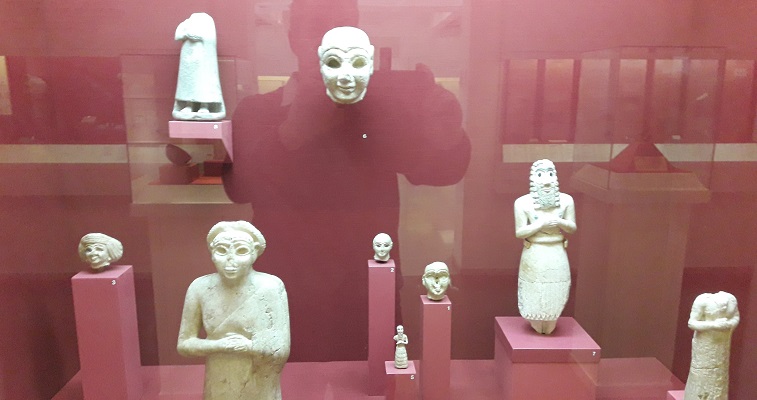
the heart of the Sumerian cities was sacred complex with temples and a sort of pyramid -ziggurat. Thousands of priests served in the temples, and around them were craftsmanship areas and markets that were supported by the temples. Inside the temples were storehouses where the peasants brought the surplus agricultural produce and taxes. Religion added an element of internal motivation that made humans want to be part of the common project. This element (which sometimes tends to be underestimated) was the decisive factor.
The Sumerians were deeply religious, with a complex system of beliefs, worship practices, scriptures, legal codes, and myths. It could be argued that the establishment of temples served as the catalyst for the development of cities and society. Initially, grand temples were constructed, around which markets and craft workshops gradually emerged, ultimately leading to the formation of cities. These temples also served as the birthplace of Sumerian cuneiform script, the world’s first writing system.
The priests wielded significant influence due to their mastery of writing, enabling them to serve as educators, healers, and diviners. Sponsored by the gods, a cultured society centered on writing flourished, with temple schools offering instruction in subjects such as botany, zoology, geography, and mathematics. Both officials and nobles were literate, proficient not only in writing letters but also in handling numerical concepts. The Sumerians developed an intricate mathematical system grounded in the divine number six and the terrestrial number ten.
The imperative to construct temples served as a catalyst for scientific advancement, motivating both the populace and rulers to develop technologies, trade, transportation, architecture, and management skills. The Sumerians demonstrated remarkable capabilities in executing monumental projects based on pre-designed architectural plans, organizing and sustaining large workforces, excavating, leveling, and moving vast quantities of earth, manufacturing durable bricks from clay, transporting massive stones, and procuring metals from distant sources for tools and adornments. These achievements reflect the sophistication of a culture that reached its zenith in the early 3rd millennium BC.
While agriculture remained the foundation of existence, the Sumerians pioneered advanced farming techniques centered on irrigation canals and centralized management. The organization of these endeavors fell under the purview of the priestly kings, conducted with the sponsorship of temples. Establishing an intricate network of waterways required the recruitment of tens of thousands of laborers, all sanctioned by divine authority. With innovations such as crop rotation, ox domestication and its adaptation to plowing, the utilization of bronze tools, and more, the Sumerians achieved an over thirtyfold increase in agricultural yield, enabling them to sustain populous cities. The largest among them (Uruk) boasted an astonishing population of 80,000 individuals.
The Sumerians boasted advanced knowledge in hydrology, geology (including soil types), and engineering. They pioneered the invention of the Pottery Wheel and further developed various crafts. Innovations such as the wheel and bearings, along with the domestication of donkeys and oxen, facilitated the creation of a groundbreaking mode of transportation: the wheeled cart. This innovation enabled the transportation of soil for extensive earthworks, facilitated the transfer of agricultural produce from remote fields, and facilitated the importation of raw materials for city construction.
The advent of writing paved the way for the development of governance structures, decision-making systems, and legal frameworks. The Sumerians embraced a form of governance akin to democracy, striving for societal and cosmic harmony. Kings were entrusted with upholding justice, guided by abstract principles known as “ma,” which they were duty-bound to enforce. Society was stratified into distinct classes: kingship, nobility, priesthood, and servitude. Notably, women enjoyed equitable rights, with opportunities to hold positions as governors, healers, and more.
One hallmark of the sudden and wondrous emergence of cities is the flourishing of art and literary culture. Among the Sumerians, literature encompassed not only religious texts but also moral teachings, animal allegories, and epics delving into the human experience. Additionally, they cultivated poetry, music, and dance, with a particular fondness for percussion, brass, and string instruments. Remarkably, researchers from the University of Berkeley in California successfully decoded Sumerian musical notation, resurrected ancient musical instruments, and brought forth the melodies of ancient Sumerian music!
Sumerian city-states engaged in extensive trade, sourcing raw materials from both nearby regions and distant lands to fuel their burgeoning industries. These materials included lapis lazuli from Afghanistan, obsidian from Anatolia, various metals from the Armenian plateau, and more. To facilitate and regulate international trade, they pioneered units of measurement and the cylinder seal. Long before Gutenberg, they devised a method akin to printing and engraving on clay tablets (instead of paper), revolutionizing record-keeping for commercial transactions, certificates, warehouses, industrial and agricultural products, and the authentication of product quality and provenance.
The Sumerians advanced various industries, including textiles, and cultivated apricots and cherries. They were skilled boat builders and navigated the seas, utilizing tar and natural oil for their furnaces and for glazing pottery urns, likely employing them in metallurgy as well. They fortified clay vessels with mortar for diverse purposes, and their medical practices, taught through clay models, encompassed intricate surgeries.
Among the affluent, homes boasted amenities like stoves, toilets, sewage systems, and running water. They furnished their dwellings with beds, furniture, toys, and games, and evenings were often filled with storytelling and music played on local instruments. Their diet included barley bread and beer. Wool was the common fabric for clothing, while the wealthy favored linen. Men typically wore robes or skirts, while women wore tunics, and both genders used perfumes and cosmetics.
Prior to the advent of Sumerian civilization, the region was characterized by an ancient goddess culture known as the “Ubaid culture.” Despite their location in Sumer, the Sumerians perceived themselves as distinct from surrounding peoples, with a language unrelated to Semitic tongues like Akkadian or other ancient languages in the region such as Egyptian or Hittite. They even described themselves as having a unique appearance, referred to as “black-headed.”
These factors have led to various hypotheses regarding the origins of the Sumerians. Some conventional beliefs suggest migration from regions like the Balkans, the flooded Black Sea area, or sacred locales like Bahrain. Alternatively, there are more unconventional theories positing extraterrestrial origins, proposing that the Sumerians were visitors from outer space who interbred with or genetically engineered early humans. Other theories speculate connections to lost continents like Atlantis, known for its advanced civilization. Zechariah Sitchin is notable for his alternative theories on the Sumerian origin, civilization, and deities.

The theories of Zechariah Sitchin
Zachariah Sitchin, born in Azerbaijan in 1920, immigrated to Israel as a child and later relocated to the United States in 1952, where he spent the remainder of his life until his passing in 2010. Proficient in the study of ancient Sumerian, Sitchin gained renown as a prolific writer, particularly known for his theories regarding the Sumerian gods. He proposed that extraterrestrial beings have been visiting Earth throughout history, engaging in genetic manipulation that led to significant evolutionary leaps. According to Sitchin, these interventions resulted in the emergence of Homo sapiens as well as the appearance of Cro-Magnon man in Europe approximately 35,000 years ago. Additionally, he argued that these beings imparted agricultural knowledge to humans around 11,000 years ago and facilitated the development of civilization approximately 5,500 years ago. Sitchin contended that these episodes of sudden advancement in human evolution were the result of external intervention. For instance, he noted a pattern where significant achievements, such as the cave paintings in southern France during the Paleolithic period, were followed by periods of regression and then sudden leaps, such as the agricultural revolution in the Middle East.
Sitchin proposed that there are undiscovered chapters in human history involving extraterrestrial civilizations visiting Earth and initiating early stages of human evolution through genetic engineering. According to his theory, the first, somewhat unsuccessful attempt at human evolution occurred in the Land of Israel around 100,000 years ago, followed by a more successful emergence approximately 40,000 years ago. This newly evolved human species, Homo sapiens, then spread across the globe, eventually superseding other hominoid species that had existed for hundreds of thousands of years prior.
He argued that over a span of two million years, from the appearance of Homo erectus to the extinction of the Neanderthals, there was minimal advancement in tools and lifestyle. However, the sudden emergence of Homo sapiens with remarkable abilities deviated from the expected evolutionary trajectory. If solely driven by natural evolution, the emergence of Homo sapiens would have required several more million years. Similarly, the progression of cities and civilization would have taken an extended period if left to evolve naturally. The fact that certain tribes, such as those in Australia or the Amazon, did not develop technologically suggests that history is not solely dictated by natural processes; otherwise, advancements would have occurred universally.
Sitchin argues that there are mysterious regressions in human history followed by sudden and remarkable developments, as vividly illustrated in the historical narrative of the Land of Israel. For instance, the remarkable Chalcolithic culture, characterized by temples, subterranean settlements, metallurgical expertise, and intricate burial customs, inexplicably vanished around 5,500 years ago from various locations in Israel, including the Ein Gedi temple, Golan settlements, and Negev villages. There were no signs of destruction, yet this culture made way for the emergence of the first cities and the broader settlement of new populations at the dawn of the historical period.
Similarly, advanced cities materialized seemingly out of nowhere in Israel at the onset of the 3rd millennium BC (some of which are only being unearthed now), only to disappear without apparent cause around the 24th century BC. Following this disappearance, the land reverted to being inhabited by nomads, paving the way for a new type of cities and a fresh civilization to emerge at the beginning of the 2nd millennium BC, eventually flourishing into the magnificent Canaanite civilization.
Sitchin posits that these regressions indicate human development at early stages was not natural, but rather the result of external intervention. Each time humans returned to their normal state, some form of guiding hand intervened, pushing human development forward to the next stage. Sitchin contends that beings from outer space were the ones guiding, supporting, and teaching human beings, often intervening through sages to aid in their progress and development. The appearance of these extraterrestrial beings was perceived by ancient civilizations as the arrival of “gods,” a concept depicted vividly in the stories of the Bible and the mythologies of ancient cultures.
In his book “The 12th Planet,” Sitchin argues that the Sumerian gods, known as the Annunaki, were actually extraterrestrial beings with advanced technology. Drawing from the Bible and his understanding of ancient Sumerian texts, Sitchin posits that these so-called gods hailed from an unknown planet in the solar system called Nibiru, arriving on Earth around 450,000 years ago. Ancient writings, including descriptions of the Nephilim in the Bible, portray these gods as mortal beings who make mistakes, disrupt heavenly order, and lament their fate, strengthening the idea that they were a form of humanoid beings from another realm.
According to Sitchin, the Sumerian deities traveled through the air in rounded, egg-shaped spacecraft, which is why stones such as the pebbles engraved with human-like figures, found at prehistoric sites in Israel like Shaar Hagolan, depict gods in their spaceships.
Stone steles found across the country were also believed to symbolize these spacecraft, hence their sanctity. These steles, referred to as “shining stones,” emitted light. Sitchin suggested that the Hebrew Matzevot (small standing stones) were known as “Yad VaShem” (hand and name), where “Yad” resembled a pyramidion monument, akin to the Ben Ben stone in Heliopolis, and “Shem” featured a rounded top. The word “shem” and the term for sky (“shamaim”) share the same root, indicating that establishing a “shem” was akin to pointing towards or imitating the sky. Interpreting “mu” and “shem” as space vehicles offers a different perspective on mythological narratives. The arrival of beings from outer space, Sitchin argued, provides an explanation for the plethora of astronomical observations and references to celestial bodies.
Sitchin continued to live, work, and write until 2010. While his ideas face ridicule from the scientific community and the public at large, a close examination of his books reveals intriguing insights that warrant consideration, underscoring the importance of his theories.

Sumerian religion
So much for Sitchin’s theories, but what did the Sumerians themselves believe? What was their religion? It turns out that the Sumerians believed that celestial beings, akin to human-gods, descended to Sumer from the sky, created humanity, and imparted the knowledge of civilization. These deities were known as the “Anunnaki,” comprising 12 entities, each half man and half woman. The Anunnaki were depicted with wings, symbolizing their ability to fly. At the helm was “Anu,” the father of the gods, assisted by “Aha” (also known as “Enki”), the god of magic, and “Enlil.” According to Sumerian mythology, Enki fashioned a human prototype named “Adapa” from mud, breathed life into his nostrils, and bestowed upon humans the wisdom of civilization. This, the Sumerians believed, was to ensure that there would be beings to serve and provide for the gods, offering sustenance and garments.
Sumer was revered by its inhabitants as a divine reflection of the heavens, a land established by the gods. According to Sumerian mythology, after creating humanity, one of the deities established five cities in sacred locations, naming and designating them as centers of worship. Following this, the gods entrusted the rulers with the blueprints for constructing both the cities and their temples. In a dream recounted by King Gudea, Queen Nidaba presents him with a tablet inscribed with auspicious stars, while a deity reveals the temple’s design. Eliade suggests that these temple and city models are “transcendent,” existing in the celestial realm before manifesting on Earth. Babylonian cities were believed to have counterparts in the stars; for instance, Nineveh was associated with Ursa Major, and Assyria with Arcturus. This belief in celestial archetypes was widespread across the ancient Middle East.
In Sumerian accounts, the gods descended from the stars and collaborated with humans to construct earthly replicas of celestial realms. If we entertain this notion, then Sumerian ziggurats, resembling pyramids, might have served as launch pads for celestial journeys toward the stars associated with the cities where they were erected—the very stars from which the city’s gods purportedly hailed. Cities and temples were aligned with different constellations, rendering Sumer a terrestrial “reflection” of the heavens, akin to Egypt’s beliefs.
The pivotal question remains: Are Sumerian myths mere whimsical tales, or might there be kernels of truth behind the narratives of extraterrestrial beings endowed with extraordinary abilities? Alternatively, these stories and deities could symbolize cosmic principles governing Earth. Indeed, the Sumerians perceived a cosmic order underlying the world’s phenomena, known as “ma,” orchestrated by the gods. This order was interpreted as “commands” dictating the destiny of all existence. Opposing this cosmic harmony was a force of chaos—the “great serpent”—which threatened to disrupt life and manifested through sins requiring purification. Erecting a temple was an endeavor to restore this cosmic order, as the temple mirrored the world (Imago Mundi).
According to Eliade, the cosmic order must be rejuvenated annually through magical rites performed during the New Year’s Eve celebration known as “A-Ki-Til,” signifying “the force that renews the world.” The central ceremonies, known as “Nam Tar,” facilitated the influx of divine energy into the city and the land, fostering prosperity and abundance. Among these rituals was the sacred marriage, symbolizing the union between the king, embodying Dumuzi, and the high priestess, representing the goddess Inanna—a symbolic merging of gods and humans.
In contrast to Noah Kramer’s more pessimistic view, Eliade posits that the Sumerians were not mere subjects of the gods but collaborators, aspiring to emulate them. Eliade suggests that humanity possesses a divine essence, the life-giving breath of Anki, enabling individuals to bridge the gap between human and divine existence. According to Sumerian religious beliefs, humans could transcend their mortal state to embody divine qualities. Eliade interprets human actions as mimicking the gestures of the divine, with the institution of monarchy representing an opportunity for humans to attain godlike status and wield divine powers. Thus, human behavior is viewed as a replication of the actions revealed by divine beings.
The kings were perceived as divine representatives, with the temple serving as the divine seat adjacent to the king’s palace. Each city had its patron god overseeing its administrative affairs, collectively forming a council of gods governing the world. This distribution of deities among Sumerian cities underscored the distinct roles each city played within the religious and social framework, depicting the Sumerian kingdom as a federation where cities enjoyed autonomy and interdependence. Unlike some historical perspectives, there was no inherent desire for one city to dominate another; instead, they coexisted in mutual support.
Humanity’s duty was to assist and provide for the gods, tending to their needs and serving them, with priests appointed for this purpose. Alongside the “royal” religion, a personal religion emerged among the masses, involving domestic worship directed toward minor deities. Each individual adopted a personal god, responsible for their safety and well-being, serving as their advocate before the council of the major gods. This reciprocal relationship between gods and humans fostered interdependence.

The principal deities of Mesopotamia
It’s important to note that despite the decline of Sumer itself at the onset of the 2nd millennium BC, Sumerian culture and religion endured. In Mesopotamia, subsequent peoples and empires, notably the Babylonians and Assyrians, largely embraced Sumerian religious practices and its sacred language. Even as new deities were incorporated into the pantheon, they were often equated with Sumerian gods. For instance, the Babylonian god Marduk came to be associated with Anu, the sky deity, or Enlil, the god of the atmosphere.
By delving into the knowledge of Mesopotamian gods, one can gain insight into the prevailing spirit of the era and attempt to unravel the religious tapestry that existed in the Land of Israel at the dawn of history. Each city-state in Sumeria had its own patron deity, and it’s conceivable that a similar arrangement existed in Israel. For instance, if the moon god “Sin” was revered as the patron deity of the city of Ur in Mesopotamia, it’s plausible that he held a similar status in the city of Bet Yerah in Israel. Likewise, if the sun god “Shamash” was honored in Larsa, he may have been venerated in the vicinity of Yarmut near Beit Shamash in Israel.
However, while Mesopotamia boasts numerous written records detailing the gods and their worship, no such documentation exists from the early history of Israel. Therefore, it’s prudent to draw from the knowledge of Mesopotamian and Egyptian deities to infer the possible religious practices and beliefs in Israel during that time. Given the geographical proximity and cultural exchanges between these regions, they likely shared common influences and religious traditions.
In Sumerian tradition, the gods are typically depicted as humanoid figures with distinctive attributes, unlike the Egyptian pantheon, which often featured hybrid forms of humans and animals. A prominent characteristic of Sumerian deities is their headdress adorned with horns and a star, symbolizing their connection to the celestial realm. According to Eliade, this symbolism dates back to the Neolithic era and reflects the transcendental nature of the stormy sky. Sitchin, on the other hand, interprets this as emblematic of the gods’ status as super beings who traversed the galaxy or hailed from a distant planet, perhaps the elusive “12th planet.” Regardless of interpretation, the gods were associated with luminosity and radiance.
The foremost deities among the Sumerians were “An,” the god of the sky (later supplanted by his son “Anu,” born of his union with the goddess “Ki”), “Enki” or “Ea,” the god of wisdom (alternatively considered the god of the elements and the earth, sometimes identified with water), and “Enlil,” the god of the atmosphere that separates the earth from the heavens (the patron deity of Nippur, the religious and spiritual hub of Sumer).
“Anu,” the Sumerian deity associated with the sky, was the offspring of the primordial divine pair “An” and “Ki,” representing the union of heaven and earth. He held dominion over the celestial realms, where he spoke the stars into existence, administered justice (overseeing moral order), and embodied the realm of abstract ideas. Like other gods, he was often depicted wearing a headdress adorned with horns and a star, sometimes depicted holding an object reminiscent of the Egyptian symbol of life. Interestingly, in Hebrew, the word for “I” is “Ani,” suggesting a recognition of divinity within oneself, as per Sumerian linguistic roots. It’s worth noting that many Hebrew words have ancient origins traceable to Egyptian or Mesopotamian languages.
The temple dedicated to the sky god “An” or “Anu” stood prominently in Uruk, one of the most significant cities in Sumer (and the world at that time), situated atop the ziggurat—a pyramid symbolizing the cosmic mountain—at the heart of the city’s sacred precinct. “Anu” initially wed the goddess of creation, “Antu” (or “Ki”), from whose union emerged the Annunaki and seven malevolent demons known as “Assaki.” Later, “Antu” was supplanted by “Inanna,” the second deity venerated in Uruk. Consequently, two distinct sacred complexes emerged—one atop the ziggurat dedicated to “Anu,” and another near the river honoring “Inanna.”
In Babylonian tradition, “Anu” is regarded as the offspring of “Epsu” and “Tiamat” (the deity of freshwater and the goddess of the salt sea, engaged in a cosmic battle with Marduk, who fashions the universe from her remains). Situated in the third heaven, “Anu” assumes the role of the supreme ruler and progenitor of the gods, lacking any human depiction; instead, he is symbolized by a temple featuring a divine horned dome. Associated with the number 60 and the celestial equator, his veneration involves the use of a special drum. “Anu” is linked to the heavenly bull and is revered as the patron of kings and princes, known as “the beloved of Anu,” rather than the common populace.
The Babylonians contributed significantly to astrology and numerology, building upon Sumerian precedents where gods were construed as abstract principles. Each deity was assigned a specific celestial domain—distinct angles of the sky—represented by numerical values within the sacred cosmology. Mathematics became intertwined with astrology, with Babylonian priests dedicating themselves to the meticulous calculation of celestial movements—a practice known as astronomy. Their expertise in sacred mathematics facilitated the construction of temples and ziggurats, which, besides serving as architectural marvels, likely doubled as sites for astronomical observations aligned with celestial constellations.
Sun, moon and storm gods
It’s intriguing to observe that the Sun, the Moon, and the planet Venus, three of the most prominent celestial bodies, are deified in numerous cultures worldwide. Their inclusion as a secondary triad in Sumerian cosmology suggests that the abstract order governed by the primary gods extends to the intermediary realm of the heavens. While a hidden divine world underlies existence, its manifestation in our world occurs through this celestial intermediary.
Known as Nana Suan in Sumerian, the Sumerian moon god takes on the name Sin in Akkadian and Babylonian traditions. As the son of Enlil, Sin oversees cattle productivity, vegetation, and agricultural abundance. His sacred number is 30, and his symbol is the crescent moon sickle, often adorned with a beard made of lapis lazuli—a golden-blue hue. Depicted riding a winged bull, he typically wears a turban and horns like other gods, with his symbol often represented as a triple tripod. According to Professor Emanuel Anati, worship centers dedicated to the moon god Sin dotted Mesopotamia, with significant sites located in Ur in the south, Haran in the north, and even in Israel, notably at Mount Karkom in the Negev, identified by some as the biblical Mount Sinai, hence its name.
Indeed, the imposing ziggurat of Ur, situated in southern Mesopotamia, stood as a testament to the reverence of the moon god Sin. The city’s monarch held the esteemed role of high priest to Sin, while the female members of the royal family served as priestesses in Sin’s temple. Sin also held paramount importance in Haran, a city located in northern Mesopotamia. The Temple of Sin in Haran underwent renovations by both the Assyrians and Babylonians, featuring a series of distinctively colored and shaped temple buildings, each dedicated to one of the seven planets visible to the naked eye traversing the sky.
In Mesopotamian mythology, every night, the god Sin embarks on his celestial journey aboard a chariot resembling a crescent moon, traversing the heavens. At times, the crescent is depicted as a weapon wielded by Sin, but when the moon reaches its full phase, Sin assumes the guise of the “crown of Sin,” and his appellation changes to “Nana,” meaning “the luminary.” The moon’s cyclical transformations imbued Sin with an air of mystique, leading him to be dubbed “the one whose deep heart no god can penetrate.” Sin is attributed with profound wisdom and is closely associated with prophecy. His significance extended even into international relations and politics, as he convened with the gods at the conclusion of each lunar month, rendering decisions on their behalf.
According to Eliade, the moon orchestrates a vast array of destinies and forms of existence, weaving together harmonies, symmetries, participations, and more, all coordinated by the lunar cycles. This intricate web simultaneously connects humans, rains, vegetation, fertility, health, animals, death, and the afterlife. As the lord of all things, the moon oversees cycles and time, serving as the guide for the departed souls. To some extent, the moon held a central role in Mesopotamian religion, akin to the sun’s importance in Egyptian religious beliefs.
In Babylonian and Akkadian mythology, the god Shamash (the etymological origin of the Hebrew word for “sun”) assumed greater prominence than in Sumerian lore. In Akkad, Shamash is revered as the guardian of cosmic order, lauded in Akkadian hymns as the source of light and warmth, the arbiter of day-night cycles and seasons. He is the patron deity of prophets and magicians, with the burgeoning field of astrology among the Babylonians closely associated with him. As the god of justice, Shamash upholds moral leadership, depicted in the iconic image of Hammurabi receiving divine laws from him on the famous stele. Shamash also oversees prophecy interpretations, his sacred number being 20, symbolized by the winged sun disk.
Ishtar
So far, our focus has been on male deities, but it’s essential to acknowledge the presence of female goddesses in Mesopotamian mythology. Each male god was paired with a wife and a mother. Among these goddesses, one of the most significant is Inanna, also known as Ishtar. In Uruk, alongside the temple dedicated to Anu, the father of the gods and the sky, stood a temple devoted to Inanna. This independent status granted to Inanna underscored her vital and unparalleled importance among the pantheon, often regarded as the consort of Anu and embodying the diverse attributes of the female deities.
Inanna-Ishtar embodies the paradoxical realms of love and war, overseeing the intricate cycles of life and death while bridging opposites. This duality is symbolized by her androgynous portrayal, representing the unity beyond duality itself. Artifacts, such as the central stele found in the Temple of Tombstones in Canaanite Hazor, depict two raised palms as a homage to Inanna, reflecting a prayerful gesture.
The worship of Ishtar extended to the Semitic peoples of the Levant, where she held a prominent position, known as “Ashtoreth” among other titles. In Babylon, her priestesses engaged in ritual prostitution and were known as Kdeshot, while Assyrian depictions emphasized her martial aspect, often portraying her wielding a bow. Ishtar’s association with the planet Venus, visible both in the morning and evening sky, underscores her connection to the cycles of life and death. Additionally, she is linked to the star Sirius, shining brightly in the celestial expanse. Ishtar’s domain encompasses the fertility of crops, animals, and humanity, with her sacred number being 15. Her symbol, an octagonal star, sometimes adorned with 16 points, embodies her multifaceted nature. Often depicted riding a lioness or accompanied by one, she holds symbols of rulership—a scepter and a ring—while donning the horned cap signifying her status among the principal deities. Her hairstyle, reminiscent of Egyptian “Hathor’s curls,” further highlights her divine presence.
Ishtar features prominently in one of the foundational myths of Mesopotamian religion, recounting her union with Dumuzi (as Inanna), her descent into the underworld, death, and subsequent resurrection. This myth symbolizes the cyclic nature of agricultural seasons and humanity’s quest for eternal life, forming the core of spring rituals and sacred marriage ceremonies. In the context of the Land of Israel, Ishtar’s significance lies in her association with local goddesses, not only as Ashtoreth but also as Anat, as we will explore later. The widespread Canaanite cult of Ishtar is evident in mythological writings discovered in Mari and Ugarit.
The sacred pillar serves as a prominent symbol of Ishtar and other female deities. Canaanite figurines of Ashtoreth were often hollow and mounted on wooden posts. Sometimes depicted as gateposts, these pillars were crafted to resemble reeds and culminated in elaborate curls. At other times, the cedar tree symbolized the goddess, revered by the Mesopotamians as sacred and referenced in the tale of Gilgamesh’s journey to the holy mountain (Lebanon). The cedar represents Ishtar’s lament for her beloved Dumuzi, coinciding with the onset of summer.
Inanna and Dumuzi
The Sumerian myth recounts the tale of Inanna (Ishtar), the sky queen, whose union with the shepherd Dumuzi elevated him to the throne of Uruk. Their marriage symbolizes hierogamy—a sacred union between humans and gods, bestowing blessings upon humanity, fertility upon the land, and advancing civilization.
Inanna resolves to descend into the underworld to supplant her sister, Ereshkigal, as its ruler, perhaps driven by a desire to address the human dilemma of death. The sky’s sovereign seeks dominion over the earth’s depths, a quest laden with symbolic significance. Along her descent, she sheds seven garments, rendering her vulnerable in the presence of Ereshkigal, whose gaze bestows death upon her. Inanna succumbs, her lifeless form hung upon a hook. Yet, three days later, she is resurrected by the waters of life—an echo of themes found in the resurrection of Jesus.
Before her descent into the underworld, Inanna instructs her vizier, Ninshubur, to appeal to the great gods for aid in her absence, should she fail to return. Ninshubur approaches Anki, the god of wisdom, earth, and fresh water, who fashions two sexless beings from the dirt beneath his fingernails. Entrusted with the plant and waters of life, they journey to the underworld, retrieve Inanna’s lifeless form from Ereshkigal, and restore her to vitality. However, her release from the underworld is contingent upon leaving a substitute in her place. Discovering that her husband, Dumuzi, reveled in her absence, she chooses him as her replacement. Despite Dumuzi’s pleas to the sun god Utu for mercy, seven demons seize him and drag him into the underworld.
In this turn of events, both Inanna and Ereshkigal, the queen of the underworld, show pity. Dumuzi’s sister, Geshtinanna, known as the Lady of the Vine, volunteers to take Dumuzi’s place. Eventually, an agreement is reached: Geshtinanna will dwell in the underworld during the winter, while Dumuzi will do so during the summer. Thus, the belief emerges that Dumuzi (Tammuz) dies with the arrival of summer, a cycle that repeats annually. While Dumuzi’s return to the underworld is regrettable, it is deemed the lesser of two evils. The true significance of Inanna’s descent into the underworld lies in severing the bond between humans and gods, and consequently, in the loss of fertility on earth—a “cosmic catastrophe” of profound dimensions.
The goddess’s absence leads to repercussions among both animals and humans, akin to the impact of Demeter’s absence in Greek myths. The sacred union between humans and gods is disrupted, prompting the intervention of the great gods. Tammuz, also known as Dumuzi, is revered in a cult that commemorates his descent into the underworld each summer. He embodies the tragic archetype of the youthful god who experiences death and resurrection. Kings, too, share in his fate, reflecting the inherent link between creation and mortality. While conquering death proves futile, Inanna’s quest, it is replaced by the concept of resurrection—a merging of the human and divine that offers redemption.
Eliade interprets Dumuzi’s “death” as an initiation ritual, akin to a sacred “mystery.” This cult was widespread across the Middle East. According to Eliade, the cyclical destruction and renewal of the world each year was essential. He suggests, “Given the goddess of love and fertility’s failed attempt to overcome death, one must embrace the cycle of life and death. Within this cycle lies the enigma of resurrection—the salvation of humanity and their destiny beyond death.”
One poignant aspect of Mesopotamian religion is Ishtar’s lamentation over the death of her beloved husband Dumuzi, despite her role in his demise. Dumuzi’s descent into the underworld at the hands of demonic forces unleashes havoc upon the world above. Previously, he served as the shepherd of his people, but his fall prompts him to express his sorrow for his land and city through words imbued with magical potency. These words unleash droughts, troubles, storms, and diseases, bringing devastation upon the land. The suffering persists until the divine decree is reversed, but Dumuzi lies in a magical slumber and can only be awakened by the lamentations of Inanna and the humans. Upon awakening, he emits the resounding bellow of a wild bull, heralding a change in fortune for both himself and the land.
Dumuzi, also known as Tammuz, embodies the archetype of the slain god, akin to the Greek Adonis. His annual descent into the underworld mirrors the withering of vegetation during the scorching season, symbolizing his imprisonment in the realm of the dead. Countless laments are sung over his disappearance, accompanied by the subsequent devastation of nature—ritual dramas in which women play a prominent role. Three women mourn Dumuzi: his wife, his sister, and his mother. These laments, found in Mesopotamian literature, chronicle the futile quest to find and console him in the realm of the deceased. The purpose of this mourning is to rouse the god of vegetation, facilitating Dumuzi’s resurrection and ascent from the underworld, thereby revitalizing flora and fauna and bringing abundance to the land. Dumuzi represents not merely a deity or mythical figure returning to life but also the potential for humanity to achieve resurrection and eternal life
Enuma Elish – the Sumerian epic
According to Shin Shifra’s “In Those Distant Days,” the Mesopotamians held literature in high regard within their worship and religious practices. They believed in the inherent power and virtue of words, bestowing upon literature a sacred status and attributing its works to higher authority. Poetry was not considered a product of the individual’s creative spirit—the poet—but rather a divine revelation bestowed upon them, which they then transcribed. As such, future generations were instructed to contemplate these divine revelations. Among the most significant religious texts and poetic epics in Sumerian culture is the Enuma Elish, a cosmogonic poem that encapsulates Sumerian beliefs regarding the origins of the world and the creation of humanity.
This significant text provides insight into the Sumerian perspective on the universe’s structure, a viewpoint mirrored in the layout of their cities, much like the myths surrounding Inanna and Dumuzi were reflected in their religious practices. The initial cities were constructed as super-temples, serving as bastions of cosmic order—cosmos—amidst the surrounding chaos. According to this belief, the formidable city walls acted as mystical barriers demarcating the realm of cosmos from the abyss of chaos, with the city representing the first manifestation of order from the formless primordial Sea.
The term Enuma Elish, as mentioned above, suggests that the physical manifestation in our world mirrors a divine celestial reality. The text unveils a narrative wherein an undifferentiated sea housed the divine couple Apsu and Tiamat (the abyss), often depicted as a primordial crocodile. From their union, additional divine pairs emerged: Lahmu and Lahamu, who were ultimately sacrificed to bring forth humanity (thus imbuing mankind with a divine essence), and Anshar (the sum of celestial elements above) and Kishar (the sum of elements below), whose union birthed the heavens.
In the Babylonian rendition of Enuma Elish, the sky deity Anu begets Aa, who slays Apsu, and Aa’s offspring Marduk vanquishes Tiamat, fashioning from her remains the earth and sky, culminating in the creation of humanity, who erects temples in Marduk’s honor. Man is formed from the blood of the monsters battled by Marduk, led by Tiamat’s consort, Kingo, yet fashioned by Aa in a divine mold. Enuma Elish was recited at the temple of Marduk in Babylon during the New Year’s celebration.
Tiamat indeed embodies a source of creation, albeit of a negative nature, necessitating Marduk’s corrective intervention, struggle, and initiation to realign creation’s course. The cosmos embodies ambivalent matter and divine form, with the sky constituting one aspect of Tiamat’s essence and the earth forming the other. Hence, the universe possesses a dual structure, with matter entwined with harmony and form imbued with divine essence, crafted by Marduk. The primordial deities, led by Tiamat, seek to thwart humanity’s progress by the hands of the new gods, necessitating magical operations to counterbalance their destructive influence, sanctifying the earth (a part of Tiamat’s form). This entails the construction of cities and temples by both gods and humans, transforming the land into a fusion of creative energy, divine wisdom, and chaotic desolation. Complementing operational magic is religious worship, particularly during festive occasions.
Epic of Gilgamesh
The Sumerians held the belief that their ruler descended from the heavens to assume kingship over the earth, marked by a celestial radiance above his head, and ordained for rulership even before his birth. Regarded as the offspring of the divine, he served as a mediator between gods and mortals, bearing the burden of their transgressions. Dwelling among the gods in a mythical garden where the tree of life and the fountain of immortality reside, he functioned as the divine envoy and caretaker of his people, embodying a fusion of mortal and divine essence. Despite his elevated status, he remained human, akin to his subjects, thus necessitating prayers for his success.
Among the illustrious rulers, the legendary figure of Gilgamesh stands out, whose quest for eternal life ultimately ends in failure. The tales of Gilgamesh, the King of Uruk, constitute the most renowned Mesopotamian epic, originating in Sumerian lore and achieving widespread popularity in Babylon. Though first transcribed towards the close of the 3rd millennium BC, the narrative may have existed in earlier iterations.
According to Eliade, Gilgamesh’s quest for immortality symbolizes a veiled journey of initiation. Prompted by the death of his dear companion Enkidu in their confrontation with the gods, Gilgamesh sets out to seek Utnapishtim, the legendary figure granted eternal life and divinity after surviving the great flood. Along his odyssey, Gilgamesh traverses the gate of the sun, navigates through concealed darkness, resists the allure of the seductive nymph Sudri, and crosses treacherous waters symbolic of death. Upon encountering Utnapishtim, he is tasked with staying awake for seven days and nights—a trial he fails by succumbing to sleep. Subsequently, Gilgamesh attempts to obtain a plant of everlasting youth from the depths of the sea, only to lose it en route, thereby remaining mortal like all humanity.
During his travels, Gilgamesh purportedly reaches Mount Lebanon, and there are indications that he may have ventured into the Land of Israel. Archaeological findings, such as a tablet dating back to the 14th century BC discovered in Megiddo, contain fragments of his epic tale.
Akkad and the new Sumer
The demise of the ancient cities in the Land of Israel occurred around the 24th century BC, coinciding with the rise of Akkad as a regional power and its conquest of the Sumerian cities. It appears that subtle connections link the existence of the independent city-states in the Land of Israel to those of Sumer.
The Akkadians, a Semitic people, ascended to prominence by establishing the first empire in the world. Led by the renowned ruler Sargon I, they founded the city of Akkad near present-day Baghdad, naming it after Ereshkigal, the Sumerian goddess of the underworld. Embracing Sumerian religion and culture, the Akkadians forged an enduring Akkadian-Sumerian synthesis that persisted until the 6th century BC, marked by the Persian conquest of Mesopotamia.
Compared to the Sumerians, the Akkadians were more secular and militant. Following Sargon’s death in 2279 BC, his grandson Naram-Sin emerged as the empire’s next formidable ruler. However, by the 21st century BC, the Akkadian Empire collapsed, paving the way for a resurgence of power among the Sumerian cities, particularly Ur under the leadership of Shulgi. This period ushered in another brief golden age for Sumerian civilization, lasting approximately a hundred years until the 20th century BC. Concurrently, city-states reemerged in the Land of Israel, marking the onset of a new era.


