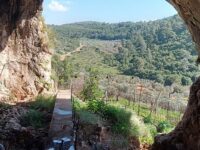
Three Luminous Mysteries of the Rosary and their associated locations: The Mystery of the Proclamation of the Kingdom of God at the Mount of Beatitudes, The Mystery of the Transfiguration on Mount Tabor, and The Mystery of the Institution of the Eucharist at Mount Zion.
Proclamation of the Kingdom of God Mystery
the fruit of the Mystery is confidence in God and a call to accept Christianity
The Proclamation of the Kingdom of God suggests that beyond our physical world and earthly kingdoms lie other, invisible realms, which hold greater significance for humanity’s future. In today’s materialistic, superficial, and fragmented world, believing in these spiritual domains can be challenging. However, a time is approaching when these spiritual worlds will manifest on Earth with full force, becoming palpable to everyone. Then, the world will be governed by the heavenly kingdom. In this future era, the laws that govern life will undergo radical changes. For instance, whereas in the physical world, giving away leads to having less, in the kingdom of heaven, the more one gives, the more one possesses, thanks to divine abundance’s infinite flow. To navigate this forthcoming reality, which, according to Christian belief, is not distant, one must have faith in the course of events, or in other words, trust in God. This concept is linked to the next phase in human evolution, a new level of consciousness that we need to develop.
The Proclamation of the Kingdom of God is the first thing that Jesus does when he arrives to the Galilee, this happens after his baptism in the Jordan river and 40 days’ trial in the desert, he repeats The Proclamation of the Kingdom of God time and time again, and in the most complete form in the Sermon on the Mount, which contains the main themes of his teachings and the Christian faith. The Proclamation of the Kingdom of God appears in Mark (1:15): “The time is full and the kingdom of God is near! Repent and believe in the gospel!”, but I chose to present it in the Sermon on the Mount (Matthew 5:6:7) because this allows to connect the Mystery to a place.
The Proclamation of the Kingdom of God marks the commencement of Jesus’s ministry in Galilee, following his baptism in the Jordan River and his 40-day trial in the desert. Jesus consistently emphasizes the Proclamation of the Kingdom of God throughout his teachings, culminating in its most comprehensive presentation during the Sermon on the Mount. This sermon encapsulates the core teachings of Jesus and the essence of the Christian faith. While the Proclamation of the Kingdom of God is mentioned in Mark (1:15) as “The time is full and the kingdom of God is near! Repent and believe in the gospel!” it is through the Sermon on the Mount (Matthew 5-7) that the Proclamation is linked to a specific location, enriching its significance by associating it with a tangible place.
According to John Paul II, the Proclamation of the Kingdom of God Mystery encompasses the forgiveness of sins, marking it as a pivotal spiritual legacy of the Church (John 20:22-23). Contemplating this Mystery fosters trust in God and an invitation to embrace Christianity. Reflecting on the Kingdom of Heaven fundamentally shifts our perception of life’s events, as Jesus articulates in the Sermon on the Mount: “Blessed are the meek, for they shall inherit the earth.” Typically, it is the strong and the proud who are seen as the inheritors of the earth. However, Jesus of Nazareth’s teachings ultimately triumphed over the Roman Empire, leading to its transformation.
The Mystery of the Kingdom of Heaven addresses life’s dilemmas, explaining why the righteous may suffer and the wicked prosper, and indicating the true order of priorities. It underlines that success in this world is fleeting, and what truly counts are the treasures we accumulate in heaven. Furthermore, the proclamation of the Kingdom of Heaven shows that there are times, as in the era of Jesus, when the spiritual realms manage to appear and act upon the earth, resulting in miracles. During these moments, the eternal and sacred realm penetrates the mundane, everyday life, imbuing it with spiritual meaning and eternity.
Individuals hoping for the future advent of the Kingdom of Heaven should bear in mind that this realm encompasses not just kindness and love, but also justice and truth. It calls for morality and selflessness, dedication and effort. Jesus sets forth exceedingly high moral standards, as highlighted in the Sermon on the Mount: “Ye have heard that it was said by them of old time, Thou shalt not commit adultery: But I say unto you, That whosoever looketh on a woman to lust after her hath committed adultery with her already in his heart. And if thy right eye offend thee, pluck it out, and cast it from thee: for it is profitable for thee that one of thy members should perish, and not that thy whole body should be cast into hell.” (Matthew 5:27-29).
In the Kingdom of Heaven, characterized by its new and strict order, Mary introduces a vital aspect of humanity and compassion, underscoring her significance. Following her death, she is recognized as the Queen of Heaven and serves as an intercessor for the people.

Mount of Beatitudes
The Mystery of the Proclamation of the Kingdom of Heaven is beautifully encapsulated in the architecture and art of the Church of the Beatitudes, located north of the Sea of Galilee, the site of Jesus’s Sermon on the Mount. This church, a masterpiece by architect Antonio Barluzzi, melds social and religious narratives with artistic brilliance. Constructed alongside a nearby hospice in 1936/7, a period marked by political turmoil, the church integrates Italian Renaissance styles with local oriental influences. However, its distinction lies in being an original work within the tradition of pilgrimage churches in the Land of Israel. Unlike any other in the world, these churches aim to guide visitors through the experiences recounted in the Gospel by virtue of their architecture and art. Thus, each “visiting Church” is unique, commemorating a distinct biblical event.
The Church of the Mount of Beatitudes is situated atop a hill, offering a stunning view of the Sea of Galilee, at the location traditionally believed to be where Jesus delivered one of his most significant teachings – the Sermon on the Mount. This sermon, to a great extent, announces the coming of the Kingdom of Heaven. It famously starts with the word “Blessed,” echoed eight times, giving rise to the name: “The Mount of Bliss – Beatitude.” Jesus begins by saying: “Blessed are the poor in spirit: for theirs is the kingdom of heaven. Blessed are they that mourn: for they shall be comforted. Blessed are the meek: for they shall inherit the earth. Blessed are they which do hunger and thirst after righteousness: for they shall be filled. Blessed are the merciful: for they shall obtain mercy. Blessed are the pure in heart: for they shall see God. Blessed are the peacemakers: for they shall be called the children of God. Blessed are they which are persecuted for righteousness’ sake: for theirs is the kingdom of heaven.” (Matthew 5:3-10).
In this proclamation, there appears to be a contradiction, as the rich are typically seen as blessed, yet Jesus states that it is the poor who are blessed. Contrary to the usual admiration for the strong and proud, Jesus declares that the meek will inherit the earth. Those who mourn, and those who are hungry and thirsty, who are not usually deemed fortunate, are blessed. Jesus suggests that our worldly views of what constitutes a blessing may not be accurate, and that often, what is culturally recognized as blessed is the opposite in the spiritual realm, which operates differently from the physical world. Furthermore, Jesus frequently criticizes wealth and the affluent, notably stating that “it is easier for a camel to go through the eye of a needle than for a rich man to enter the kingdom of God.” This comment reinforces his message about the inversion of worldly standards in the realm of the Kingdom of Heaven. Jesus emphasizes that the physical world’s importance pales in comparison to the spiritual realm, for ultimately, everyone will face death. What truly matters is not the wealth one amasses but the spiritual merits gained in the Kingdom of God. A person might be impoverished in material terms yet immensely wealthy in the Kingdom of Heaven, which exists both within individuals and beyond, in a realm that could be referred to as heaven. This message gains additional context against the backdrop of the Roman Empire, characterized by its economic system focused on money and a culture steeped in materialism.
During Jesus’s era, the Roman culture, marked by materialism and the pursuit of wealth, dominated the Land of Israel and much of the ancient world. Roman officials in Israel, with support from certain elite factions, subjugated the populace through heavy taxation on livestock, fields, and properties. Aggressive tax collectors ensured the collection of these taxes, leading to those unable to pay being sold into slavery or deprived of their possessions. This resulted in growing societal disparities, with a few holding wealth while many had nothing. For the numerous impoverished, escape from their plight seemed impossible amidst an arbitrary, harsh, and cruel government, with law enforcement left to ruthless generals. Against this grim backdrop, Jesus’s message shines as a beacon of hope, proposing an alternate reality vastly different from the earthly one—a realm that coexists with our world but on a distinct plane: the Kingdom of Heaven.
This theme is masterfully captured by Barluzzi in the Church of the Beatitudes through the use of contrasting elements. The distinction between black and white stones on both the exterior and interior walls of the church, along with the interplay between darkness and light within, serves as a powerful expression of this message. The black stones are local basalt, and at times, Barluzzi incorporates travertine stones from the vicinity of Rome, possibly representing the Italian Roman influence in the Holy Land. Conversely, the white stones are local limestone from Galilee. The entrance features columns and arches crafted from white limestone, against walls of black basalt. At the altar beneath the dome, a juxtaposition of white and black marble is evident, with the dome itself being black, supported by white walls with black accents. This stark contrast between black and white highlights the world’s dualistic nature, underscoring the coexistence of opposites and guiding us to a deeper understanding that we inhabit a realm of duality.
The Kingdom of Heaven operates under different principles than those of the Earth. Earthly laws are symbolized by the number seven, reflecting the natural order. For instance, a rainbow displays seven colors. Following the biblical flood, God promised there would be no such catastrophe again, contingent upon humanity’s adherence to the seven commandments given to Noah’s sons, which represent basic moral laws for all humankind. This covenant was symbolized by the rainbow and its seven colors. Another illustration of the number seven governing earthly phenomena is seen in the sky, where seven celestial bodies visible to the naked eye move across it: the Sun, the Moon, and the planets Mercury, Venus, Mars, Jupiter, and Saturn. In ancient times, these bodies were regarded as deities, and there is a correlation between their names and the names of the week in Latin. Thus, the number seven is not only evident in the planets and the rainbow but also in other areas such as the seven notes in the musical scale and the seven metals used by humans, showcasing its significance and prevalence in the natural world.
In ancient times, the number seven was symbolic of the “natural” order, emblematic of the earthly realm. This symbolism is why the creation story spans seven days. Conversely, the number eight represents the miraculous and divine intervention in the natural world, signifying elements beyond nature and time, linked with eternal promises and the sacred. Thus, the covenant between God and the Jewish people is signified by the number eight, with the circumcision ritual performed on a baby boy’s eighth day of life. Similarly, the new covenant between God and humanity, heralded by Jesus’s incarnation, and the forthcoming Kingdom of Heaven are encapsulated by the number eight. This is reflected in the eight beatitudes of the Sermon on the Mount, and notably, Jesus’s resurrection on the “eighth day,” symbolizing a new creation beyond the original seven days.
The distinction between the numerology of the Earthly kingdom and the Heavenly kingdom is strikingly represented in the architecture of the Church. The entrance façade features seven arches, with one large central arch flanked by three smaller ones on each side. Barluzzi deliberately associates the exterior with the number seven, symbolizing the natural order. In contrast, the interior of the church adopts an octagonal shape, resonating with the number eight, which signifies the miraculous. Constructed as an octagon with a central dome, this architectural design is prevalent in many sacred sites in Israel (such as the Dome of the Rock on the Temple Mount) and ancient churches, all of which are tied to a miraculous event. Inside the church hall, there are eight arches. Notably, the number of arches on the longer, lateral sides of the building is nine – the ultimate number, representing perfection. This architectural progression reflects the interplay and significance of numbers: seven arches at the entrance, leading inward to the octagonal arrangement around the dome supported by eight arches, all enclosed by the nine arches of the building’s outer walls.
In the Church’s octagonal hall, the core of the building, eight arches supported by pillars hold up the dome. Each arch corresponds to a large window on the building’s exterior, creating an octagonal corridor with windows that offer views of the Sea of Galilee and the landscape beyond. Contrary to typical radial church structures where the dome’s interior is illuminated and the surrounding corridor remains dim, in the Church of the Beatitudes, the external corridor is brightened by the windows’ views, while the interior appears comparatively darker. This interplay of light and shadow gives the church’s interior an otherworldly ambiance. At the dome’s center is a gold mosaic that represents the sky, with a blue sun at its heart, a symbol of spiritual light recurring in Barluzzi’s work. The sun, created on the fourth day of creation, contrasts with the light brought forth on the first day, underscoring the presence of a hidden, spiritual light before physical light’s emergence, hinting at spiritual realms predating our world. Mystical Christianity refers to this as the “Light of Mount Tabor,” envisioned as a “spiritual sun.”
A physical sun is traditionally depicted as a golden circle against a blue sky, whereas a spiritual sun is portrayed as a blue circle on a golden background, illustrating the inversion of rules between the spiritual and physical realms. This duality of concealed and visible light is manifested through eight semi-circular windows beneath the dome, which allow light from unseen sources (as only their lintels are visible), contrasting with the corridor’s broad windows that admit visible light. Below these are eight stained glass windows, each depicting one of the eight beatitudes, further embedding the structure with layers of spiritual symbolism.
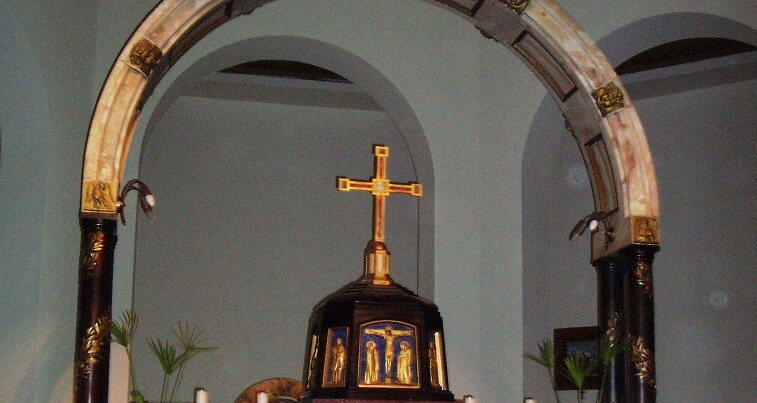
The dome, positioned directly above the altar, symbolizes Jesus’s sacrifice—a pivotal act enabling the Kingdom of Heaven to manifest and interact with our earthly realm. Over the altar, an arch constructed from marble incorporates six alabaster stone windows, designed to let light filter through. This feature serves as a metaphor for an inverted world, where a stone permits the passage of light, embodying the concept of spiritual illumination. The altar itself is adorned with marble and precious stones like onyx and lapis lazuli, setting the stage for artworks depicting the crucifixion, resurrection, and ascension, along with images of the Virgin Mary, Peter, and Paul. These materials and images represent the celestial treasures bestowed from heaven. Suspended above the altar is a silver dove, symbolizing the Holy Spirit, further enriching the space with layers of spiritual significance and connecting the material with the divine.
Surrounding the altar and beneath the dome, the floor features inscriptions and symbols representing the seven virtuous qualities Christians are encouraged to embody, serving as a counterpoint to the seven sins identified in medieval Christian literature. These virtues are faith, justice, prudence, hope, temperance, fortitude, and charity. The eighth attribute, distinct in that it does not stem from human effort but is instead a divine endowment of grace, is symbolized by the dome itself. This architectural element not only crowns the space but also metaphorically signifies the grace that envelops and transcends the other virtues, highlighting the spiritual essence that pervades the church’s design and its deeper theological implications.
The Church of the Beatitudes is maintained by the Franciscan order, which also oversees the neighboring guest house. The surrounding gardens, adorned with serene sitting areas, offer a peaceful setting for reflection. It’s an ideal spot for pondering the Mystery of the Proclamation of the Kingdom of Heaven, recognizing the historical impact of a once obscure preacher whose teachings, like “the meek will inherit the earth,” dramatically influenced and transformed the Roman Empire. Such meditation encourages a deepened trust in God.
From the Mount of Beatitudes, visitors are invited to explore other significant sites related to Jesus around the Sea of Galilee. Notably close by is the Tabgha Valley, home to two remarkable churches: The Church of the Multiplication, commemorating Jesus’s miracle of the loaves and fishes, and the Church of the Primacy of Saint Peter. These sites are accessible by car or by foot via a scenic dirt road descending from the Church of the Beatitudes’ parking area to Tabgha Valley, just a kilometer away, offering breathtaking views along the journey.
The Mystery of Transfiguration
The fruit of the Mystery of Transfiguration is aspiration (desire) for holiness
The spiritual light, which emerged on the first day of creation and exists since time immemorial, is referred to in Judaism as “the Hidden Light” and in mystical Christianity as “the Light of Mount Tabor,” revealed during the Transfiguration on the Mountain. In both Orthodox Christianity and Catholicism, there are practices designed to connect with this light. Pope John Paul II incorporated the Luminous Mysteries into the Rosary, stating that the act of praying the rosary mirrors the hesychasm meditation of Orthodox Christianity, a tradition especially common among the monks of Mount Athos, enabling one to perceive and connect with the spiritual light.
In hesychasm meditation, practitioners repetitively recite the phrase “Lord Jesus Christ, Son of God, have mercy on me, a sinner” for extended periods. This practice, combined with rhythmic breathing and the visualization of mental images, facilitates the purification of the heart’s mirror, a spiritual faculty within us capable of perceiving God. Through this cleansed mirror, one can witness and connect to the spiritual light of Mount Tabor, experiencing a vision of the surrounding realms of light, typically beyond our normal awareness. According to Orthodox belief, it was not Jesus who transformed on Mount Tabor, but rather the disciples’ perception. Jesus’s radiant form was always present; however, the disciples were initially unable to perceive it until their ascent up the mountain.
The New Testament syas thus: “And after six days Jesus taketh Peter, James, and John his brother, and bringeth them up into an high mountain apart, And was transfigured before them: and his face did shine as the sun, and his raiment was white as the light. And, behold, there appeared unto them Moses and Elias talking with him. Then answered Peter, and said unto Jesus, Lord, it is good for us to be here: if thou wilt, let us make here three tabernacles; one for thee, and one for Moses, and one for Elias. While he yet spake, behold, a bright cloud overshadowed them: and behold a voice out of the cloud, which said, this is my beloved Son, in whom I am well pleased; hear ye him. And when the disciples heard it, they fell on their face, and were sore afraid. And Jesus came and touched them, and said, Arise, and be not afraid. And when they had lifted up their eyes, they saw no man, save Jesus only. And as they came down from the mountain, Jesus charged them, saying, Tell the vision to no man, until the Son of man be risen again from the dead.” (Matthew, 17:1-9).
The Mystery of the Transfiguration, chronicled in both Mark and Luke, echoes the Mount Sinai episode, featuring a divine voice from a cloud and Jesus’s face shining similarly to Moses’s. Significantly, Moses and Elijah, who had the distinction of encountering God on Mount Sinai and experienced profound transformations in their lives, stand beside Jesus. These figures have become exemplars of spiritual life for Christian monastics. The aspiration for holiness emerges as the fruit of meditating on the Transfiguration Mystery. Once a person glimpses the spiritual realms and beholds the hidden light, their sole desire becomes to relive this “experience of the Sacred”.
In the Transfiguration, alongside God, who speaks from the cloud, and Jesus, who shines with divine light, a white cloud represents the Holy Spirit, marking the presence of the Trinity in one sacred moment. Equally important are the disciples—Peter, James, and John—who to encounter divinity, ascend a high mountain, a metaphor for their spiritual ascent, doing so after six days, on the sanctified seventh day. They observe not only Jesus but also Moses and Elijah, two figures who have previously journeyed up the spiritual ladder to achieve Theosis, or divinization. As witnesses to Jesus’s transfigured state, they are privy to foreknowledge of forthcoming events and pledge to keep this revelation undisclosed. Thus, the Transfiguration reveals hidden lessons on the spiritual journey towards enlightenment and contributing to the spiritual progression of humanity.
The Transfiguration not only showcases a moment of divine manifestation but also symbolizes the resurrection of the dead, as evidenced by the appearance of Moses and Elijah, both of whom had passed away. It is during this event that the disciples learn of Jesus’s impending death and resurrection, linking the Transfiguration closely to themes of resurrection. This connection is reflected in the artistic depictions of the Transfiguration, which share motifs and colors with representations of Jesus’s resurrection. One notable motif is the transformation of colors within Jesus’s aura, shifting from blue and gold near his body to white towards the edges. Jesus is depicted in robes made of light, reminiscent of humanity’s original state in the Garden of Eden, suggesting that his spiritual, luminous body is the one that transcends death. Following the Transfiguration on Mount Tabor, Jesus and his disciples proceed to Jerusalem, setting the stage for the crucifixion, death, and subsequent resurrection of Jesus.
At first glance, the Mystery of the Transfiguration seems unrelated to Mary. However, a deeper examination reveals its foundational significance to her relationship with Jesus, as she continuously perceives his true, spiritual luminosity. This divine light of Jesus is believed to be instilled within her, likened by some to a ray of light traversing through a clear window. Despite Mary’s absence from the Mount Tabor Transfiguration scene, it’s suggested that her presence was not required; she was metaphorically already on a high mountain, always beholding the authentic visage of Jesus.
The Church of the Transfiguration on Mount Tabor
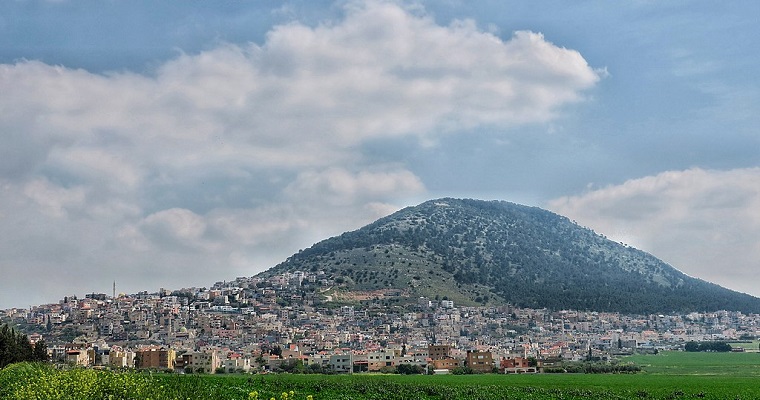
The Transfiguration occurred on a high mountain, though the specific mountain isn’t named in the narrative. From the 3rd century onwards, Mount Tabor has been traditionally associated with this event. However, contemporary scholars have proposed alternatives like Mount Hermon or Mount Horns of Hattin as possible locations. Despite these scholarly debates, the traditional identification with Mount Tabor remains prevalent. This association is partly due to Mount Tabor’s proximity to the village of Nain (Na’in), where Jesus resurrected a dead boy, highlighting its significance in Jesus’s ministry in Galilee.
Although Mount Tabor’s elevation at 583 meters above sea level might not seem particularly imposing in terms of sheer altitude, its prominence within the landscape is undeniable. It stands out distinctly due to its height and unique, rounded shape, making it visually striking in comparison to its surroundings. In fact, in ancient times, it was referred to as “Little Hermon,” distinguishing it from the Great Hermon situated about 100 km to the northeast. Both Little Hermon and Great Hermon were considered sacred sites even in prehistoric times and later among the Canaanite inhabitants of the land. This reverence is also reflected in Jewish tradition, as evidenced by Psalm 89:12, which states: “The north and the south thou hast created them: Tabor and Hermon shall rejoice in thy name,” highlighting the spiritual significance of these mountains.
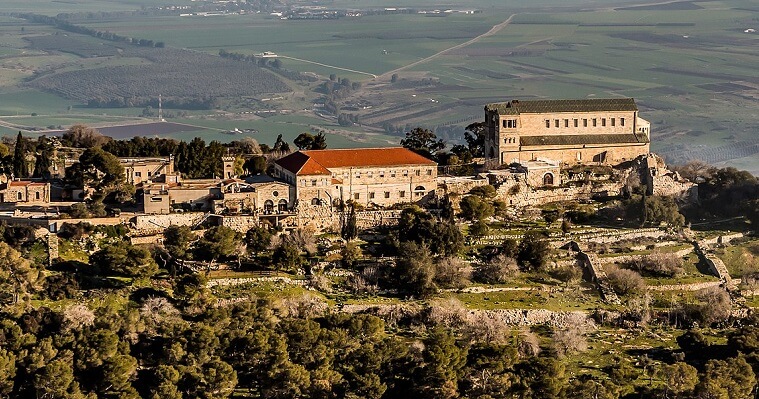
Christianity has not only preserved the ancient sanctity of Mount Tabor and Mount Hermon but has also augmented it with new significance. Philippi Caesarea, situated at the foot of Mount Hermon near the springs of Banias, became holy ground as Jesus arrived there with his disciples. It was here that Peter, inspired by the Holy Spirit, recognized Jesus as the Messiah, the Son of God (Matthew 16:16), further enhancing the sacredness of Mount Hermon. Mount Tabor, identified as the site of the Transfiguration, has been adorned with Christian religious structures since the 4th century. Construction of these religious edifices continued through the Byzantine and Crusader periods. However, following the Crusades, these structures fell into ruin under Muslim rule, with only a small Orthodox Church serving as a testament to Christian presence on the mountain. Following World War I and the English occupation of the region, the Vatican initiated a significant effort to restore the holy sites. In 1924, architect Antonio Barluzzi undertook the reconstruction of Mount Tabor’s ancient ruins, culminating in the creation of the magnificent Church of the Transfiguration. This church, visible from nearly every vantage point in the Galilee, stands as a testament to Barluzzi’s architectural prowess and his profound insights into the significance of the Transfiguration, mysticism of light, and Christian religious expression. Alongside this endeavor, Barluzzi also designed and built the Church of All Nations at Gethsemane.
For his project, Barluzzi enlisted 350 laborers and artisans who alternated between Mount Tabor and Gethsemane, where two Churches were constructed simultaneously. Barluzzi personally engaged with the laborers and builders, adopting a paternal approach. He meticulously sketched the architectural plans after a prolonged period of religious contemplation, aiming to grasp the essence of the Transfiguration Mystery and establish a spiritual connection with it. The resulting masterpiece provides visitors with a glimpse into the profundity of the Transfiguration Mystery, allowing them to experience it to some extent.
The Church’s architectural style is Roman-Syrian, reminiscent of the 4th-5th centuries AD, with the lower apse incorporating remnants from a Byzantine basilica. This amalgamation of architectural elements reflects Barluzzi’s distinctive approach of blending the old with the new. Structurally, the Church is designed in the likeness of a colossal Noah’s ark perched atop a mountain. This symbolic representation evokes the transformative narrative of the biblical flood, signifying the emergence of a new land and the divine promise of preservation extended to humanity and all creation.
The front of the Church features three interlocking towers with alabaster windows, incorporating both Byzantine and Eastern decorative motifs. Flanking the sides are two towers, with a more prominent tower positioned above the entrance porch at the center. Symbolically, Jesus represents the central and overarching tower, while Moses and Elijah correspond to the side towers, each of which houses a chapel dedicated to one of the two figures. Here, the archetype of the Trinity is fully realized, along with the symbolic significance of the towers.
The presence of Moses and Elijah alongside Jesus signifies the continuation of Moses’s teachings and the prophets’ work through Jesus. This highlights that Jesus’s Transfiguration and presence are not a rejection of the past, but rather an evolution from it, showcasing the ultimate aim of the divine plan. Moses introduced the Torah’s laws and morality to the world, while Elijah embodied the proactive morality of the prophets, emphasizing the pursuit of justice beyond mere law adherence. Jesus symbolizes a significant leap forward, embodying the heightened morality necessary for the Kingdom of Heaven’s arrival. He represents the fulfillment of Biblical prophecies and the climax of a historical journey initiated with the Torah’s reception by the Israelites. Jesus’s authority is rooted in these prophecies, yet he extends far beyond them, reaching a new phase of evolution, the Kingdom of Heaven. Notably, Moses and Elijah were the only two individuals to encounter God at Mount Sinai, but Jesus is distinguished as part of God Himself.
The Church of Transfiguration prominently features light as its central motif, encompassing both physical illumination and spiritual enlightenment. Barluzzi, through his architectural and artistic endeavors, emphasizes the significance of light. From the entrance, the church’s interior is fully visible, devoid of hidden or dark spaces. Its ceiling soars, inviting the gaze upward. The interior is bathed in light, enhanced by windows crafted from transparent alabaster stone, while the walls and columns are constructed from bright white marble. Historically, the church’s roof was also made of transparent alabaster, allowing sunlight to filter through. However, due to leakage problems—water seeping through the stone—the roof was covered. When composed of alabaster, the church shimmered in sunlight, marking a beacon atop the mountain, symbolizing the transformative spiritual light manifested at this sacred site.
The Church features grand bronze doors, each weighing one and a half tons, leading to an interior adorned with radiant gold mosaics. This progression from bronze to gold mirrors the structure of the Jewish Temple, representing an alchemical transformation from a base metal to a precious one. This transition symbolizes the spiritual journey, with the varying motifs within the Church further emphasizing the path of spiritual evolution and enlightenment.
The Church’s basilica shape extends the motif of the three towers: a central nave with expansive windows above, flanked by two narrower aisles, delineated by columns. At the basilica’s eastern end is a significant apse divided into two sections: the upper part is adorned with a large golden mosaic. This mosaic, crafted by Italian artist Antonio Villanini, depicts Jesus in mid-air, clothed in radiant white, above a white cloud. The artwork’s appearance shifts with the day; it sparkles under sunlight that enters through the western openings and roof windows. Uniquely, the sun in the mosaic is blue, contrasting with the predominantly golden sky. This blue sun symbolizes the spiritual, hidden light revealed during the Transfiguration, believed to have been created on the first day of Creation, before the physical world and sun. The spiritual light is further echoed in the white of Jesus’ garments and the cloud. Flanking Jesus are Moses and Elijah, with the three disciples prostrated in awe below. Jesus’ face is raised, seemingly in conversation with God, bearing an expression of boundless peace and kindness.
The upper apse signifies Jesus’ divine essence, his authentic manifestation as divine light. This fleeting glimpse granted to the disciples, deeply affecting them, illustrates that this spiritual light dwells within all humans, being composed of both flesh and spirit. It posits a divine spark within each person. The transformation achievable in individuals is a shift in focus from the physical—our senses and earthly existence—to the spiritual, seeking religious meaning and the afterlife. This shift represents the most profound and genuine change possible: a Transfiguration from a lateral journey across the earth to an upward climb towards the sky, symbolized by the ascent of a tall mountain. Any other changes are superficial, merely external and thus inconsequential. The essential message of the Transfiguration is about a change in consciousness and awareness, preparing humans to engage with the spiritual domain and secure eternal life.
Beneath the mosaic in the upper apse lies a balcony featuring an altar, and beneath that, a smaller hall with a round, cylindrical ceiling—this is the lower apse, symbolizing Jesus’ human nature. The floor of this room has two openings that allow a view of the foundation stone and remnants from the early Byzantine and Crusader churches. Below the floor, there is an ancient Canaanite worship site. This layered structure highlights the continuity with past generations and the spiritual heritage of humanity. Twelve wide steps lead down to the lower apse, each step symbolizing one of the 12 disciples. The ceiling of this room features a yellow sun set against a blue background, representing the physical sun, in contrast to the spiritual sun depicted in the upper apse. The walls are adorned with paintings depicting scenes from the life of Jesus as a man. At the end of the hall, a large fixed window spans the entire eastern wall, showcasing a glass mosaic. This mosaic depicts two large peacocks facing each other, with an illuminated cup set between them on a triangular background.
In Christian tradition, peacocks are symbols of eternity because a peacock feather placed between the pages of a book will outlast the pages themselves. The cup, in this context, represents the aspiration for eternal life, akin to drinking from the fountain of youth. At dawn, the first rays of the sun pierce through the colored windows, breathing life into the space and echoing the divine light that illuminated Israel two millennia ago, made manifest in the imagery of Jesus adorning the room’s walls and ceiling. Positioned above an altar, the illuminated cup plays a central role during the Eucharist ceremony, where wine is transformed into the blood of Jesus, allowing attendees to experience His presence. This act constitutes the Next Luminous Mystery – the institution of the Eucharist.
Before delving further, it’s important to recognize how the Church of Transfiguration harmoniously integrates with its surroundings. Light floods in through the colored windows from the east, while the church itself appears to perch atop cliffs, featuring balconies on its sides that offer breathtaking views of Galilee. To the west, exquisite gardens blend remnants of the past with an entrance plaza, creating spaces ideally suited for contemplation on the Mystery of Transfiguration. The grandeur and beauty of the site inspire a pursuit of sanctity.
The Institution of the Eucharist Mystery
the fruit of the Institution of the Eucharist Mystery is adoration
A week before Passover, Jesus enters Jerusalem, fully aware that he will become the Passover sacrifice, destined to be crucified, to die, and then to rise from the dead. Before he endures the path of suffering and secures the crowns of glory, he undertakes one final act to illuminate the world, a transformative action that would embed his essence and spirituality into a simple ceremony. This act, which Christians can perform after his death to connect with him, is the institution of the Eucharist during the Last Supper. He teaches his disciples a series of simple actions through which they can remember him, connect with his presence, and reinvigorate it. The institution of the Eucharist ensures that the spiritual light continues to shine in the world, affirming Jesus as the light of the world and enabling his enduring presence through this sacrament.
And so the New Testament says: “And as they were eating, Jesus took bread, and blessed it, and brake it, and gave it to the disciples, and said, Take, eat; this is my body. And he took the cup, and gave thanks, and gave it to them, saying, Drink ye all of it; For this is my blood of the new testament, which is shed for many for the remission of sins.” (Matthew 26:26-28). Luke adds: “this do in remembrance of me” (Luke 22:19).
Scripture portrays Jesus as being truly present in the bread and wine during the Eucharist, suggesting that by instituting the Eucharist, he culminated his life’s journey and transitions. This journey begins with water, as seen in the Baptism of Jesus in the Jordan Mystery, evolves into the transformation of water into wine at the Wedding in Cana Mystery, and culminates in the wine of the Institution of the Eucharist Mystery, which becomes his blood. Through the Eucharist, Jesus grants his disciples the means to partake in his essence via a ceremonial act, establishing the central ritual of Christianity. In this ritual, the priest consecrates the wine and bread, which then become the flesh and blood of Jesus. To believers, consuming the wine and bread is akin to internalizing the essence of Jesus. While this may superficially resemble cannibalism or idolatry, it carries profound significance. Jesus, as the sacrificial atonement for humanity’s sins, renders the Eucharist a spiritual replacement for the temple’s sacrificial rites. As John Paul II, who introduced the Luminous Mysteries, points out, Jesus demonstrates his boundless love for his followers through the Last Supper, where he inaugurates the Eucharist worship. Contemplating this Mystery fosters a spirit of adoration and devotion.
Before Jesus teaches the Eucharist, Judas Iscariot betrays him and immediately after the Eucharist they go to Gethsemane in the Mount of Olives. The next sentence that Jesus says to them is: “But I say unto you, I will not drink henceforth of this fruit of the vine, until that day when I drink it new with you in my Father’s kingdom” (Matthew 26:29). This sentence teaches us that the Eucharist is a connection between the appearance of God in the world in the person of Jesus and the time of salvation and when Jesus will return. As long as the Eucharist is done, there is a connection between the times and the historical course of events leading to redemption is guaranteed. But this cannot happen automatically, the true Eucharist must happen with intention, with true worship and adoration.
Before instituting the Eucharist, Jesus faces betrayal by Judas Iscariot. Following the Eucharist, they move to Gethsemane on the Mount of Olives. There, Jesus tells his disciples, “But I say unto you, I will not drink henceforth of this fruit of the vine, until that day when I drink it new with you in my Father’s kingdom” (Matthew 26:29). This pronouncement highlights the Eucharist as a link between God’s manifestation in the world through Jesus and the future time of salvation when Jesus will return. The enactment of the Eucharist serves as a continual bond across these eras, ensuring the forward march of history towards redemption. Yet, this linkage does not occur by mere routine; it requires the Eucharist to be conducted with genuine intent, coupled with true worship and adoration.
The Eucharist can also be viewed through a spiritual lens beyond its traditional interpretation. When Jesus broke the bread, declaring, “This is my body,” and poured the wine, stating, “This is my blood,” he was illustrating a deeper truth: every act of eating and drinking is an opportunity to internalize a piece of divinity. Creation itself feeds and sustains us, generously offering itself in myriad forms to support our existence. This process should inspire gratitude and a commitment to fulfilling our purpose on Earth. Neglecting this sacred duty is tantamount to denying Jesus and symbolically re-crucifying him in spirit repeatedly. Therefore, eating and drinking transcend mere physical nourishment, becoming acts of divine worship.
Considering Mary’s involvement in key events surrounding the Last Supper, it’s reasonable to speculate on her presence at or near this pivotal occasion. The New Testament documents her presence at the crucifixion, which closely followed the Last Supper, and her subsequent dwelling with the disciples in Mark’s house. Given her significant role in Jesus’s inner circle, it’s plausible she was nearby during the Last Supper, possibly in an adjacent room designated for women, aligning with the customs of that era. This scenario suggests she maintained a supportive presence, if not directly at the Last Supper, then in close proximity.
According to Catholic tradition, the Last Supper is viewed as the traditional Passover meal, reinforcing the argument that Mary was likely present. Holding the Passover meal without a Jewish mother present would be considered unthinkable, given the central role of family and tradition in the observance. The institution of the Eucharist at the Last Supper marks the culmination of Jesus’ mission on Earth, symbolizing the close of an era where divine light directly interacted with the world. Over three years, Jesus taught, performed miracles, and drew disciples to him. In this celebratory and intimate setting among his closest followers, Jesus imparts the essence of his teachings and achievements. Despite the impending betrayal by Judas Iscariot, it’s conceivable that Jesus experienced a moment of contentment, appreciating the completion and fulfillment of his life’s mission. This sense of fulfillment could have provided him the resilience needed to face the forthcoming trials, ultimately leading to the redemption of humanity.
The Institution of the Eucharist Mystery, having occurred in the Last Supper room, makes this location a natural site for attempting to feel and connect with this significant event. While Syrian Christians identify a different location within the Old City for the Last Supper, our focus will be on Mount Zion, situated outside the walls of today’s Jerusalem Old City. This site is traditionally recognized as the place where the Last Supper took place, offering a unique opportunity for reflection and connection to the profound events commemorated there.
The Last Supper room on Mount Zion
The pilgrimage tracing the Luminous Mysteries begins at the Jordan River, setting the stage for a journey through three significant sites in the Galilee, reflecting Jesus’ ministry from his baptism to his crucifixion over three years. The first stop is Kfar Cana, commemorating the Wedding at Cana mystery where Jesus miraculously turned water into wine. Next, we visit the Mount of Beatitudes, near the Sea of Galilee, recognized for the Sermon on the Mount and the proclamation of the Kingdom of Heaven. Following this, Mount Tabor is the destination, celebrated as the site of the Transfiguration mystery. After exploring these pivotal locations in the Galilee, the journey circles back to Jerusalem, concluding with the final Luminous Mystery at Mount Zion, the site of the Last Supper and the institution of the Eucharist mystery. The subsequent phases of the pilgrimage, involving the Sorrowful and Glorious Mysteries, unfold within and around Jerusalem, continuing the exploration of key events in the Christian faith.
The Institution of the Eucharist mystery is commemorated in the room of the Last Supper, also known as the “Cenaculum.” This site ranks among the most sacred Christian locations globally. Reflecting on the Institution of the Eucharist mystery within this room inspires adoration and worship of Jesus for the sacrifice he prepared to make. Should the Cenaculum be too bustling with tourists and pilgrims, quiet spaces for contemplation can still be found within the courtyards and the expansive areas surrounding the site, offering a serene environment for reflection.
About the Last Supper room – Read the article – Sacred Christian site on Mount Zion