Marian Apparitions in Israel part 2
In the initial article on the Marian Apparitions in Israel, I discussed the apparitions of Miriam Bouaurdi, Patriarch Barlasinna, and the 1954 Apparition at the Coptic Church of Saint Anthony. read more in – Marian Apparitions in Israel part one
This article covers the Marian Apparitions of Alphonse Ratisbonne, which led to the formation of the Sisters of Zion Order, and the Marian Apparitions of Mary Alphonsine, which led to the establishment of the Sisters of the Rosary Order.
Alphonse Ratisbonne
In 1842, the journey began for Alphonse Ratisbonne, a young man from a wealthy Jewish banking family. At the request of his brother Theodore, who had converted to Christianity, Alphonse reluctantly agreed to wear the miraculous medal of Catherine Laboure for a trial period. Despite his initial skepticism, on January 20, 1842, while entering the Church of St. Andreas in Rome, Alphonse witnessed the apparition of Mary. This encounter profoundly impacted him, filling him with divine enlightenment and a clear sense of purpose. The apparition, known as “Our Lady of Zion,” revealed to Ratisbonne that he must become Christian and journey to Israel (Zion).
It appears that at this juncture, Mary decided to intervene on behalf of her people and her homeland, viewing Ratisbonne as an instrument for this purpose and thus appearing before him. A year after the apparition, Ratisbonne, along with his brother, founded the Sisters of Zion Order. In 1855, he relocated to Israel with the sisters of the order, dedicating himself to establishing charitable institutions, religious centers, churches, and monasteries in the Holy Land until his passing in 1884. It is believed that he maintained some form of connection with Mary throughout this time.
The first step he took was to establish a French school for Christian children in Jerusalem. To achieve this, he sought out a suitable location within the Old City, near Christian sites. He succeeded in purchasing the “Ecce Homo” arch and its surrounding ruins at the beginning of the Via Dolorosa. In 1856, he constructed a church, monastery, orphanage, and school on the site, which later became the main church of the Sisters of Zion order. Simultaneously, he initiated the construction of the Ratisbonne Monastery on Shmuel Hanagid Street in Jerusalem, inaugurated in 1860 as a school and orphanage for boys. He also oversaw the construction of the monastery in Ein Karem, which opened in 1961 as a residence for Maronite orphans. Ratisbonne eventually moved to live there part-time and was laid to rest there.
The Zion Sisters Monastery in Ein Karem rests on the edge of the village’s picturesque hill, encompassing a vast compound enclosed by a stone wall. Within its grounds lie gardens, a hostel, and various monastery buildings. At the heart of this complex stands a small house that was once Ratisbonne’s home and now serves as a modest museum in his honor. Inside, visitors can view his rosary beads, bed, clothing, and personal prayer book. Following Ratisbonne’s passing in 1884, his tombstone in the Ein Karem Monastery cemetery bears the inscription, “O Miriam, remember your child conquered by your sweet and glorious love.” Adjacent to his grave stands a statue of Mary in the likeness of her apparition to him, depicted with outstretched hands radiating light, and her feet triumphantly crushing the serpent of evil.
In addition to the welfare institutions he established, Ratisbonne played a crucial role in planning and constructing the Saint Etienne Monastery, and the French Bible School in East Jerusalem. His contributions made him one of the most influential figures in establishing Christian welfare institutions in Jerusalem during the latter half of the 19th century, particularly in assisting the young and needy. Furthermore, he was actively involved in founding monasteries and other Christian establishments. Through Ratisbonne’s efforts, Maria extended her care to the abandoned children of Jerusalem, marking the beginning of her profound involvement in the lives of those residing in Israel.

Saint Mary Alphonsine
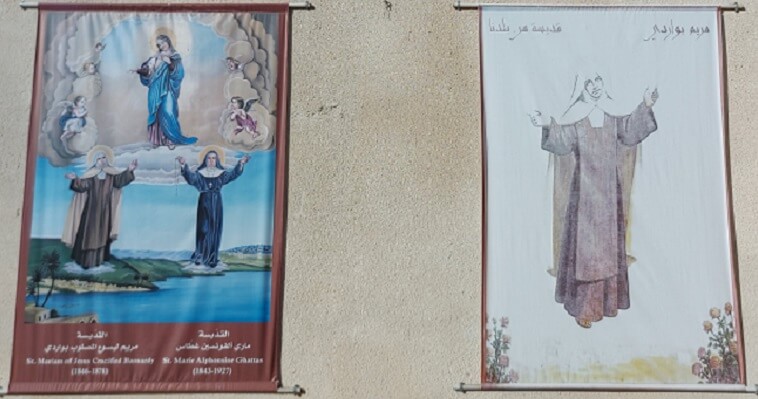
In 2015, Pope Francis canonized two Palestinian women, Mary Alphonsine and Mariam Baouardy, as saints, acknowledging their genuine Marian Apparitions. This historic event marked the first time Christian Arab women were recognized as saints. Both women lived and worked during the late 19th century, coinciding with the resurgence of Catholic presence in Israel. It appears that Maria chose to intervene and contribute to her country and its people with the onset of the Modern new era in Israel.
In 1847, following a hiatus of more than 700 years, the Catholic Church reestablished itself in Jerusalem by constructing the Catholic Patriarchate, a grand building featuring a gothic-style cathedral, the patriarch’s residence, accommodations for staff and visitors, as well as administrative and service facilities. Nearby, was a humble home where a young girl named Marie-Alphonsine was born in 1843. Her family, the Goethes, were carpenters from Bethlehem who resided in the Christian quarter of Jerusalem. They also owned a summer house in Ein Karem, where they often spent vacations and holidays. Interestingly, Mary Alphonsine shared her birthday with St. Francis, with whom she had notable parallels. From a tender age, Marie-Alphonsine was deeply influenced by Maria, from whom she derived her name.
During that era, Christian Arab women, many of whom were illiterate, gleaned their knowledge of Christianity from tales about Mary and Jesus. Barred from attending school and receiving instruction from men, particularly Europeans, such practices were viewed as challenging the social and cultural hierarchy. Their education was limited to teachings from Arab women like themselves, who shared their language and gender. Consequently, there arose a need to establish an order of Christian Arab women tasked with instructing and supporting women in their native tongue and within their gender roles.
Aware of the challenges faced by her daughters, Mary appeared to Mary Alphonsine on numerous occasions throughout her life, providing guidance in establishing the Order of the Rosary—an accessible form of worship that infused daily life with the presence of the divine. Mary Alphonsine successfully recruited many Christian Arab women into the order, individuals eager for the prospect of direct communion with Mary, Palestinian women like herself who resided and labored within their communities.
In 1847, four years following Mary Alphonsine’s birth, the Catholic Patriarchate was founded. The inaugural Catholic patriarch in Jerusalem was a monk named Valerga. While this marked a significant occasion, it became evident that Catholicism would struggle to flourish in Israel without the presence of indigenous priests and nuns. The “Sisters of St. Joseph of the Apparition” attempted to address this gap by establishing a girls’ school near the Patriarchate in 1848, yet their efforts fell short of meeting the community’s needs.
The Sisters of St. Joseph of the Apparition order was established in 1832 by Mother Emilie de Vialart, with a primary focus on serving the Christian population, particularly in Arab countries, initially in North Africa and later in the Middle East. The sisters are involved in operating medical, educational, and religious institutions and take a vow of devotion until death. They continue to own some of the most significant welfare, medical, and educational institutions in Israel, such as the St. Joseph and St. Louis hospitals in Jerusalem. Additionally, they oversee the largest number of monasteries among Catholic orders, with a total of fifteen, including the “Our Lady of the Ark of the Covenant” monastery in Abu Gosh.
Marie-Alphonsine was among the earliest students enrolled in the new Catholic schools, where she was instilled with the ideals of Monasticism promoted by the Sisters of St. Joseph of the Apparition, particularly Mother Emilie Julian. They encouraged young women to consider a life devoted to religious service. Apparently, Mary Alphonsine demonstrated exceptional academic prowess, as she received the Sacrament of Confirmation from the Patriarch himself at the age of 12. By 17, she expressed her desire to become a nun, but her father only consented under the condition that she remain in Israel. While previous candidates typically underwent a period of initiation at a seminary in France, Mary received special approval to be ordained without this requirement. Consequently, she received her training privately in Jerusalem and was ordained at the Golgotha site in the Church of the Holy Sepulcher, a place she cherished deeply and frequently visited thereafter.
As a nun, she assumed the name Mary Alphonsine, in honor of Mary and Mary Alphonse of Ratisbonne, the founder of the Sisters of Zion and the monasteries in Ein Karem and Jerusalem. Interestingly, there was mutual admiration between Mary Alphonsine and Ratisbonne. Although they lived in the same small city and likely crossed paths, there existed deeper spiritual connections between the two individuals who both received apparitions of Mary, despite their apparent differences.
Mary Alphonsine’s initial role as a nun involved teaching Christian catechism at the Sisters of St. Joseph school in Jerusalem. Her influence led many Arab girls to embrace religious life, resulting in the establishment of the “Immaculate Pregnancy” brotherhood (non-monastic religious organization) dedicated to Mary. In 1862, she transitioned to teaching at the Catholic school operated by the Sisters of St. Joseph in Bethlehem, where she lived modestly with four other sisters. She was actively engaged in the community and occasionally experienced moments of blessing and ecstatic states, particularly during personal meditation prayers of the rosary.
On January 6, 1874, the day of the Epiphany, at nine o’clock in the morning, an indescribable event occurred: Sister Mary Alphonsine prayed and meditated on the Mystery of the Rosary Crucifixion. As she focused on the Mother of Sorrows, her heart overflowed with love for Mary. Simultaneously, she found herself enveloped in a magnificent and radiant light beyond words. The Virgin Mary appeared before her within this luminous cloud, her hands extended, emanating a radiant and ineffable beauty. Adorned on her chest was a cross, from which hung a rosary in a circular form, its lower part extending to the hem of her garment, revealing her feet. Each bead of the rosary gleamed like stars, with images of the corresponding Mystery appearing at their centers. A crown adorned with 15 stars rested above the Virgin’s head, while beneath her feet, two clouds bore two parallel rows of seven stars.
Mary Alphonsine described the apparition as follows: “All of this unfolded before me simultaneously. Oh, what a blessed moment it was, my heart brimming with such sweet love! Words fail to capture the essence. And my mother, in particular, how stunningly beautiful she appeared. I’ve never encountered any image that remotely does justice to her beauty. The moment my gaze fell upon her, tears brimming with love streamed down my face. I stretched out my arms, yearning to embrace her. She then glowed even more brilliantly, giving the impression she was coming closer to me. I could gaze upon her comfortably, wishing to draw nearer, but then I found myself losing all consciousness.”
As soon as Marie-Alphonsine attempted to approach the vision, she lost consciousness, being enveloped by the heavenly spheres, and became unaware of herself: “After that experience, I can’t fully explain what occurred, but I do know that I stayed in a blissful, ecstatic state from nine in the morning until one in the afternoon. Then, she vanished abruptly, leaving behind an indescribable sense of spiritual peace and comfort, a fervent hope to see her again, and a readiness to undertake significant endeavors and to perform noble acts for the sake of others. My primary aim became to seek an internal purification of the heart, and I devoted myself entirely to accomplishing this, which is a crucial aspect.”
The apparition experienced by Mary Alphonsine instilled in her a new and all-encompassing state of mind. For four months, she lived in a state of happiness, exaltation, and enchantment: “Since the time my beloved mother graced me with her apparitions, I found myself detached from worldly sentiments and transient things, developing an insatiable longing to endure any hardship and pain. Suffering and bitterness transformed into sweetness for me, solitude turned into a splendid paradise, and discipline became an essential need for both heart and mind. I adhered to the directives and wishes of my superiors with unparalleled affection and faithfulness. My mother bestowed upon me a wealth of virtues effortlessly and undeservedly. All these blessings were a testament to her maternal generosity.”
However, for four months, Mary ceased to appear to Mary Alphonsine, leading to several weeks of anxiety. Was the apparition genuine? Could it be the work of the devil trying to sow confusion? Yet, through fervent prayer to God, the crisis resolved, and another apparition of Mary occurred. On May 31, 1874, while praying the rosary, Mary manifested in a different manner before Marie-Alphonsine. She appeared immersed in a radiant, transparent light resembling pure gold, clutching the rosary in her hands. Beneath her feet, two rows of seven stars gleamed, inscribed with the words “The Joys and Sorrows of the Virgin”. Above the crown adorning her head, luminous letters read “Virgins of the Rosary”. This marked the initial indication of Mary Alphonsine’s mission: to establish the Order of the “Virgins of the Rosary”. The apparition infused her with confidence, faith, happiness, and joy, continuing to shape her character. Although the Virgin remained silent, she allowed Mary Alphonsine to feel her presence deeply.
Seven months elapsed until the next feast of baptism in January 1875. On the eve of the day, Marie-Alphonsine prayed, fully acknowledging her shortcomings compared to the beauty and virtues of the Virgin, earnestly desiring to emulate her and embark on a new, pure life. Suddenly, while immersed in these thoughts, she felt as though she was drawn into the presence of divine goodness, akin to a boundless ocean. A wondrous and radiant light filled her heart without causing any discomfort to her eyes. Within the heart of the light, she beheld the sweet mother holding the rosary in her hands, surrounded by figures of young girls on her right and left, attired in white and blue garments like her own. Above them, the inscription “Virgins of the Rosary” shone brightly. Marie-Alphonsine heard Mary’s voice within her, though no words were spoken aloud, conveying, “I want you to initiate the Order of the Rosary.”

And here is her account: “She looked at me with gentleness, that filled me with sweetness, I began to shed tears. It was as if I was in a heavenly paradise. While I was bathed in that sweet comfort, she disappeared, leaving me on earth wounded by her love.”
Maria filled Marie-Alphonsine with determination, courage, strength, and devotion to fulfill her life mission. As a result, she understood the sentence: “That which is impossible for humans, is possible with the help of God.” It took another year and three more apparitions for Marie-Alphonsine’s mission to become clearer in no uncertain terms: Marie-Alphonsine must establish the Order of the Rosary, where young girls from the local Arab Christian population will serve.
The apparition coincided with other appearances of Mary around the world during the same period. During those years, from 1875 to 1878, Maria appeared to the Carmelite Nun Miriam Baouardy in Bethlehem, guiding her to establish the Discalced Carmelite order in Israel. Sixteen years prior, Mary appeared to another young girl in Lourdes, France, which subsequently became the most significant pilgrimage site in the country.
From the day of the apparition on the Feast of Baptism in January 1875 until her death in 1927, the communication between Mary and Mary Alphonsine persisted. Mary appeared to Mary Alphonsine in visions during her prayers, especially during the recitation of the Rosary, accompanied by mystical experiences. One significant instance occurred early in the morning of the Feast of Baptism, when Mary Alphonsine attended mass at the Nativity Cave in Bethlehem. During the consecration, she witnessed a light emanating from the chalice, enveloping the altar and the priest. Vivid images of the Nativity and the Baptism of Jesus followed: Baby Jesus with Saint Joseph, the Three Magi offering gifts, and Jesus being baptized in the Jordan River. These visions, clear yet mysterious and beautiful, continued throughout the ceremony and recurred whenever Mary participated in the Mass. As a result of these extraordinary experiences, she was infused with supernatural power, enabling her to celebrate fifteen consecutive Masses while kneeling.
After the Masses, Mary Alphonsine had a mystical experience that few people ever have: “She felt as if a radiant ray emanated from the Virgin, her mother, and pierced her. Overwhelmed by her love, she shed tears for the duration of the Apparition. Her heart glowed with love for God and the Virgin.” This experience echoes the mystical encounters of other Christian mystics like John of the Cross and Teresa of Avila. It transformed her state; she felt as though she was reborn in love, endowed with courage and invincible strength capable of enduring any trial. The Virgin herself accompanied her in the form of a “beautiful shining star.” This phenomenon became a constant presence: “At every Mass, at every blessing of the Holy Sacrament where I was present, I witnessed a radiant light, from which emanated a beam that pierced my heart, enabling me to behold my Lord and God, Jesus as both man and God. I saw my beloved mother alongside him.”
A year passed, and on the Epiphany of 1876, the visions of previous years returned, accompanied by a profound change in her inner state. She felt a profound sense of tranquility within, delving deeper into the mysteries of the rosary and experiencing visions of the Virgin accompanied by young girls dressed in blue and white. Moreover, from that day forward, she gained the ability to perceive the inner state of the people she encountered and to discern their future paths. All of this was revealed to her through the spiritual light that manifested during the masses where she experienced these visions. Her strength and charisma grew, as God’s grace rested upon her: “How is this possible? Where does this strange situation come from if not from you, my God? You have transformed me… and for this, I am eternally grateful,” she writes.
Father Belloni instructed Mary Alphonsine to pray to Mary for further instructions, and this is how it unfolded: Mary appeared and repeatedly commanded Mary Alphonsine to establish the Order of the Rosary, whose purpose was to eradicate all evil and distress from the face of the earth, and which would endure until the end of time. During the visions, Marie-Alphonsine found herself surrounded by the sisters of the future order: “She (Maria) arranged the sisters in order, up to the tenth bead of the rosary (the crucifixion), and in a deep voice blessed them, saying: ‘I bless you in the name of the Father, the Son, and the Holy Spirit.'” Then, while extending her hands above them, she continued, saying: ‘I empower you in the name of my joys, my sorrows, and my glories,’ before disappearing.”
In essence, Maria instructs Marie-Alphonsine to establish an order of sisters comprised of Christian Arab women living in a covenant devoted to God’s work. Each woman in the covenant will embody one of the Mysteries of the rosary, and together they will form a living rosary.
In 1880, Father Joseph Tannous, who served as Mary Alphonsine’s godfather and advisor to the Patriarch in Jerusalem, was approached for assistance. With the patriarch’s blessing, he endeavored to establish the order according to Marie-Alphonsine’s guidance. While it appeared to be his initiative outwardly, inwardly it was hers; Mary’s task required the guise of a man seen as the initiator of the Order. Father Joseph Tannous successfully gathered seven girls and officially initiated the order in 1880. Mary Alphonsine sought to join, but first had to secure permission to leave (break her vow) from the Sisters of St. Joseph, a process fraught with challenges. It was only after three years that she was permitted to join the order she herself had founded, as its tenth member, all the while her role in its establishment remained unknown.
From 1883 to 1927, Marie-Alphonsine was an active member of the Rosary Sisters Order. Each nun in the Rosary confraternity was considered to embody one of the Mysteries, with Mary herself representing the Crucifixion Mystery. Marie-Alphonsine established schools in various locations in Israel and Jordan, and toward the end of her life, she founded an orphanage in Ein Karem, her birthplace and eventual resting place. Throughout these years, she was credited with performing miracles through her rosary, ultimately leading to her recognition as a saint.
The two most famous miracles associated with Marie-Alphonsine were the saving of a girl who fell into a well in the village of Yafia and the reviving of a deceased person. In 1886, at the school in Yafia, Galilee, a 12-year-old girl named Nuseira fell into a water well in the yard and began to drown. Marie-Alphonsine, who was a teacher at the school, heard the screams and quickly rushed to the yard. She threw her rosary into the well, invoking the power of the Rosary, and as a result, Mary appeared before the girl, filling her with strength and light. Mary directed her to catch a rope that was thrown to her, and the girl was saved. In another instance, a man named Gabriel Daoud died of typhus in Bethlehem. Marie-Alphonsine placed her rosary bead necklace in a glass of water, and when she dripped a few drops on his mouth, he was miraculously resurrected.
For 53 years, Mary-Alphonsine recorded her apparitions in her personal diary, keeping them secret. In March 1927, she passed away, and remarkably, a few weeks later, ceremonies in honor of Our Lady of Palestine were established. Before her death, Mary-Alphonsine revealed the secret of the apparitions to her sister, who was also a member of the Rosary Sisters Order, and gave her the diary. Her sister disclosed the secret to Patriarch Louis Barlassina, and only then did the revelations become known, though still within a closed circle. In fact, until 1968, Marie-Alphonsine was regarded as a simple nun. It was only after research by the Benedictine monk Stolz in the 1960s that her story was published, and in 2015, she was recognized as a saint by the Pope for the miracles she performed.
Throughout the years, Maria’s visions revealed to Marie-Alphonsine future historical occurrences, including World War I, along with aspects of her own life. During one vision, she envisioned herself soaring hand in hand with Mary across the Moab desert, spending time among the Bedouins. This vision materialized years later, in 1887, when she, along with other sisters, was dispatched to serve among Bedouin tribes in the Salat region, where Christian Catholic Bedouin tribes, largely isolated from the broader Christian community, resided.
In 1937, a church along with a spacious convent for the Sisters of the Rosary was established on Agron Street in Jerusalem, aligning with a plan and vision Marie-Alphonsine had received during her lifetime. Although she had passed away a decade prior, her remains were transferred to the church and laid in a distinguished coffin. Additionally, her rosary beads and other personal items were displayed in a glass case close to the church’s altar.
Marie-Alphonsine envisioned the future convent of her order with 15 rooms, each occupied by a nun, with the Mystery corresponding to that room and the nun’s name inscribed above it. For instance, names such as Mary of the Annunciation, Mary of the Visitation, were designated. She found herself in the tenth room, associated with the Mystery of the Crucifixion. In her visions, she also saw a statue of Mary placed above the church’s entrance, the sisters’ attire in blue and white, the posture for their prayers (kneeling before the altar), the specific rosary Mysteries to be contemplated at different times of the day, and the days dedicated to special rosary observances (Monday and Wednesday). Moreover, she foresaw the names that would be given to each of the founding sisters. Throughout her life, the Virgin Mary, symbolized as a radiant star, was a constant companion to Marie-Alphonsine, bringing her immense joy and enabling her to embrace suffering with happiness..
Currently, the Sisters of the Rosary Order comprises several hundred Arab Christian nuns who serve the local Arab communities in Israel, the Palestinian Territories, and Jordan. The Order oversees numerous educational institutions across these regions. Besides the Rosary Convent on Agron Street, the Order also manages a guest house in Ein Karem, situated at the site of the family’s former summer residence, as well as a convent in the Christian Quarter of Jerusalem. This particular house in the Christian Quarter is where Marie-Alphonsine spent her childhood, experienced numerous visions, and later passed away. Within this house, a small museum room is dedicated to preserving her personal items and her library, offering a glimpse into her life and legacy.